
The Escalating Crisis of Food Insecurity in Africa
The persistence of conflicts across Africa has led to a record number of people facing acute food insecurity. In 2025, an estimated 167 million Africans are experiencing acute food insecurity, marking the sixth consecutive year of increasing numbers. This crisis is primarily driven by ongoing conflicts, which have left 130 million people—approximately 78 percent of those affected—in countries experiencing conflict.
Famine has re-emerged as a significant threat, with over 700,000 people affected, all located in conflict zones. Famine has been confirmed in multiple regions of Sudan, and parts of South Sudan and Mali may also be experiencing famine-like conditions. However, limited access to these areas has hindered data collection and reporting.
Acute food insecurity refers to a situation where individuals are unable to consume adequate food, putting their lives or livelihoods at immediate risk. This is categorized as a risk level of 3 or higher on the Integrated Food Security Phase Classification (IPC) scale, which ranges from 1 (none/minimal) to 5 (catastrophe).
Understanding the IPC Scale
-
Phase 1: None/Minimal
Households are able to meet essential food and non-food needs without engaging in atypical and unsustainable strategies to access food and income. -
Phase 2: Stressed
Households have minimally adequate food consumption but are unable to afford some essential non-food expenditures without engaging in stress-coping strategies. -
Phase 3: Crisis
Households either: - Have food consumption gaps that are reflected by high or above-usual acute malnutrition; or
-
Are marginally able to meet minimum food needs but only by depleting essential livelihood assets or through crisis-coping strategies.
-
Phase 4: Emergency
Households either: - Have large food consumption gaps which are reflected in very high acute malnutrition and excess mortality; or
-
Are able to mitigate large consumption gaps but only by employing emergency livelihood strategies and asset liquidation.
-
Phase 5: Catastrophe
Households have an extreme lack of food and/or other basic needs even after full employment of coping strategies. Starvation, death, destitution, and extremely critical acute malnutrition levels are evident.
For a famine classification, an area must have extreme critical levels of acute malnutrition and mortality.
Five Countries Account for the Bulk of Africa’s Food Insecurity
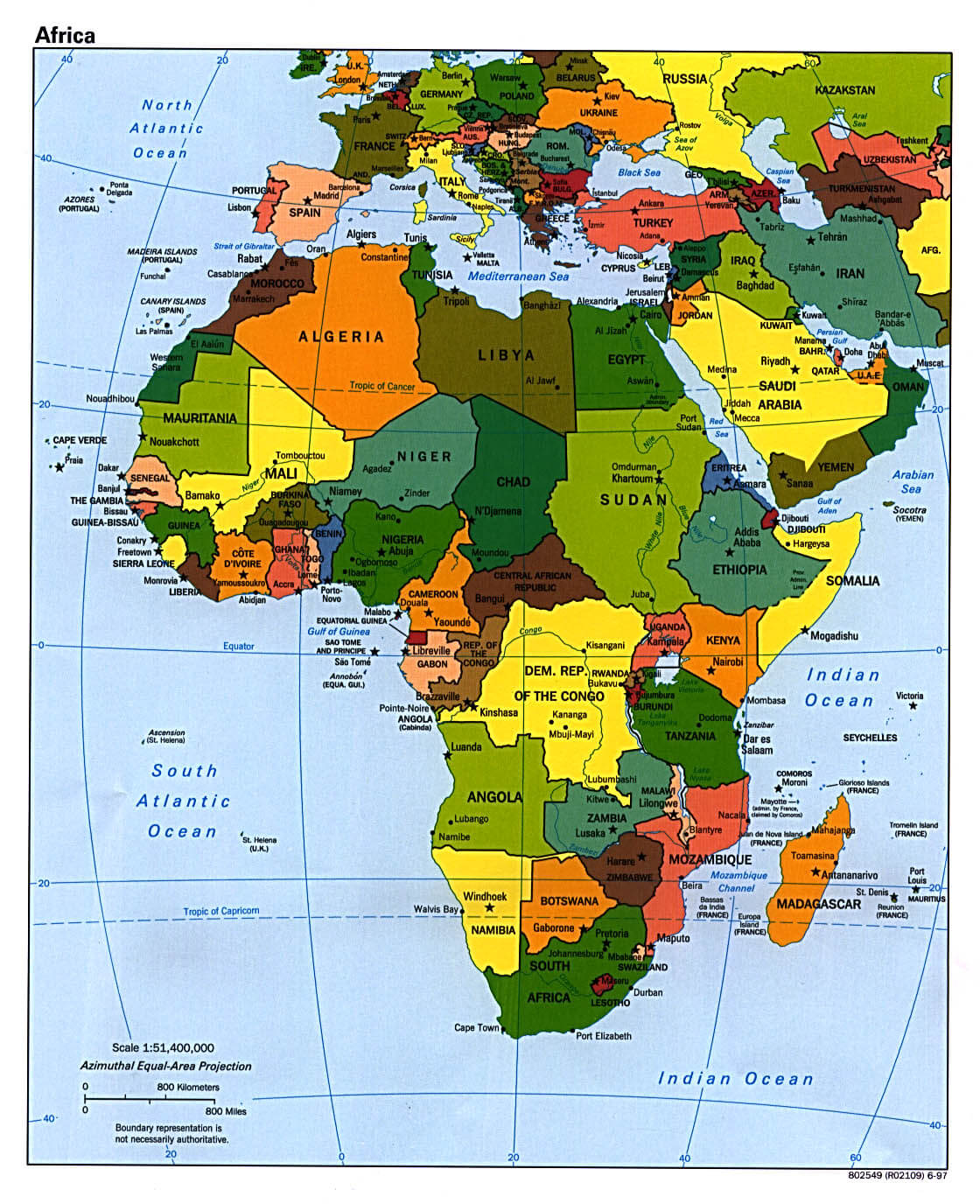
Nigeria, the Democratic Republic of the Congo (DRC), Sudan, Ethiopia, and South Sudan account for almost two-thirds of Africa’s acute food insecurity. These five countries are all in conflict, with each having experienced some level of armed conflict for an average of 29 years since 1990. The prolonged nature of these conflicts not only undermines food production and economic capacity but also weakens institutional, financial, and social coping systems.
Even when conflicts subside, the effects on food insecurity can linger. For example, the Tigray war in Ethiopia between 2020 and 2022 caused a dramatic increase in the number of people facing acute food insecurity, from 8.6 million to 23.6 million. While the numbers have declined to 15 million, they remain higher than pre-2020 levels.
Although concentrated in these five countries, 20 African nations have at least 10 percent of their populations facing acute food insecurity. These include Zimbabwe, Zambia, Somalia, Malawi, Chad, Burkina Faso, the Central African Republic, Burundi, and Guinea. While some southern African countries are recovering from droughts linked to El Niño in 2023 and 2024, food insecurity in others is largely due to conflict and political instability.
Regional Conflict Zones Amplify Food Insecurity
Four of the five countries with the largest number of people experiencing acute food insecurity—DRC, Ethiopia, South Sudan, and Sudan—are neighbors. This contiguous pattern of food insecurity extends across the continent from the Western Sahel to Somalia. These regional linkages highlight the spillover effects of political instability and conflict, straining regional coping capacities. Transportation routes for food supplies and humanitarian aid are often disrupted, limiting access to vulnerable populations. Displaced populations from one conflict zone frequently flee into another, exacerbating the crisis.
East Africa hosts the largest share of Africa’s acute food insecure population, with 57.9 million people (35 percent of the total). West Africa follows with 47.4 million (28 percent), Central Africa with 38.2 million (23 percent), and Southern Africa with 23.5 million (14 percent). West Africa has seen a more accelerated deterioration in food security in recent years, largely due to ongoing conflicts in Nigeria and the Sahel.
Famine as a Manmade Disaster
Famine has been expanding in three countries since its reemergence in 2024—Sudan, South Sudan, and Mali. In Sudan, the country is experiencing its worst famine since 1984-85, with the paramilitary Rapid Support Forces (RSF) targeting food production infrastructure. Both the RSF and Sudan Armed Forces have prevented humanitarian aid from reaching needy populations. Over 600,000 people are known to have been exposed to famine-like conditions, though many areas remain inaccessible, especially in the Darfur region controlled by the RSF.
South Sudan faces famine-like conditions due to conflict, displacement from the Sudanese conflict, and climate shocks. Renewed fighting has displaced over 325,000 people, mostly from Jonglei and Upper Nile States, where 83,000 people have experienced catastrophic levels of food insecurity this year.
In Mali, levels of acute food insecurity have risen as militant Islamist insurgencies expand. People in Ménaka have experienced catastrophic levels of food insecurity since March 2023. Due to accessibility challenges and repression of independent media, the actual levels of famine may be worse.
Historical Famines in Africa
Since 1980, several great famines have occurred across Africa, each with devastating consequences. These include:
- Mozambique (1981–85): Estimated 300,000 deaths due to conflict, pillage, and drought.
- Ethiopia (1983–85): 800,000 deaths attributed to conflict, drought, and blocked humanitarian assistance.
- Sudan (1984–85): 240,000 deaths from drought, failed economic policies, and blocked aid.
- Somalia (1991–93): 240,000 deaths due to conflict and forced displacement.
- Democratic Republic of the Congo (1998–2007): 290,000 deaths from conflict and state collapse.
- South Sudan (2014–18): 193,000 deaths from conflict and scorched earth tactics.
- Ethiopia (2021–23): 336,000 deaths from conflict and destruction of infrastructure.
- Sudan (2023–present): Ongoing conflict could result in the largest famine-linked mortality event in 40 years.
Long-Term Impacts of Famine
Experience globally shows that famine and acute food insecurity leave lasting impacts on societal stability and economic potential. Undernutrition in childhood is linked to worse economic outcomes in adulthood, affecting future generations. Areas severely impacted by China’s famine in 1959–1961 still have lower per capita GDP today. High rates of malnutrition cost Latin American and Caribbean countries an average of 6.4 percent of GDP annually.


