
Political Tensions Over Prosecutors’ Decision
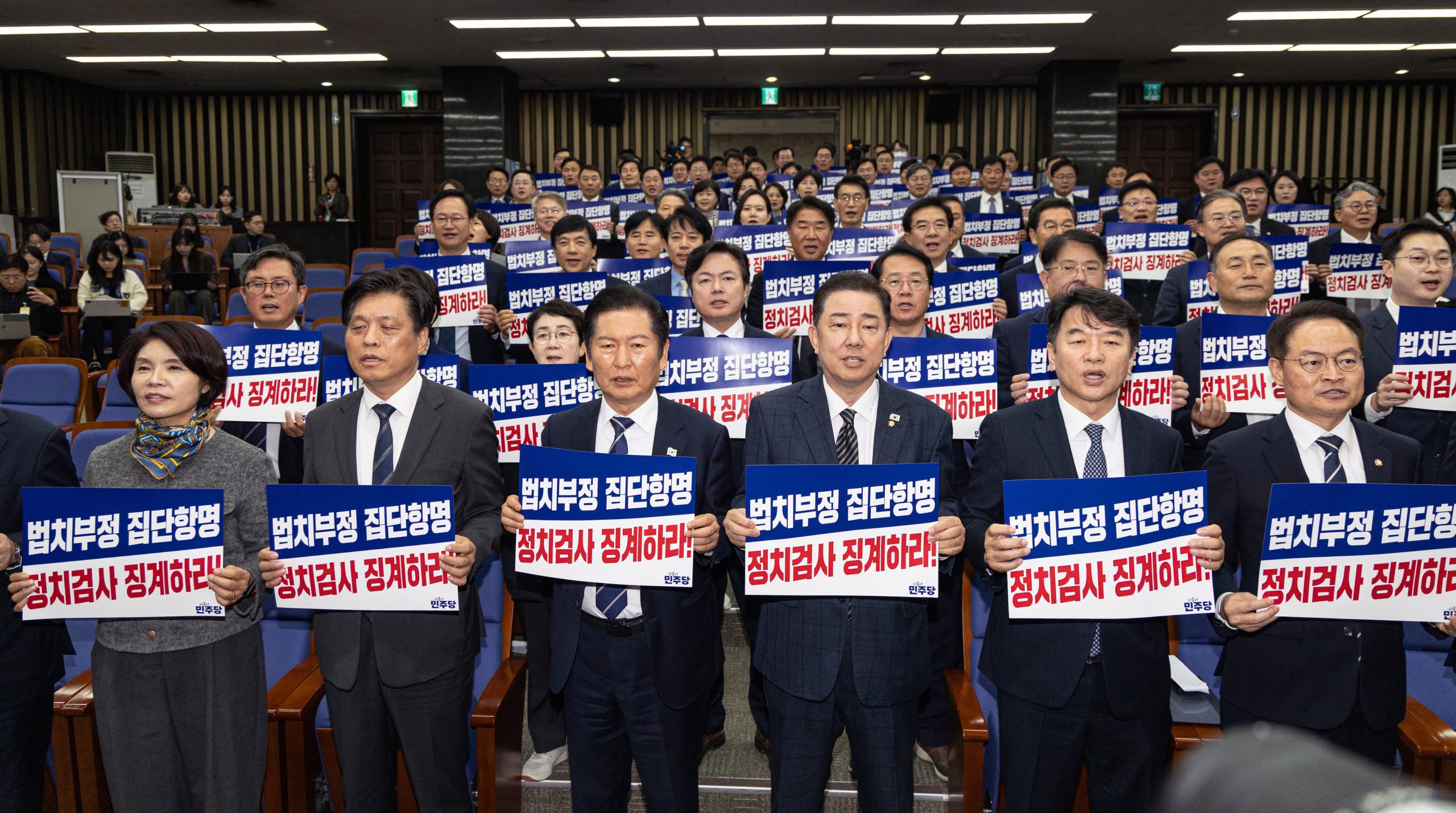
The Democratic Party of Korea has taken a strong stance against prosecutors who have protested the decision to abandon the appeal in the Daejang-dong case. On the 14th, the party stated that prosecutors who defied orders should be immediately investigated and dismissed from their posts. This response came after prosecutors demanded Acting Prosecutor General Noh Man-seok to “explain” the circumstances and legal grounds for abandoning the appeal, which the party labeled as “disobedience.” The Democratic Party also proposed the so-called “Prosecutor Dismissal Act,” which would allow for the dismissal of prosecutors without impeachment proceedings, similar to ordinary public officials.
On the same day, the party urged Justice Minister Jung Sung-ho to initiate an investigation into the prosecutors who protested the decision and to take measures such as disciplinary action, dismissal, and reassignment. Earlier, 18 frontline prosecutors had posted a statement on the prosecution’s internal network, requesting Acting Prosecutor General Noh Man-seok to explain the circumstances and legal grounds for abandoning the appeal.
The proposed “Prosecutor Dismissal Act” stipulates that prosecutors should follow disciplinary procedures, including suspension and dismissal, in accordance with the State Public Officials Act. It also allows even the prosecutor general to be dismissed without a Constitutional Court impeachment decision. In cases of prosecutors general appointments, personnel measures can be taken to reassign them to general prosecutor positions instead of their current senior roles.
Criticism and Concerns
The People Power Party criticized the Democratic Party’s actions, stating, “How can it be considered disobedience if the Justice Minister never issued an order to abandon the appeal?” They added, “This is clear political retaliation, an attempt to tame the prosecution, and a massacre of prosecutors.” Prosecutors themselves protested, calling the move “an idea fit only for a dictatorship,” and warned, “Eventually, only prosecutors who comply with the power will remain.”
The ruling party’s dismissal act has been seen as aimed at weeding out non-supporters. The government and ruling party have stated they never instructed the prosecution to abandon the appeal, yet they are defining the prosecutors’ backlash as collective disobedience and threatening disciplinary action. The People Power Party asked, “If there was no instruction, how can the prosecutors’ demand be considered disobedience?” and added, “Isn’t this an admission that there was de facto instruction?”
Legal and Political Reactions
The Democratic Party labeled the prosecutors’ actions as “selective disobedience by political prosecutors” and vowed to mobilize all legal and administrative measures to block and crush them. They first urged Justice Minister Jung Sung-ho to initiate “demotion and disciplinary investigations” against the protesting prosecutors. They also publicly declared plans to legislate the Prosecutor Dismissal Act within the year and dismiss the so-called disobedient prosecutors, barring them from opening law practices for five years.
Justice Minister Jung echoed the Democratic Party in the National Assembly on the 13th, stating, “Collective actions by the prosecution have been repeated multiple times. I question whether the current guarantee of status, premised on high political neutrality, is necessary.” A senior prosecutor commented, “We had expected Minister Jung, classified as a ‘rationalist’ within the Democratic Party, to block unfair external pressures, but now he seems to agree with the ‘prosecution eradication’ campaign.”
In particular, the Democratic Party declared that if illegal activities by prosecutors are discovered through a “national investigation” into the Daejang-dong case, they would not hesitate to appoint a special counsel. The Democratic Party and the ruling bloc have already labeled some of the protesting prosecutors as “prosecutors who manipulated the Daejang-dong case” and “pro-Yoon (Suk-yeol) prosecutors who led the disobedience,” and announced plans to summon them for the national investigation.
Public Opinion and Legal Circles
In legal circles, there are reactions that the Democratic Party’s responses since the first-instance ruling in the “Daejang-dong group” case are logically inconsistent. After the first-instance sentence for the Daejang-dong group, the Democratic Party claimed, “The court did not recognize the collusion between President Lee Jae-myung and the Daejang-dong group,” while Justice Minister Jung Sung-ho described it as a “successful investigation and trial.”
However, amid the backlash against the prosecution’s decision to abandon the appeal, the Democratic Party suddenly claimed, “The Daejang-dong case was a ‘fabricated indictment,’” and pressured the prosecution to “drop the charges against President Lee.” A former prosecutors general-turned-lawyer argued, “According to the Democratic Party’s logic, the Daejang-dong group used ‘Lee Jae-myung’s Seongnam City.’ Instead, shouldn’t they encourage an appeal to further examine whether the first-instance court’s ruling, which ordered the confiscation of 47.3 billion Korean won, could lead to the confiscation of the Daejang-dong group’s 780 billion Korean won-range criminal proceeds?”
A Gallup Korea poll released the same day showed that 48% of respondents found the prosecution’s decision to abandon the Daejang-dong appeal “inappropriate,” surpassing the 29% who deemed it “appropriate” by 19 percentage points. President Lee’s approval rating fell by 4 percentage points from the previous week to 59%, but remained around 60%. A political source commented, “Even citizens who view President Lee’s governance positively see his personal legal risks as separate from his administration.”
Ongoing Legal and Political Debates
The Democratic Party revisited the idea of a “dedicated insurrection trial bench” after the court rejected arrest warrants for former Justice Minister Park Sung-jae and former Prime Minister Hwang Kyo-ahn, requested by the “insurrection special counsel.” The dedicated insurrection trial bench, which opposition parties and some chief judges have argued is unconstitutional, was previously pushed by the ruling bloc but discussions paused due to parliamentary audits. Representative Jung Chung-rae stated on the same day, “I cannot shake the suspicion that the ‘Jo Hee-de judiciary’ is an obstacle,” while Rep. Kim Yong-min said, “Introducing a dedicated insurrection trial bench and judges specializing in insurrection arrest warrants only requires the party leadership’s decision.”


