
The Evolving Landscape of Fintech and Its Global Implications
The financial technology (fintech) industry is at a pivotal moment, with leaders from around the world gathering to discuss how digital technologies are reshaping the global economy. Topics such as macroeconomics, artificial intelligence (AI), new forms of money, and policy sustainability have taken center stage. As the sector continues to explore and advance innovations like AI, asset tokenization, and electronic payments, it faces both opportunities and challenges.
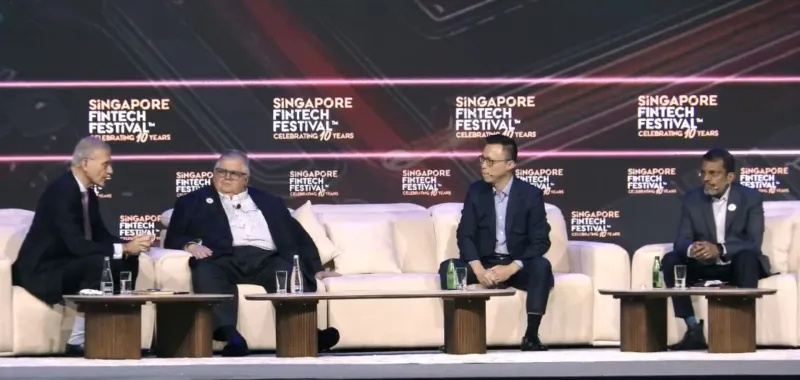
Ravi Menon, chairman of the board of directors for the Global Finance & Technology Network (GFTN), emphasized the transformative potential of these technologies. “Digital technologies centered on foundational architecture, electronic payments, digital identities, trusted data, asset tokenization, and programmable money are the basis for the new financial system and a key enabler for not just financial activities, but almost all parts of the economy,” he said during the “Steering the Global Future” session at the Singapore Fintech Festival 2025.
Menon, also an ambassador for climate action in Singapore and a former managing director of the Monetary Authority of Singapore (MAS), highlighted that we are on the cusp of a “quantum leap” in financial systems. He noted that while advancements in fintech bring tremendous benefits, they also come with governance and sustainability risks.
Embracing Innovation with Caution
Agustin Carstens, former general manager of the Bank for International Settlements (BIS), echoed this sentiment. He stressed the importance of regulators embracing innovation. “Authorities have to embrace innovation now. There are some examples where the authorities have kept up with the pace of innovation, and you can see that in their ecosystems that they’re producing. MAS has embraced innovation, invested a lot in innovation, and developed a very strong human capital to be able to do the job.”
Carstens added that the same approach must be adopted globally. “We have to embrace innovation in such a way that we can assure that adoption is safe, is appropriate, and welfare is improving without being a major stumbling block in the process of innovation.”
Regarding sustainability, Menon expressed hope that AI could help decarbonize the financial sector. “It cannot be eating up all the world’s energy resources just to do what we are doing much more efficiently. So that stage of AI’s development is what’s going to make sure it’s sustainable,” he said.
The Role of AI and Tokenization in Financial Evolution
Eric Jing, chairman of Ant Group, discussed the growing influence of AI in fintech. “Agenetic AI will be booming. I think today, agents already have you to purchase maybe a product or help you make a reservation and paying a deposit, so that’s a pulling force for agentic pay to ensure a smooth customer experience, right? But that’s not the whole thing. That’s just the beginning.”
Jing explained that multi-agent systems will allow AI to perform complex tasks, leading to revenue creation and efficient payment allocation through smart contracts. “I think the agendic pay we have definitely will be booming, very, very quickly.”
He also touched on the future of tokenization. “Tokenization of money will enable global, real-time settlement, particularly benefiting SMEs and companies catching global trade sooner. On the asset side, tokenization of various assets onto the chain will enable efficient, transparent, and credible trading across markets and institutions.”
The Future of Money and Policy
Dr. Razeen Sally, moderator of the panel, asked Carstens about the future of money and public policy. Carstens outlined the three essential characteristics of money: medium of exchange, store of value, and unit of account. “Money needs to have these characteristics. The real issue is whether we have money with the technological representation that society and modernity demands today,” he said.
Carstens emphasized the need for money to evolve alongside technological advancements. “We need a representation of money that can raise to the challenge of those type of transactions, with one condition: that money continues to be safe and trustworthy.”
Major Shifts in Economic Growth
When asked about major shifts that have reshaped economic growth, Menon pointed to the mobile phone revolution starting around 2015. “The mobile phone gave a lot of mobility, combined with massive processing power and broadband connectivity, allowing many financial developments to take place.”
He also highlighted the emergence of faster payment systems and cross-border connectivity. “This has democratized access, enabling small and medium enterprises and individuals to transcend national borders without physical presence, which has had tremendous economic benefits.”
As the fintech landscape continues to evolve, the balance between innovation, regulation, and sustainability remains a critical focus for global leaders. The path forward will require collaboration, adaptability, and a commitment to ensuring that technological progress benefits all.


