
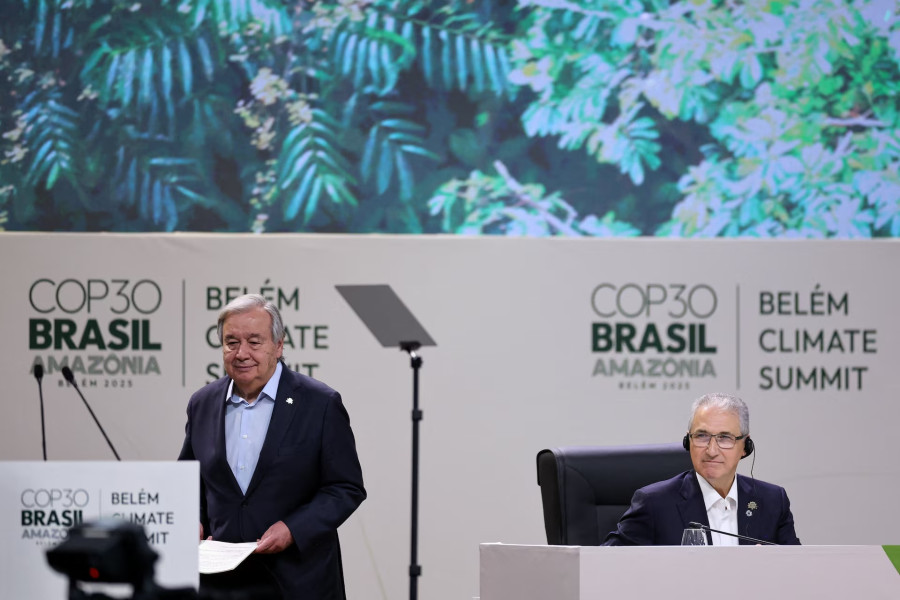
A Global Climate Summit in a Fractured World
The 30th Conference of the Parties to the UN Framework Convention on Climate Change (UNFCCC), known as COP30, has begun in Belem, Brazil, on November 10 and will run until November 21. This conference is part of an ongoing global negotiation process aimed at addressing climate change. It takes place against the backdrop of a stark contrast with the first such event, the ‘Earth Summit’ held in Rio de Janeiro in 1992 (Rio-92). Back then, the United Nations benefited from a renewed post-Cold War multilateralism, with expanded mandates and increased budgets.
The creation of the UNFCCC during the Rio-92 summit helped establish global norms within a rules-based international order. It was one of many environmentally focused UN bodies, contributing to a more complex and robust framework for global governance. However, the broad international consensus that made the 1992 agreement possible has since disappeared.
Since the turn of the millennium, the United States has distanced itself from the rules-based international order it once supported. The first sign of this shift came in 2001 when President George W. Bush announced the U.S. would not participate in the Kyoto Protocol, an extension mechanism of the UNFCCC. This decision led to a breakdown in the climate change regime, with unfulfilled expectations remaining until the Protocol expired in 2020.
In 2015, the Paris Agreement was reached during COP-21, aiming to preserve the outlines of the climate regime after widespread non-compliance. Instead of a single baseline agreement, the focus shifted to voluntary reductions through Nationally Determined Contributions, emphasizing major emitters like the U.S. and China. This flexible framework relied on continuous political commitment from key polluters.
However, this was just the beginning of a retreat from multilateralism, marked by a decline in institutionalized cooperation and leaving the UN system at a crossroads. The arrival of Donald Trump in 2016 further disrupted the progress, as climate change negationism overlapped with the rise of far-right populism, inflicting damage on the fragile commitments of the Paris Accord.
The COVID-19 pandemic exacerbated these challenges, leading to a fragmented international order fueled by domestic nationalism and declining international institutions. Conflicts like Russia’s war in Ukraine and Israel’s war in Gaza have worsened the situation further.
COP30: A Divided World in Motion
In its 2024 edition, COP30 reflected the ambivalence of a divided world. In sharp contrast to expectations of economic transition to sustainable platforms, the COP29 conference in Baku, Azerbaijan, saw a dramatic return of fossil fuels to diplomatic discussions, influenced by Trump’s policies and the ongoing war in Ukraine. This led to a $300 billion compromise by developed countries to mitigate climate change effects on the Global South by 2035.
Brazil has approved a longstanding claim by Petrobras to allow oil extraction at the mouth of the Amazon River. At the same time, Lula promoted COP30 as a “moment of truth” for climate financial commitments. Brazilian authorities are aware of potential diplomatic fallout, as recent G20 and BRICS summits lacked ambitious agendas and normative commitments.
Challenges and Diplomatic Struggles
The Belem summit faced compromises even before it began. An infrastructure crisis led several delegations to delay confirmations until the last minute, creating a hospitality crisis in Brazil. The absence of two major Brazilian allies— the U.S. and Argentina—also stood out.
Despite President Lula da Silva’s outreach to President Trump during the latest UN General Assembly meeting and the ASEAN summit in Malaysia, the U.S. continues to backtrack on its multilateral commitments, especially in environmental matters. Once again, the major carbon emitter is not attending COP30 in an official capacity, signaling a decline in Brazil’s diplomatic prestige.
Long-standing Brazilian aspirations for leadership in Latin America face challenges due to limited outcomes. The concept of “leadership without followers” highlights this struggle. Over decades, Brazil combined investment in institutions with presidential diplomacy to promote its leadership claims. However, the end of the left-wing Pink Tide left regional institutions in disarray.
Argentina’s alignment with Trump’s climate change denialism, under the leadership of neoliberal economist Javier Milei, has strained relations with Brazil. MERCOSUR, once a success story, now faces challenges despite attempts to work out a trade deal with the European Union.
Global South’s Dilemma
Rising Global South powers like India approach the climate change conference with caution. As the fastest-growing economy of the Global South, India feels no need to accelerate its climate commitments, given the world’s division. Among G20 economies, there is no consensus on how to align post-pandemic recovery with previous environmental commitments.
Most G20 economies have slowed down since 2020, with only a few, including India, China, and Indonesia, continuing to grow above the world average. The same fragmented profile can be found among Global South polities, which struggle to find a common front despite shared climate financial promises.
Reflections on a Fractured World Order
Torn between the frustrated expectations of the climate change regime and the current hardships of a fragmented world order, COP30 reminds us of the missed opportunities of multilateralism since the fall of the Berlin Wall in 1989.


