
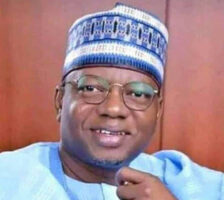
A Statesman-Philanthropist in Action
Senator Mohammed Sani Musa, often referred to as ‘Senator 313’ by many, is a rare figure in Nigerian politics whose name is spoken with a sense of familiarity and respect. His political identity is not built on empty promises or campaign slogans but on a legacy of tangible interventions that have transformed the lives of his constituents. From boreholes that bring clean water to rural communities to vocational centers that empower youth, Senator Musa has consistently demonstrated how empathy can be translated into policy and philanthropy into long-term community development.
Born on 11 May 1965 in Minna, Niger State, Musa’s journey began in local schools before he pursued higher education. He studied Business Administration, Banking, and Finance at Ahmadu Bello University and later sharpened his leadership skills through international training programs. These experiences laid the foundation for his career in public service, where he served as Special Adviser on Investment and Infrastructure to the Niger State Governor. This background has enabled him to craft policies that are not only well-targeted but also sustainable.
Governance as a Service-Delivery Template
In Niger East, where Senator Musa represents the constituency, his governance style is a deliberate model of service delivery. His work spans several key areas, including infrastructure development, healthcare improvement, education investment, and youth empowerment. For instance, he facilitated the construction of two 50-bed hospitals—one in Sarkin Pawa, Munya LGA, and another in Kuta, Shiroro LGA. These facilities have significantly improved access to healthcare for the local population.
Additionally, he launched an inclusive empowerment program that benefited 500 women and youths. The program included the distribution of 21 tricycles, 130 motorcycles, 80 grinding machines, 80 deep freezers, 30 generators, and 95 sewing machines. He also distributed 4,050 bags of fertiliser across nine local government areas to boost agricultural productivity.
Generosity and Educational Support
Senator Musa’s generosity extends beyond material support. He disbursed N143 million to 2,868 constituents, with each receiving N50,000. Furthermore, he initiated a fully funded international scholarship program, enabling 100 students to study medicine in India and another 100 to pursue engineering, artificial intelligence, and robotics in China.
His commitment to education is evident in his efforts to settle registration fees for undergraduate students, pay NECO and JAMB fees, and extend educational assistance to 1,000 higher-institution students across his constituency. These actions reflect his belief that education is a cornerstone of personal and national development.
Transforming Daily Life Through Infrastructure
The impact of Senator Musa’s initiatives is visible in the daily lives of people in his constituency. In villages across the nine local government areas of Niger East, his team has installed solar-powered boreholes, rehabilitated rural roads, electrified clinics, and supplied transformers and streetlights to market centers. These measures have brought about a subtle yet decisive reweaving of social normalcy, allowing children to study under solar streetlights and clinics to maintain unbroken cold chains for vaccines.
Legislative Stewardship and Institutional Engagement
As a member of the Senate in Nigeria’s 10th National Assembly, Senator Musa has focused on legislation that reflects his ground-level priorities. His parliamentary work includes advocating for infrastructural renewal, ensuring oversight that emphasizes functionality over mere compliance, and sponsoring bills aimed at institutionalizing development gains.
His approach to governance is both deeply local and forward-looking. He understands the rhythms of communal life and the impact of infrastructure on livelihoods. At the same time, his political narrative is marked by resilience. Despite facing multiple electoral challenges, his re-election and continued presence in public life underscore his legitimacy, which is rooted in visible delivery rather than rhetoric.
A Reconciler in the Senate
At the national level, Senator Musa positions himself as a reconciler, advocating for competence-driven governance in a politically fragmented Nigeria. In the Senate, where posturing can often overshadow policy, he is known for his meticulous work in committee deliberations, budget scrutiny, and legislative sponsorship. His roles on financial and budget-oversight committees highlight his commitment to accountability and ensuring that public resources align with human needs rather than vanity projects.
A Model for Future Leaders
While infrastructural deficits and systemic underdevelopment remain, Senator Musa’s consistent pattern of action sets him apart from many of his peers. When problems arise, he mobilizes resources and follows through; when crises occur, he responds; and when people are marginalized, he finds ways to assist them.
This pattern matters because politics is an ensemble of patterns, not singular events. Senator Musa’s blend of philanthropy and institutional engagement offers a template for other lawmakers to emulate—not just for Niger East, but for a Nigeria seeking leaders who can pragmatically transform the quotidian realities of millions.
A Statesman-Philanthropist
To call Senator Mohammed Sani Musa a ‘philanthropic politician’ is accurate but insufficient. A more fitting description is statesman-philanthropist: one who combines the soft virtues of care and proximity with the hard virtues of systems thinking and institutional stewardship. He is tender where politics demands tenderness—in healthcare corridors and market squares—and rigorous where governance demands rigour—in committee rooms and budget halls.
For the people of Niger East, he has been more than an occasional benefactor; he has been a consistent advocate of possibility. For Nigerians seeking a politics that returns to the essentials of service, Senator Musa is a voice and a record worth listening to—and learning from.


