
Political Realignments and Diplomatic Reforms in Kenya
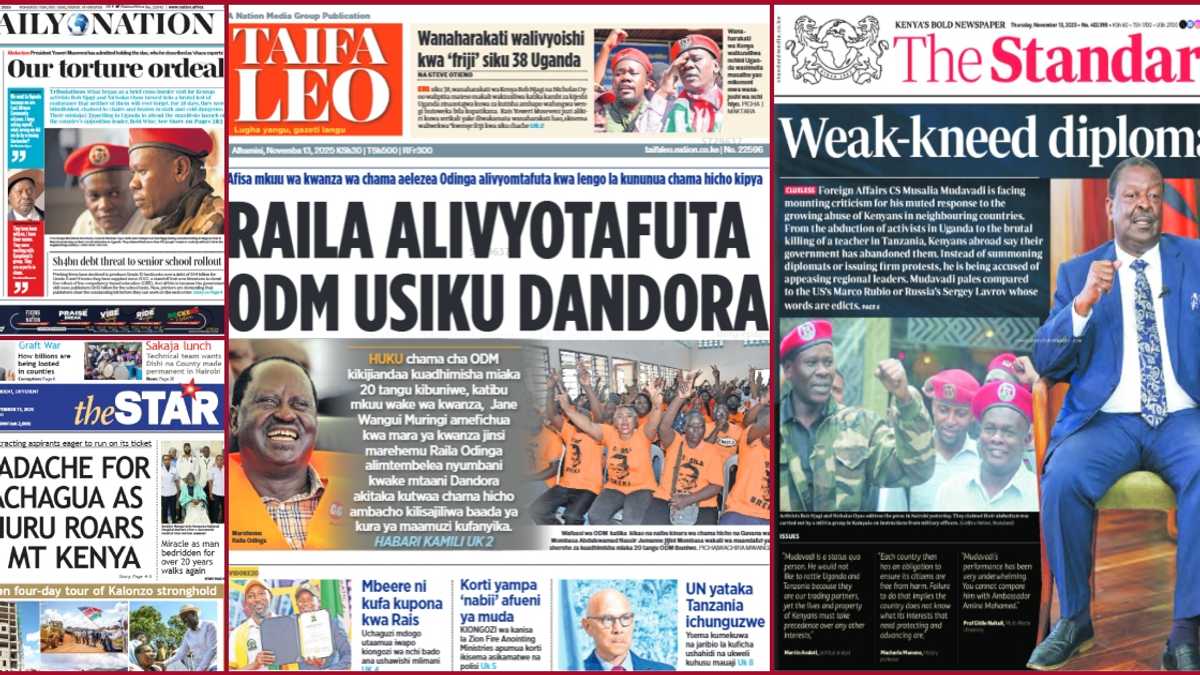
As the Orange Democratic Movement (ODM) prepares to celebrate its 20th anniversary in Mombasa, local newspapers have highlighted fresh political realignments across the country. The event is seen as a potential catalyst for new alliances, marking a significant moment in Kenya’s evolving political landscape.

New Law Aims to Professionalize Diplomatic Appointments
A proposed law before the National Assembly seeks to professionalize Kenya’s diplomatic appointments. According to the Daily Nation, the Foreign Service (Amendment) Bill, 2025, sponsored by Mwingi West MP Charles Nguna Ngusya, aims to ensure that at least 70% of Kenya’s envoys are career diplomats. The remaining 30% will be political appointees, but they must have relevant experience in diplomacy and international relations.
The bill aligns with Sessional Paper No. 1 of 2025 on Kenya’s Foreign Policy, which recommends that 70% of diplomatic appointments come from career diplomats. If passed, it will end the long-standing practice of appointing political allies or election losers as ambassadors, high commissioners, or permanent representatives.
The bill has been under pre-public scrutiny, and the National Assembly’s Defence, Intelligence and Foreign Relations Committee, chaired by Nelson Koech, met on Tuesday, November 10, to discuss the proposal. The committee will receive input from the Attorney General’s office and the Kenya Law Reform Commission before advancing the legislation.
Criticism Over Handling of Kenyan Citizens Abroad
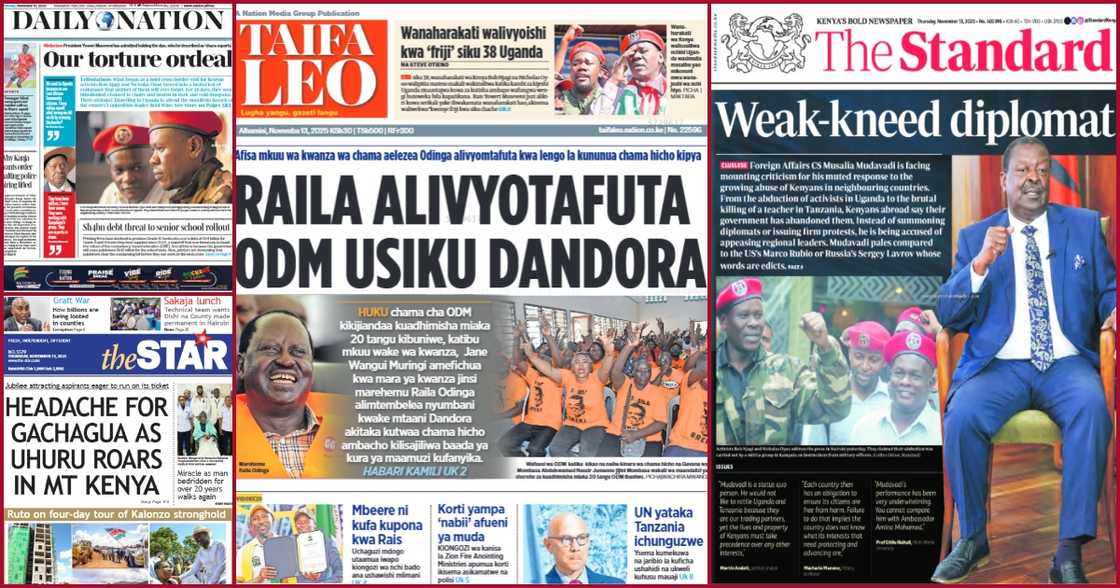
The Standard reports that the recent mistreatment of Kenyans in Uganda and Tanzania has drawn sharp criticism toward Foreign and Diaspora Affairs Cabinet Secretary Musalia Mudavadi. Analysts describe him as one of the weakest foreign policy handlers in Kenya’s history.
Since President William Ruto’s administration took office, Kenyans have reportedly suffered abuse and harassment in neighboring countries with little protest or diplomatic action from Nairobi. Historian Macharia Munene said Mudavadi’s inaction showed Kenya’s failure to protect its citizens abroad, a responsibility expected of every UN member state.
Political analysts, including Prof Gitile Naituli, argued that Mudavadi’s performance has been underwhelming compared to former CS Amina Mohammed, who built strong international relations during President Uhuru Kenyatta’s tenure. Analyst Martin Andati rated Mudavadi five out of ten, only slightly higher than his predecessor Alfred Mutua.
Critics accused Mudavadi of being slow to respond to the detention of Kenyan activists Bob Njagi and Nicholas Oyoo in Uganda, who were freed after 39 days reportedly following intervention by former president Uhuru Kenyatta. They said Mudavadi’s preference for quiet diplomacy failed to deliver results.
Concerns have also risen over the death of Kenyan teacher John Okoth Ogutu in Tanzania and the lack of government support for his family. Prof Munene warned that Kenya risks appearing as a “client state” unable to defend its citizens, while Naituli accused Ruto’s government of complicity through silence.
Political Challenges for Rigathi Gachagua
The Star reports that former Deputy President Rigathi Gachagua faces growing challenges in his bid to unite the Mt Kenya region under the Democracy for the Citizens Party (DCP). Former president Uhuru Kenyatta has returned to active politics through a revitalized Jubilee Party, leading grassroots revival and a nationwide membership drive ahead of the 2027 General Election.
Uhuru’s renewed activity is already attracting aspirants and rekindling support in Mt Kenya, threatening Gachagua’s influence and his plan to consolidate the region behind DCP. Political observers say Uhuru’s comeback could reshape Mt Kenya’s political landscape and weaken Gachagua’s bargaining power within the opposition, especially as Jubilee and other anti-Ruto parties explore coalition talks.
Reports suggest Gachagua recently shelved his 2027 presidential ambitions, opting instead to negotiate for a major power share with Wiper leader Kalonzo Musyoka. Gachagua has urged Mt Kenya residents to back one political vehicle to avoid fragmentation, warning that divided loyalties could repeat past political mistakes.
However, allies of Uhuru argue that Jubilee’s reorganization is a national effort, not a regional power contest. Jubilee deputy leader Joseph Manje said the former president’s focus is on rebuilding the party beyond Central Kenya, adding that it remains the largest political movement with over seven million members.
Analysts, including Prof Peter Kagwanja, noted that Gachagua’s push for dominance faces limits in a region that values political plurality. They warned that Uhuru’s political experience, networks, and financial strength could further complicate Gachagua’s efforts.
ODM Celebrates 20th Anniversary in Mombasa
Taifa Leo reports that preparations are underway in Mombasa county, where the Orange Democratic Movement (ODM) is set to mark its 20th anniversary this week. The event will bring together top party leaders and founding members who played a vital role in shaping its history.
One of the founding figures expected to attend is Jane Wangui Muringi, who served as ODM’s first Secretary-General after its official registration following the 2005 referendum. Although not widely known within ODM’s current leadership, Muringi’s involvement dates back to the party’s formative days under the late former Prime Minister Raila Odinga.
Muringi recalled the night Raila personally visited her home in Dandora. She said political strategist Tony Gachoka had called her that evening, asking her to step outside despite the late hour. When she did, she found a luxury car waiting and was surprised to find Raila seated inside.
She described being nervous as they drove through parts of Nairobi, including Kibra, while Raila explained why he had sought her out. According to her, Raila told her he needed her because she already had a registered political party, which she co-owned with lawyer Mugambi Imanyara.
Imanyara later confirmed that Muringi had indeed been ODM’s first Secretary-General before being replaced by Tony Chege. Muringi said Raila had asked her to name her price for transferring the party to his team, but she declined any monetary or political reward. She instead told him she wanted to work with him for change.
The following day, they met again and formalized the transfer, paving the way for ODM’s emergence as a major political force. Muringi later joined the party’s National Executive Council as Secretary for Special Programmes.


