Rising Smoking Rates in Certain Areas of England
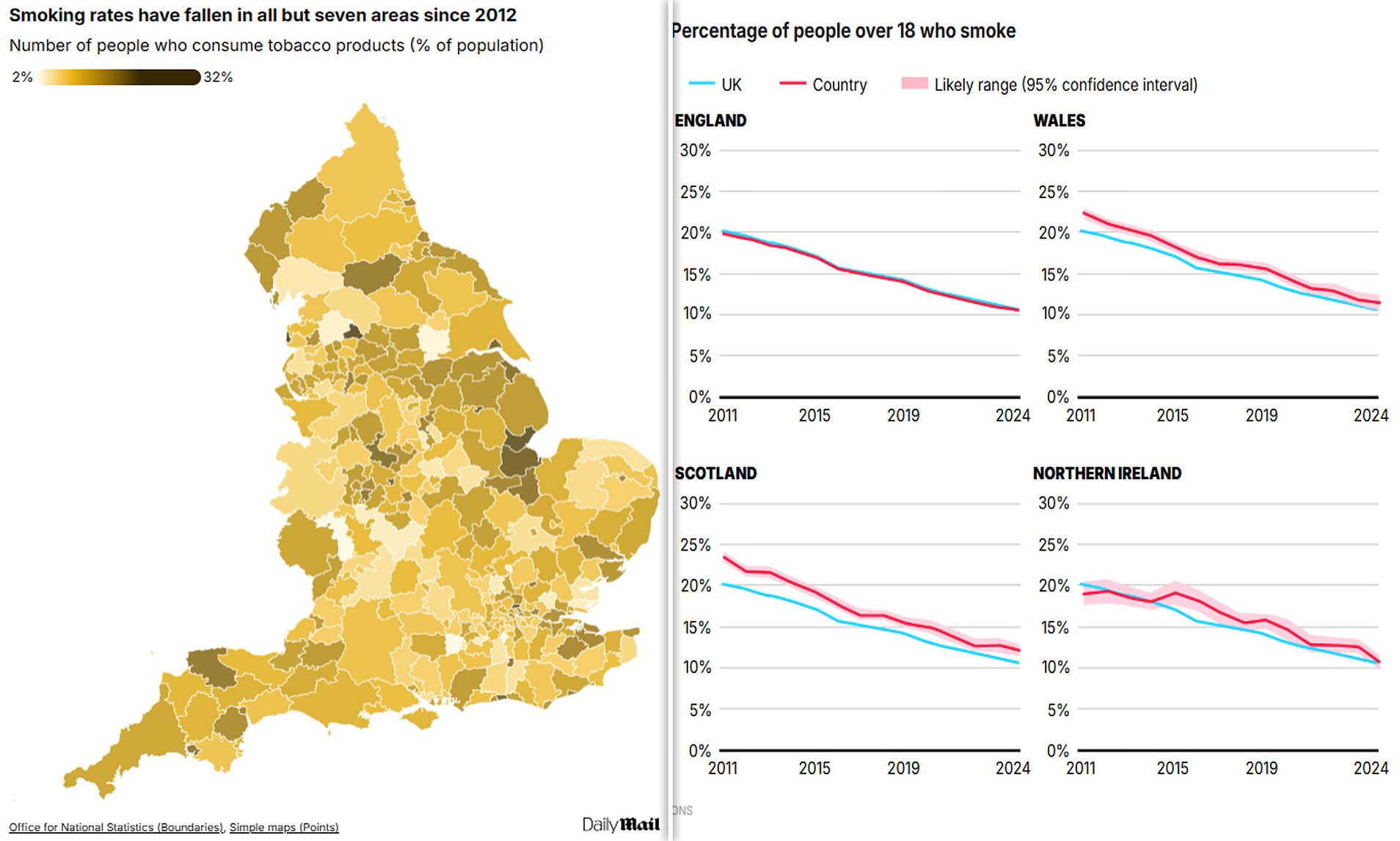
A recent analysis has revealed that seven areas in England have seen an increase in the number of smokers compared to 14 years ago. This data highlights a complex trend in smoking habits across the country, with some regions experiencing a notable rise while others show significant declines.
Nationally, the percentage of adults in Britain who admitted to smoking last year dropped to 9.1%, down from 10.5% in 2023. This decline is a stark contrast to the nearly 50% smoking rate in the 1970s, according to data from the Office for National Statistics (ONS). Despite this overall downward trend, certain localities are witnessing a concerning upward shift in tobacco use.
East Staffordshire has experienced the most significant increase, with the proportion of the population that smokes rising from 10.7% in 2012 to 17.3% in 2024. That’s a 6.6% increase over the past decade. South Holland in Lincolnshire follows closely behind, with a 3.7% rise, while Exeter and Babergh share third place with a 2.7% increase each.
On the other end of the spectrum, several areas have seen substantial decreases in smoking rates. The boroughs of Folkestone and Hythe, as well as Stevenage, recorded the largest drops, with a 20.8% reduction in smokers. Dover saw a decrease of 18.9%, and Stratford-upon-Avon had a 16.4% drop.
Despite the national decline in smoking, legal tobacco sales have fallen by 45% since 2021. However, the number of smokers has only decreased by less than 1%. This discrepancy can be attributed to repeated tax hikes on tobacco products, which have priced many out of the legal market. As a result, some individuals have turned to cheaper alternatives, including illicit tobacco.
In a related development, the number of vapers in the UK has surpassed cigarette smokers for the first time, with 5.4 million adults now using e-cigarettes. This shift has prompted the government to introduce new measures aimed at further reducing smoking rates and curbing the growth of vaping.
The Tobacco and Vapes Bill, currently under consideration in the House of Lords, proposes making it illegal for anyone born on or after 1 January 2009 to purchase tobacco. It also includes provisions to restrict the packaging, marketing, and flavors of e-cigarettes. Over 1,200 health professionals, including doctors and public health directors, have endorsed the bill.
Daily e-cigarette use is highest among those aged 25 to 34 and 35 to 49, at 9.3% and 9.5% respectively. However, overall use remains highest among 16- to 24-year-olds, with 13% using vaping either daily or occasionally. Despite a ban on selling vapes to under-18s, enforcement efforts continue to address the issue.
Campaigners have called for stricter regulations on vapes, particularly targeting marketing practices that appeal to children. They argue that manufacturers are luring young people with colorful packaging and child-friendly flavors like bubblegum and cotton candy.
While vaping is considered safer than smoking, it is not without risks. E-cigarettes contain harmful toxins, and their long-term effects remain unknown. Experts are concerned about the high nicotine content, which can lead to heart problems and high blood pressure.
The government is also planning to tighten restrictions on the sale of nicotine pouches to prevent widespread use among children and teenagers. Caroline Cerny, deputy chief executive at Action on Smoking and Health, emphasized the importance of continued efforts to reduce smoking rates and support those trying to quit.
However, not all stakeholders agree with the proposed measures. Simon Clark, director of smokers’ rights group Forest, warned that attempts to achieve a “smoke-free Britain” could backfire. He argued that alternatives like vapes and nicotine pouches have helped many smokers switch and quit voluntarily.
British American Tobacco (BAT), one of the world’s largest cigarette and nicotine product manufacturers, acknowledged the progress but stressed the need for continued education on less harmful alternatives. The company, which aims to build a smokeless future, reported that 18% of its £12 billion revenue came from smokeless products in the first half of the year.
As the debate continues, questions remain about the effectiveness of current policies and the potential impact of future regulations on smoking and vaping trends in the UK.