
Understanding Nepal’s Economic Landscape
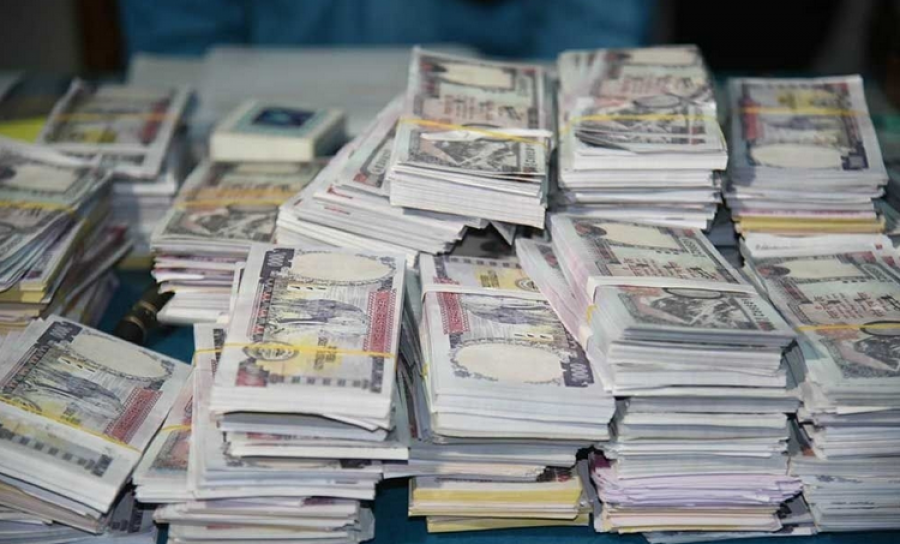
Nepal has witnessed a significant influx of liquidity in recent months, with the central bank absorbing Rs6,785 billion through deposits and other standing facilities. This move aims to stabilize the market, which is flooded with unused capital. Bank deposits have surged to Rs7.4 trillion, while foreign exchange reserves have reached an all-time high of $20.41 billion, sufficient to fund imports for 16 months. These figures are typically seen as indicators of economic strength.
However, Nepal’s situation is far more complex. As of mid-September, total loan disbursement stood at Rs5.617 trillion, with 4.62% of these loans turning into non-performing assets—an increase of one percentage point from the previous year. The real economy remains stagnant, with an average growth rate of 4.5%, and private sector investment accounts for only 17.67% of GDP. Gross capital formation grows at a minimal rate of 0.49% annually, while government capital spending is only 40% of the allocated amount. These figures reveal a deep-seated structural failure.
The Liquidity Trap Dilemma
The evidence points to Nepal being in a classic liquidity trap, where monetary policy loses effectiveness as agents prefer holding cash over making investments, even when interest rates are low. There is money, but no investment; there is a desire for prosperity, yet insufficient private sector confidence to build. A youth bulge exists, but many are migrating.
In such a scenario, where credit demand is flat and the private sector investment pipeline is minimal, increasing non-performing assets (NPAs) are not just a financial concern but a macroeconomic warning signal. When firms cannot expand and borrowers struggle to repay, the economy enters a vicious cycle: Banks hoard liquidity, credit growth slows further, and viable businesses suffer alongside weak ones. To break this cycle, Nepal must accelerate systemic restructuring of loans targeting productive sectors, strengthen early warning and credit risk systems, improve insolvency and recovery frameworks, and introduce credit guarantee schemes for productive SMEs tied to formalization and export performance.
The Bitter Truth Behind Remittances
Over the past two decades, Nepal has built an economic model reliant on the labor of young people abroad. Remittances account for over a quarter of GDP, sustaining households and keeping the banking system liquid. However, this has also led to complacency among policymakers and institutions. Why reform institutions when foreign workers finance imports? Why develop industries when consumption and trade generate quick returns?
Nepal is living in what development economists call a remittance consumption equilibrium—a comfort zone where foreign earnings fuel domestic spending, but not domestic production. Money flows in, goods flow in, jobs do not.
Dilapidating Spending and Investment
The Government of Nepal’s capital expenditure has remained chronically weak over the years. In the last fiscal year, of the Rs352.35 billion allocated for capital expenditure, only Rs222.68 billion was spent, resulting in an execution rate of 63.2%. This trend has persisted over the years. The problem is not the lack of money, but preparation, coordination, and state capacity.
Nepal’s private sector mirrors this anxiety. Policy instability, political volatility, regulatory uncertainty, and unpredictable tax administration create fear rather than confidence. The result is a liquidity surplus and investment deficit. In recession-like conditions with excess savings, government borrowing should theoretically stimulate private investment. For micro, small, and medium enterprises, every quarter is becoming more challenging. Yet, the government, hampered by implementation constraints, fails to execute even its budgeted projects. Fiscal policy, the primary tool for escaping a liquidity trap, is blunted by state incapacity.
Figuring Out a Framework for Change
Nepal’s policymakers face a moment of truth. Do they continue managing liquidity and celebrating remittance inflows while the real economy stagnates, or do they recognize that capital without investment is a warning? In a liquidity trap like Nepal’s, fiscal policy has a multiplier effect without crowding out private investment. The fiscal policy needs to structure a remittance-to-investment program, offering tax incentives for investments in manufacturing, tourism infrastructure, and information technology.
Rather than repeatedly absorbing liquidity from the market only to lend it to the government, policymakers need an efficient framework that mobilizes private capital directly, such as models like blended financing and BOOT. The state must trust the private sector’s efficiency and innovation while establishing transparent accountability metrics to ensure that private participation strengthens public interest.
Industrialization and Structural Reforms
Nepal’s industrialization process has been slow, hindered by the higher cost of doing business and low productivity. The reform goal should be to achieve sectoral reallocation—moving workers from low-productivity agriculture and informal services into higher-productivity manufacturing. This requires expanding technical training aligned with industrial needs, completing road networks connecting zones to ports, strengthening contract enforcement through commercial courts, and investing in technology transfer mechanisms.
Nepal is accustomed to stimuli, committees, and slogans, believing that change will come. It is time to realize that execution, industrialization, and export-ready industrial zones, manufacturing competitiveness, and a predictable tax and regulatory climate that rewards production over speculation are the basics of a reformed economy.
Lessons from Global Examples
Economic theory and comparative experience provide clear guidance. Remittance-dependent economies can transform. Countries like Vietnam show that late industrialization can succeed, and the Philippines demonstrates that remittances can be channeled into sustainable economic growth. Sustainable growth requires political will, institutional capacity, and sustained commitment to structural change.
For Nepal, the liquidity trap is not a technical problem requiring technical adjustments. It is a governance crisis demanding political courage. The policy instruments exist. The economic knowledge is available. The financial resources are present. What remains absent is the courage to act decisively before the opportunity passes forever and another generation of Nepal’s youth becomes another country’s economic asset. The clock is ticking.


