
Recession fears were fuelled today as official figures showed the economy slipping into the red even before Rachel Reeves’ tax-bomb Budget.
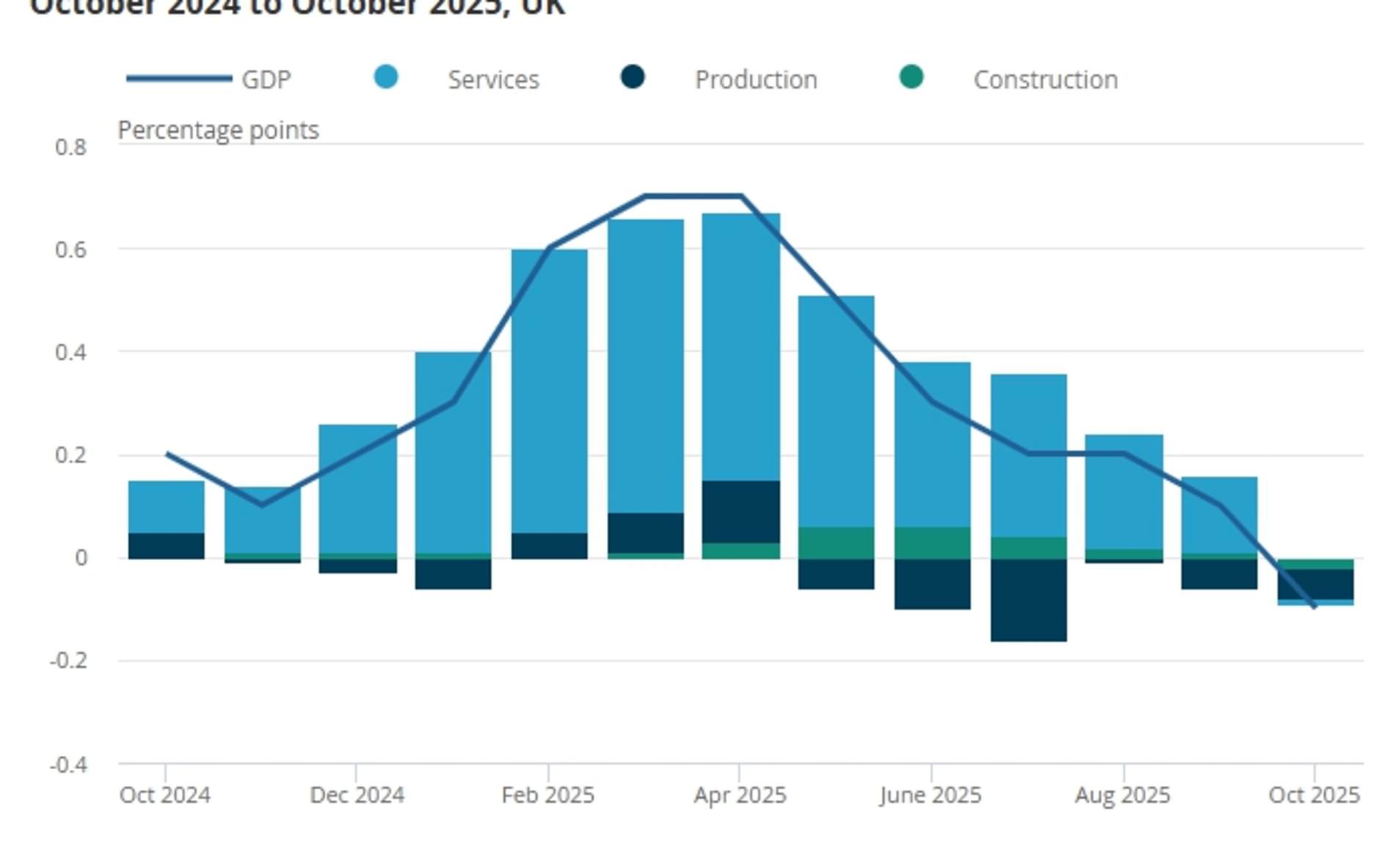
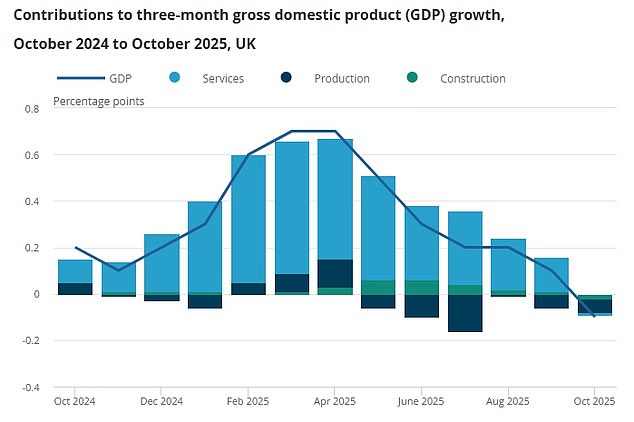
GDP was down 0.1 per cent in October, defying hopes of a bounceback following a 0.1 per cent decline in September and flatlining in August.
The grim picture underlines concerns that the Chancellor’s latest huge raid on November 26 happened when activity that was already grinding to a halt.
Ms Reeves has been accused of deliberately talking up the dire state of the public finances in the run-up to the package a bid to justify her eye-watering tax increases.
Labour’s Treasury Committee chair Meg Hillier launched an extraordinary attack on the Cabinet minister for ‘throwing grenades’ at markets today, demanding she takes responsibility for political ‘psychodrama’.
Analysts had pencilled in 0.1 per cent growth in October, expecting a recovery after the Jaguar Land Rover hacking episode was blamed for the September dip.
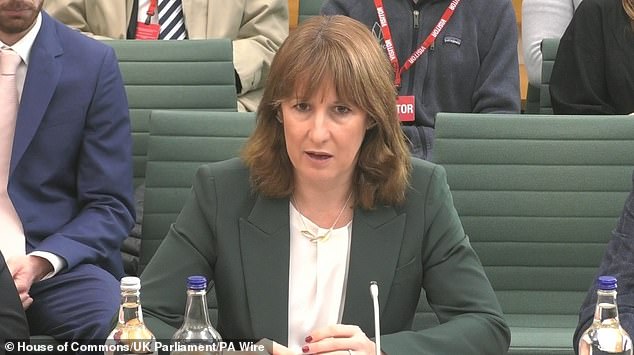
ONS Director of Economic Statistics Liz McKeown said: ‘The economy contracted slightly in the latest three months, as production fell again and services growth stalled.


‘Within production, there was continued weakness in car manufacturing, with the industry only making a slight recovery in October from the substantial fall in output seen in the previous month.
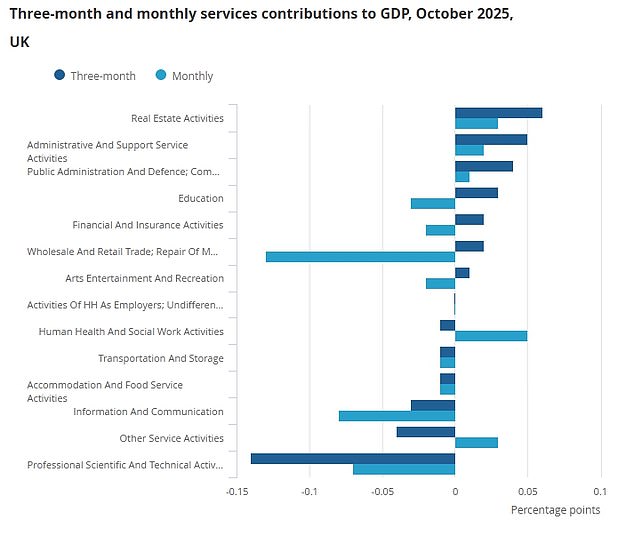
‘Overall services showed no growth in the latest three months, continuing the recent trend of slowing in this sector. There were falls in wholesale and scientific research, offset by growth in rental and leasing and retail.’
A Treasury spokesman said: ‘We are determined to defy the forecasts on growth and create good jobs, so everyone is better off, while also helping us invest in better public services.
‘That is why the Chancellor is taking £150 off energy bills, protecting record investment in our infrastructure, and we are backing major planning reforms, the expansion of Heathrow and Gatwick airports, and the construction of Sizewell C.’
Although a recession is typically defined as two consecutive quarters of GDP shrinking, economists have been increasingly anxious about the UK’s performance.
Jonathan Moyes, Head of Investment Research at Wealth Club, said: ‘The Government and the Chancellor spent much of their time sapping what little confidence the UK economy had left in October.
‘So it is not unsurprising to see the economy not only stagnate, but contract in the month before the budget.
‘Confidence is a key ingredient for a thriving economy, it is a shame to see it given away so freely to mask political choices.
‘For comparison, US GDP growth in Q3 is expected to come in at a blistering 3.8 per cent. The UK is firmly in the global slow lane.’

Suren Thiru, ICAEW Economics Director, said: ‘This dismal outturn may have been followed by a similarly turbulent November with the damage to business and consumer confidence from the frenzied speculation ahead of the Budget likely to have frozen wider economic activity.
‘The aftereffects from the Budget may mean that the UK’s economic prospects are poorer over the near term, with the growing tax burden and a weakening jobs market likely to keep growth notably lower than the OBR expects.
‘With these downbeat figures likely to further fuel fears among rate-setters over the health of the UK economy, a December policy loosening looks nailed on, particularly given the likely deflationary impact of the Budget.’
Shadow chancellor Mel Stride said: ‘This morning’s news that the economy unexpectedly shrank in the three months to October is extremely concerning but it’s as a direct result of Labour’s economic mismanagement.
‘Rachel Reeves promised growth but Labour has no plan for the economy – just their own survival, that’s why Reeves presented a Benefits Budget that rewards welfare not work.
‘For months, Rachel Reeves has misled the British public. She said she wouldn’t raise taxes on working people – she broke that promise again. She insisted there was a black hole in the public finances – but there wasn’t.’
Dame Meg, a Labour veteran who was a minister under Gordon Brown and served in the shadow cabinet, warned that the Treasury’s handling of the Budget had ‘real-world’ impact.
‘We are all accustomed to the proverbial ‘rolling of the pitch’, which essentially means that the government indicates where it intends to make major tax or spending changes in a bid to prepare financial markets for what it’s going to announce,’ she wrote in the i newspaper.
‘The pitch rolling is intended to prevent any wild volatility in government borrowing on Budget day.
‘I’m afraid what occurred this year, with the shadow of the mini-Budget looming large, was less a rolling of the pitch and more akin to throwing several grenades on to the pitch.’
Dame Meg highlighted the way Ms Reeves and officials had heavily signalled that a manifesto-busting income tax hike was coming, before it emerged the idea had been abruptly dropped.
That sparked pandemonium on the gilts market, with interest on government debt rising sharply as traders priced in risk that Ms Reeves was not serious about balancing the books.
In order to contain the situation government sources briefed a number of journalists on November 14 that the idea had been dropped because the OBR had recently upgraded tax revenue forecasts.
However, an exact timetable of forecasts released by the OBR later showed that was not the case. In fact the body had been telling the Chancellor since September that productivity downgrades had been offset by higher wages and inflation.
By the end of October she knew the public finances were in a small surplus without accounting for Labour’s own decisions to scrap the two-child benefit cap and humiliating U-turns on other welfare curbs.
Ms Reeves still delivered a highly unusual speech on November 4 giving blood-curdling warnings that ‘everyone’ would need to ‘contribute’ to bailing out the Government.
Dame Meg said the Government changing its mind on income tax was ‘worse’ because it ‘left everyone either confused or annoyed’.
‘This was a glaring error and one from which all at the Treasury must learn,’ she wrote.
‘Another part of me laments the impact of confused and excessive speculation in the lead up to the Budget.
‘The Institute for Fiscal Studies chief Helen Miller told us last week that she’d seen that ‘firms and individuals are holding back their decision-making’ due to out-of-control briefing and counter-briefing.
‘Westminster psychodrama has a real-world impact, and the Government must choose its words extremely carefully. It’s regrettable that it doesn’t appear to have done so in recent months.’
Dame Meg acknowledged that the Treasury had to strike a difficult balance between ‘preparing the country and financial markets while preserving the sanctity of Parliament as the avenue for announcing major policy decisions’.
‘But the Chancellor has wanted this job for most of her life,’ she added.
‘It is her responsibility to identify and accept the mistakes made within the process she leads and make sure they do not happen again.
‘Now, more than ever, the country needs leadership with the strength to acknowledge what has gone wrong and learn from it.’
Read more
- Could Rachel Reeves’ controversial ‘big tax’ Budget spell doom for the UK economy, plunging it into recession with dismal growth figures and mounting fears?
- Has Rachel Reeves’s ‘gloomy’ rhetoric hamstrung Britain’s economy with chrysalis-like growth in August? The Chancellor’s stance is causing alarm among investors and citizens.
- Is Chancellor Rachel Reeves’ potential tax-raising Budget next month driving fears of another economic downturn?
- Is Britain’s economy teetering on the edge as stagflation fears intensify under Rachel Reeves’s harsh Budget aftermath?
- Is Rachel Reeves spooking the economy with her dire tax warnings, boosting accountant demand ahead of the Budget?


