
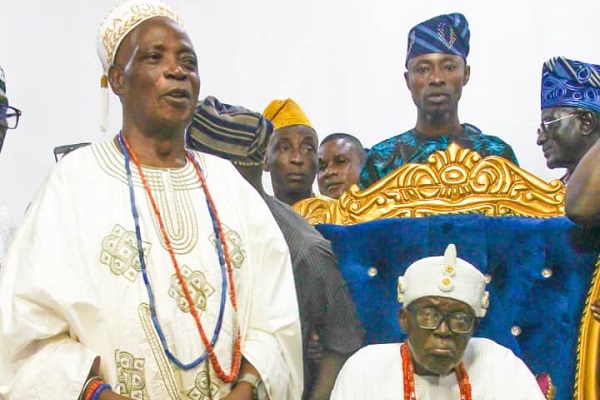
A Journey of Resilience and Legacy
Ibadan, a city known for its brown rooftops, red earth, and rolling hills, is deeply rooted in history. It was once the heart of the Oyo Empire, where warriors shaped the destiny of Yorubaland. Today, it remains a city of contrasts — modern yet traditional, chaotic yet orderly, humble yet proud. To be from Ibadan is to carry the weight of its rich heritage and the legacy of resilience that has defined its people.
Rashidi Adewolu Ladoja was born into this vibrant city, where markets never sleep and drums echo through the streets. His early years were marked by the simple rhythms of life: the call of the muezzin at dawn, the chants of schoolchildren, the bustling energy of Dugbe market, and the rhythmic beats of bata drums during celebrations. These experiences instilled in him the values of hard work, humility, and perseverance. Yet, no one could have predicted that this quiet boy would one day become the Olubadan, the revered king of Ibadan.
What set Rashidi apart was his insatiable hunger for knowledge. Education became his path to success, and he pursued it with determination. He earned a degree in chemical engineering from the University of Liège in Belgium and later built a successful career in Nigeria’s business world. Despite his achievements, he remained deeply connected to his roots, navigating the complex interplay between tradition and modernity.
Ibadan’s monarchy is unique, based on a meritocratic system rather than bloodline. The Olubadan is chosen through a long and arduous process, starting from the lowest rank and ascending over decades. This system reflects the city’s democratic spirit, allowing any son of Ibadan to aspire to the throne if they possess the patience and character to endure the journey.
For Rashidi, this system became both a challenge and an opportunity. His political career began in 1993 when he contested for a senatorial seat during the Third Republic. In 2003, he was elected Governor of Oyo State, where he implemented bold reforms aimed at restoring dignity to public service. However, his tenure was not without struggle. In 2006, he was impeached by the Oyo State House of Assembly, a move that seemed to end his political career. He faced months of humiliation, betrayal, and isolation.
Yet, like Ibadan itself, Rashidi refused to be defeated. He fought back through the courts, challenging his impeachment. In late 2006, the Court of Appeal reinstated him as governor, marking a personal and political victory. His resilience became a symbol of Ibadan’s enduring spirit, proving that perseverance can overcome even the greatest obstacles.
Beyond politics, Rashidi continued his climb through the ranks of Ibadan’s chieftaincy. Starting as Jagun, he embraced each step with humility and dedication, understanding that the path to becoming Olubadan is a long and patient journey. Unlike those who sought shortcuts, he accepted the slow process, demonstrating leadership and commitment at every stage.
After decades of service, trials, and triumphs, destiny finally called. On September 26, 2025, Rashidi Adewolu Ladoja was crowned the 44th Olubadan of Ibadanland. His ascension was more than a coronation; it was the culmination of a lifelong journey. For Rashidi, it was the realization of a dream he had shared many times — to be an Olubadan.
The coronation was a day of celebration, marked by drumming, dancing, and the presence of chiefs adorned in resplendent agbada. From Oja’ba to Mapo Hall, the city came together to honor its new king. Rashidi sat amidst the traditions of his ancestors, embodying the ancient and the modern.
His story is a testament to Ibadan’s values: perseverance over privilege, resilience over defeat, and merit over inheritance. It reminds all sons and daughters of Ibadan that greatness is not solely inherited — it can be earned through patience, endurance, and belief in destiny.
For Ibadan, the Olubadan is more than a monarch. He is a guardian of history, a protector of culture, and a symbol of unity. Rashidi Ladoja’s journey has been one of trials and triumphs, betrayals and vindications, falls and risings. But at last, he has become what destiny had long whispered he would be — the Olubadan of Ibadanland.
His story will live on, told in homes and marketplaces, sung by griots and drummers, remembered by future generations as the tale of the boy who rose from obscurity to the throne. And in the end, it is a reminder that destiny may be delayed, but it can never be denied.


