

What exactly does the
BBC
What does it think it’s accomplishing? Why should license-payers have to cover the costs for a news website published in West African Pidgin—a language that originated as a simplified version of English not meant for writing?
Astonishingly, the World Service now runs a full Pidgin version of the BBC news site, complete with online stories and headlines transcribed into what was once known as Guinea Coast Creole.
The outcomes may turn out absurd. Pidgin refers to a colloquial dialect characterized by a restricted lexicon and basic grammatical rules, commonly used among street communities. This vernacular lacks the complexity needed for covering news topics effectively; hence, numerous headings scarcely vary from conventional English, often differing only slightly in spelling.
‘Top Gun actor
Val Kilmer
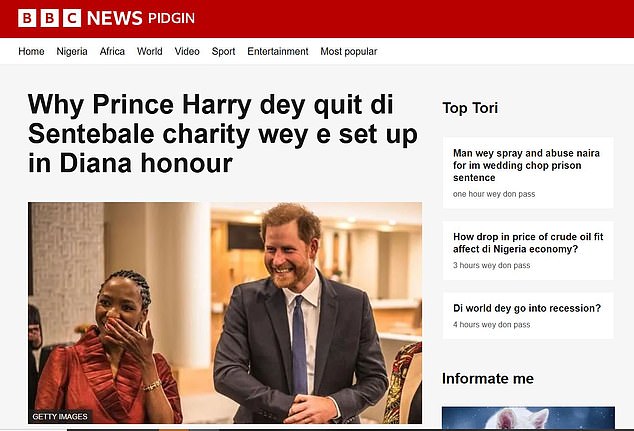
die at di age of 65’ needs no translation. Nor does, ‘Why
Prince Harry
He quit the Sentebale charity he set up in honor of Diana. Of course, ‘the’ is rendered as ‘di’, and ‘he which he’ is expressed as ‘wey e’.
Others may seem a bit more confusing, but you’ll grasp the main idea. ‘Wetin
Putin
the tok wey makes Trump upset by announcing a report on the
Ukraine
conflict, shedding light on what Putin stated that angered Trump.
‘British boarding schools set to reopen soon.’
Nigeria
“, which indicates that the institutions are eager to draw in students from West Africa.
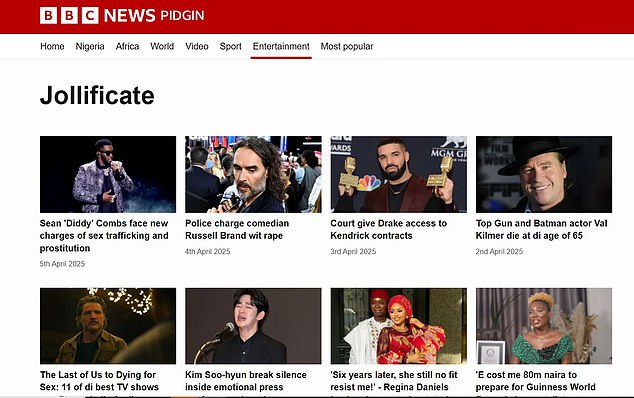


Several of the translations are hilariously poor. The entertainment news section is titled ‘Jollificate,’ intended to mean ‘making cheerful’ — this doesn’t quite fit well on a page featuring reports of celebrity deaths, legal disputes, and conflicts, including headlines like ‘Five Tins We Know About.’
Gene Hackman
and im wife death’.
And indeed, I grasp Pidgin quite easily. Having grown up in Ghana, I was frequently exposed to it. Within an extensive area containing numerous tribal dialects mingling with official languages, it serves as a practical means for individuals to communicate, regardless of their origins.
Approximately 75 million individuals in Nigeria can comprehend it; however, this does not render it suitable for use on BBC News.
In Ghana, English serves as the official language, but many residents additionally converse in Twi, Ewe, Fante, or Ga.
It’s equally typical to come across Hausa and occasionally even Yoruba, which originates from nearby Nigeria. That covers only a small fraction of the languages present.
It comes as no surprise that British sailors found it simpler to promote a simple form of English language, including some African words mixed into their speech.
It was never meant to be anything more than spoken, hence it doesn’t have strict rules or spelling conventions. You can’t even find it listed as an option.
Google
Translate.
The pronunciation clearly has an African influence as well, a characteristic it also shares with West Indian Patois.
At the playground, we occasionally used Pidgin just for kicks. However, I would never consider speaking it at home. It’s somewhat rough around the edges and entirely impolite—much akin to cursing in front of your folks. Although everyone knows how to use it, there’s an appropriate moment and setting for it.
And similar to swearing, it’s considered rather unrefined for women. You’ll most often hear groups of young men bantering in Pidgin when their girlfriends are not around.
For instance, you would never hear the President of Nigeria deliver a speech in Pidgin, or even use it when addressing anyone.
As I’ve mentioned before, this language carries a dark past. It developed during the peak of the slave trade in the 1700s and 1800s as a means for British merchants to communicate business matters with African traders and tribal chiefs—matters which frequently included the exchange of millions of lives.
Only an individual astonishingly oblivious to the nuances would attempt to make it comprehensible by putting it into writing. The one who did this was the BBC World Service.
Their Pidgin service came into existence eight years ago at considerable cost, as part of a £289 million expansion for the BBC’s international reach. Despite the announcement earlier this year that the World Service plans to cut 130 positions to save £6 million annually, the news website is anticipated to stay online.
The significant worth of the World Service lies in the international impact it provides for Britain.
Many individuals in West Africa depend on this source for impartial and rigorously verified information. The platform offers content in Yoruba and Igbo, as well as various other languages throughout the continent like Amharic and Afaan Oromo.
Ethiopia
, and Tigrinya in Eritrea.
These services are the ones that ought to be preserved, rather than Pidgin. Headlines like ’17 facts you need to know before the Oscars’ carry an unsettling hint of racism—as though African viewers wouldn’t comprehend ‘before the Oscars’.
To grasp just how condescending it seems, picture a news site penned in the Geordie accent: ‘Eh brrav, y’know? Ant’n’Dec’ve scooped yet another accolade. This canny be real, ey?’
A person who was born and raised in Newcastle would still need to say those words silently to understand them. Dialect works best when spoken rather than written down. When put into print, it can come across as somewhat mocking.
The BBC is often regarded internationally as the final stronghold of what many consider true Standard English.
That reputation is undermined by the World Service’s frankly bizarre decision to treat Pidgin as a language of equal value.
Any other nation would be shocked. Consider how offended the French would feel if the BBC released a site in Franglais for expatriates.
In Provence. It’s better to find humor in such situations rather than take offense. That said, this headline from last month had me roaring with laughter: ‘Muslim
transgender
A TikToker was sentenced to prison after saying for Jesus to cut his hair.
The narrative continues by describing how Ratu Thalisa, an Indonesian transgender woman from Sumatra, was broadcasting a live video conversation with her supporters when a male viewer recommended that she ought to have a haircut. Offended, Thalisa fired back, questioning why she would need a haircut if Jesus also required one.
The outcome was a prison term of two years and ten months for disrupting public order and religious harmony. The report went on to say, “Following multiple Christian organizations filing complaints with the police, a court ruled against Ms. Thalisa for blasphemy.” She was deemed guilty of inciting hatred under a contentious online hate speech legislation.
That last line reveals how ridiculous it is to ‘translate’ complex English into Pidgin. It has no equivalents for words such as ‘online’, ‘hate-speech’, or even ‘controversial’.
Similarly questionable are the spellings mandated by the BBC. There’s no justification for writing ‘continue’ as ‘kontinu’, implying that a Pidgin speaker wouldn’t recognize the proper spelling.
This is a standardized version produced by the BBC out of sheer self-congratulatory virtue-signaling. If individuals who genuinely use Pidgin had desired a standardized format, they would have undertaken this effort themselves, driven by a community-led initiative.
They wouldn’t have required assistance from the World Service, an entity located in
London
If the BBC had paused for thought, they could have recognised how colonialist their approach appears.
However, as usual, Auntie believes she knows best – which is what she thinks anyway.
Read more
Related posts:

CUProf Sahid Claims FAO/IAMCR Award for Groundbreaking Rural Communication Research
Disney to Acquire Full Control of Hulu for $439M: A Streaming Giant Takes Over

Betrayed Putin Watches Navy Officers Sabotage Submarines, Spying Scandal Unfolds

Albert Ojwang: Kenyan TikToker Recreates Chilling Police Scene From Blogger’s Death

