
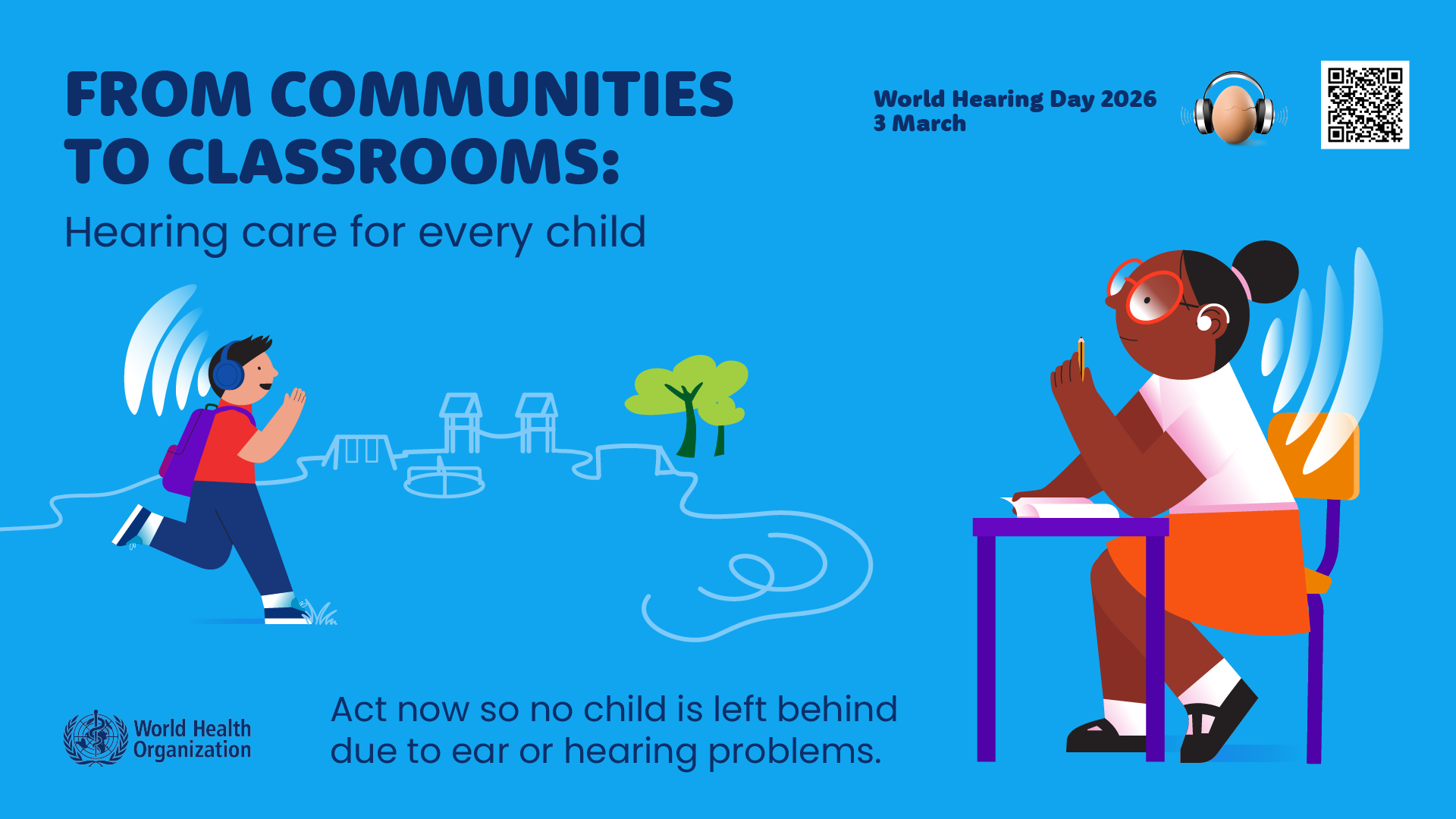
World Hearing Day 2026: A Call for Action on Children’s Hearing Care
Every year on March 3, the world observes World Hearing Day, a day dedicated to raising awareness about the importance of hearing and the challenges faced by those who experience hearing loss. In 2026, the theme “From communities to classrooms: hearing care for all children” highlights the urgent need to prioritize hearing health for children globally. The message is clear: hearing plays a critical role in learning, communication, and opportunity, and much of childhood hearing loss can be prevented through early intervention and proper care.
Globally, approximately 90 million children and adolescents between the ages of 5 and 19 live with hearing loss. Over 60% of these cases could be avoided through measures such as vaccination, improved maternal and newborn care, prompt treatment of infections, and safe listening practices. However, millions of children still go undiagnosed or untreated, especially in low- and middle-income countries where access to ear and hearing care remains limited.
Hearing Loss in Rwanda: A Growing Concern
In Rwanda, the issue of hearing loss is becoming increasingly visible in clinics, schools, and workplaces. Doctors are witnessing a range of cases, from infection-related hearing damage in children to occupational hearing loss among adults exposed to excessive noise.
At Croix du Sud Hospital in Remera, paediatrician Dr Jean Claude Kanyamihigo explains that hearing problems in children arise from various causes. “We are already receiving and dealing with children who are exposed to, or who develop, hearing loss or reduced hearing capacity,” he says. “The causes can be different—environmental factors, certain drugs, accidents, or infections.”
Some medications carry a risk of ototoxicity, which means they can damage the ear if not carefully prescribed and monitored. In children, this risk demands particular caution. “When treating children, you have to be very careful,” he emphasizes, noting that hearing loss may develop even after a child has passed through early developmental stages.
Untreated infections are another major concern. If infections affecting the ear are not properly managed, they can damage the inner structures responsible for hearing. In more severe cases, infections such as meningitis can affect the neurons involved in hearing. “One example is meningitis. After meningitis, a child can develop hearing loss,” Dr Kanyamihigo says. He also points to common ear infections, often referred to as otitis, which can progress to partial or total hearing loss if not addressed early.
For newborns, especially premature babies, environmental factors are critical. “In the first days of life, especially for premature babies, we must make sure that they are kept in safe environments and are not exposed to excessive noise,” he explains. Noise from medical machines or surrounding activity can pose risks to fragile auditory systems.
The Modern Risk: Headphones and Constant Noise
Beyond infections and medical causes, changing lifestyles are introducing new risks. Children and teenagers today have unprecedented access to smartphones, tablets, and personal audio devices. Many spend hours listening to music, watching videos, or studying with earphones in place.
Dr Kanyamihigo urges moderation. “Using earphones to listen to music, news, or even for studying is not recommended without limits,” he says. “If they are to use them, they must follow safe frequency and volume levels. Increasing the volume to the maximum is not recommended.”
Medical evidence shows that prolonged exposure to loud sounds can permanently damage the delicate hair cells in the inner ear. Once damaged, these cells do not regenerate. The result may not be immediate deafness, but gradual hearing decline, ringing in the ears, and difficulty understanding speech in noisy settings. For children whose brains are still developing, the impact can extend to language acquisition, classroom performance, and social interaction.
Hearing Loss in the Workplace
Hearing loss is not limited to children. In workshops across Rwanda, workers face daily exposure to high noise levels. Alphonse Nkundamahoro experienced this first-hand while working as a welder. “After a certain period, I kept hearing the sounds of the machines, even when I am not working,” he recalls. Eventually, he stopped hearing other people on one side, and later the doctor confirmed his left ear was going deaf.
Welding environments are filled with the sharp, continuous noise of grinders, cutting tools, hammers, and generators. Over time, exposure to such noise without protective equipment can result in noise-induced hearing loss. The damage is gradual and painless, which means many workers do not realize the extent of the harm until significant hearing has already been lost.
Experts in occupational health stress that protective ear equipment, regular hearing checks, and better awareness can dramatically reduce such cases. However, in informal work settings, safety measures are often overlooked.
A Future Where No Child Is Left Behind
This year’s global theme emphasizes the importance of taking hearing care beyond hospitals and into schools and communities. Integrating hearing screening into school health programs can allow early identification of children who need support. Teachers and parents play a vital role in noticing when a child struggles to hear or respond appropriately.
Strengthening primary health care to include ear and hearing services is equally important. When early detection and timely treatment become routine, children are less likely to suffer long-term consequences that affect their education and future prospects.
The broader goal is not only to prevent deafness but to safeguard communication, confidence, and participation in society. Hearing is closely tied to speech development, learning, and social belonging. When it is compromised, the effects ripple through every aspect of life.
World Hearing Day serves as a reminder that protecting hearing requires shared responsibility. Families must seek prompt treatment for infections and encourage safe listening habits. Employers must ensure safer work environments. Health systems must prioritize early screening and access to care.
For Rwanda, the path forward lies in awareness, prevention, and early action. By recognizing the risks in homes, hospitals, classrooms, and workshops, the country can reduce preventable hearing loss and ensure that more children and adults retain the ability to hear, learn, and thrive.


