
A Visionary Approach to Fashion
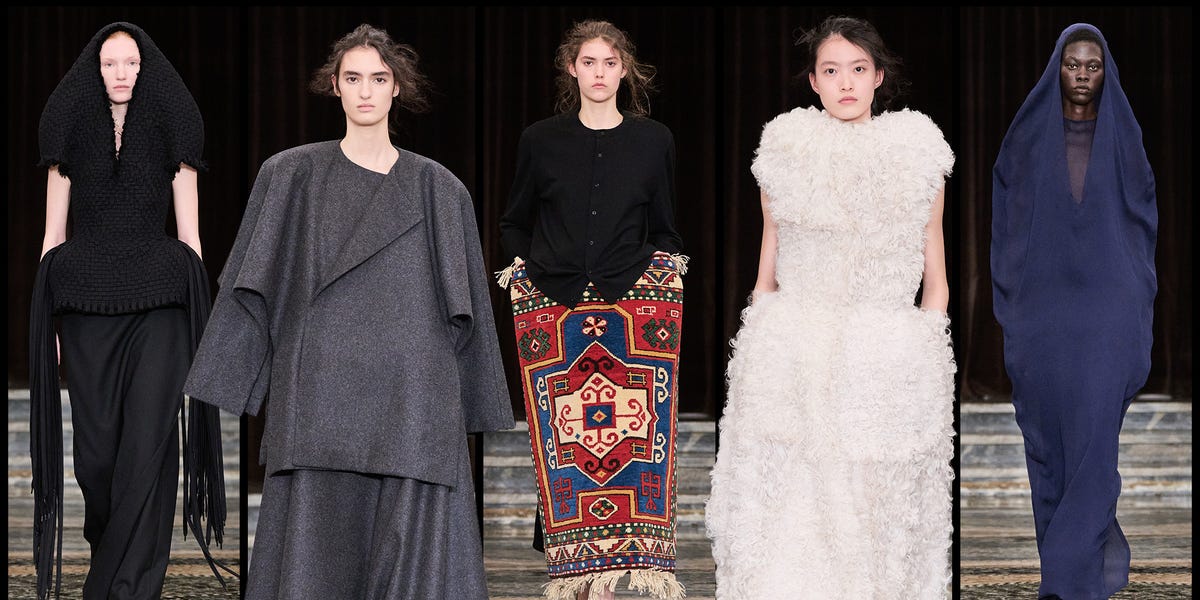
Institution’s Galib Gassanoff has always taken a unique approach to his runway collections, limiting them to 30 looks. For him, the runway is not just a place to showcase commercial outerwear or wear-everywhere tailoring. Instead, it serves as a platform for ideas and stories. His third runway collection continued his practice of elevating the traditional crafts and complex history of his birthplace, the Georgian village of Karajalar, to the fashion week stage.
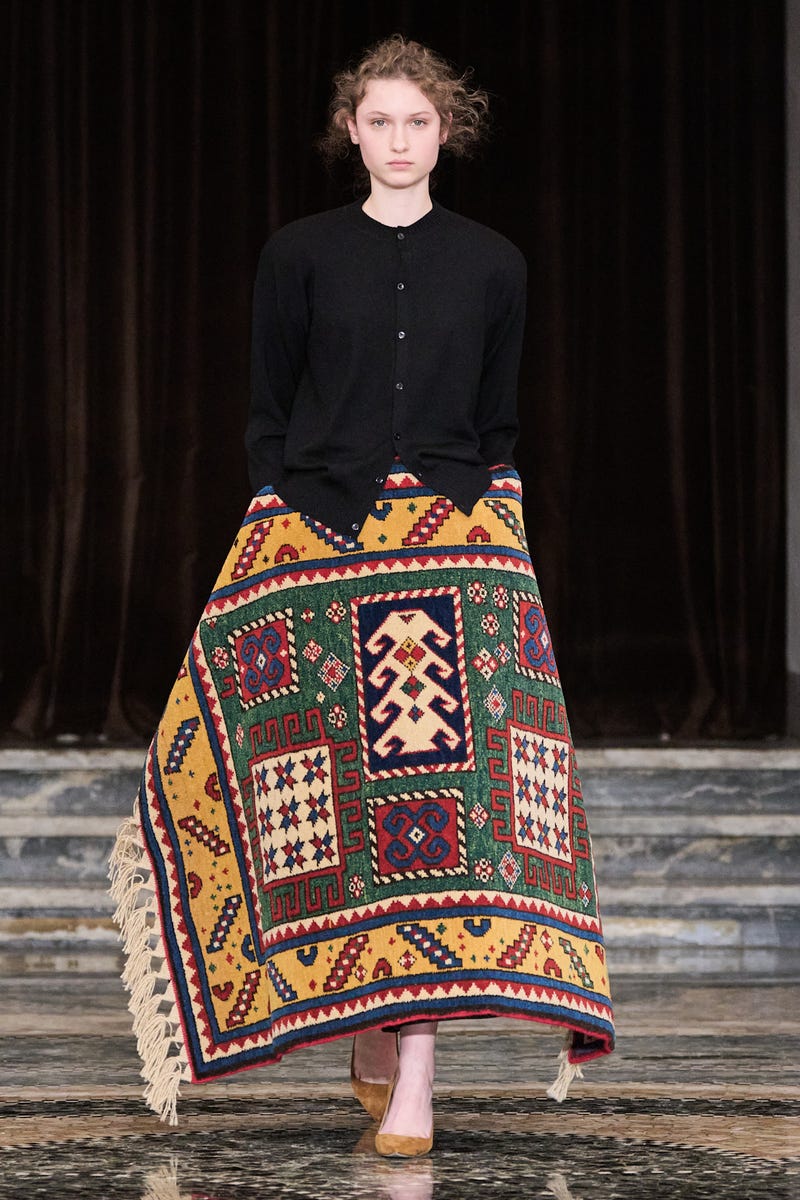
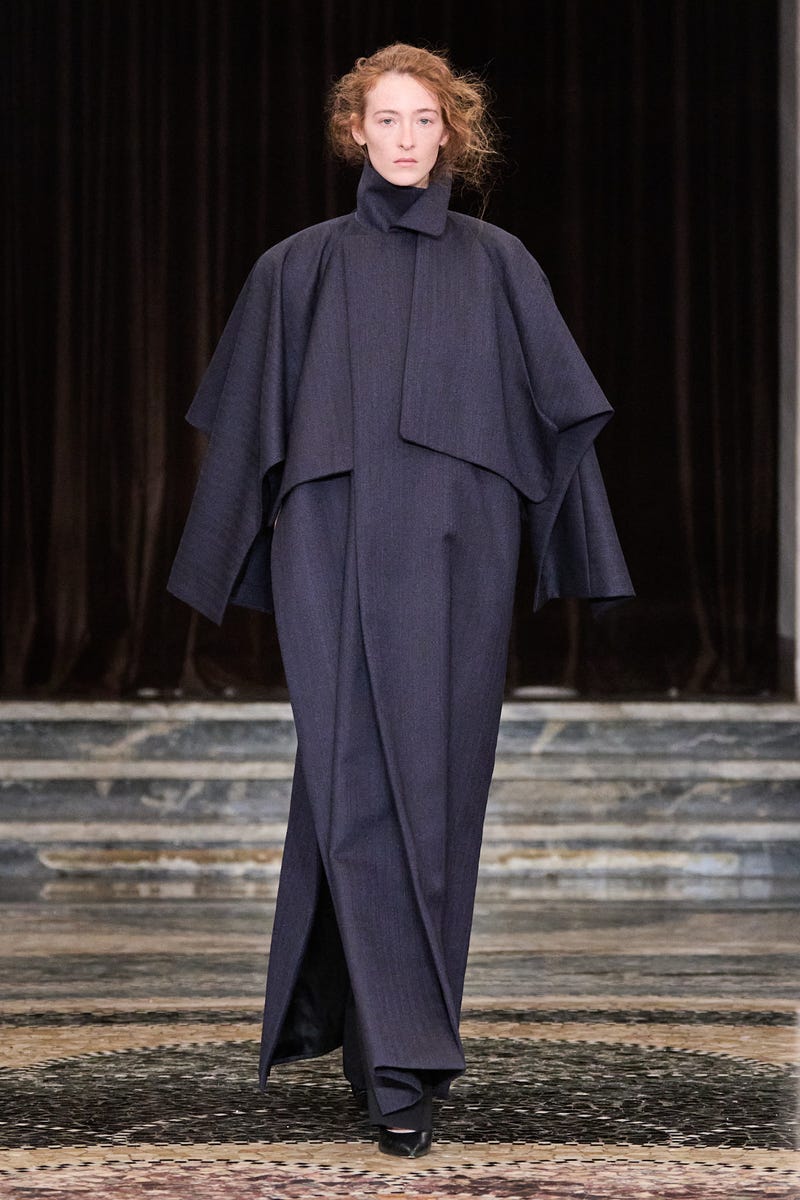
This season, the 2026 LVMH Prize semifinalist employed Azerbaijani weavers (he is also of Azerbaijani descent) to apply their labor-intensive techniques of hand-knotting on a vertical loom to three special show pieces. These carpets are easily recognizable in the collection; Gassanoff doesn’t want to disguise their origins. He lets these carpets look like carpets even when wrapped around the model like a skirt and paired with a cardigan. Surrealist takes on craft continue to take center stage throughout the collection: double-faced wool shaped into sculptural outerwear and hand-stitched shoelaces that join together to create a skirt.
The Roots of Inspiration
Gassanoff’s inspiration for this collection came from his childhood and roots. He is from Georgia with Azerbaijani roots, and that is where he began his research. He works with the community on textiles, specifically in rural areas where there is a tradition of carpet making. There will be three special pieces made in collaboration with these women in the traditional way, the same as it was done a hundred years ago. He didn’t want to only take inspiration from them. The craft of making this kind of carpet is dying, and he wants to collaborate with these makers, giving them a way to express themselves as well as inspire newer generations to start learning this craft.
In the early 20th century, when Georgia and Azerbaijan gained their independence from the Russian Empire, it was the first democratic republic in the Caucasus. Women gained independence with the right to vote and to be elected to Parliament in 1918. It was really early, earlier than many European countries, for women to have this kind of freedom. It was also a time when religion became secondary, and liberation, freedom, and expression were at the forefront. There was a woman, Peri-Khan Sofiev, who is from Gassanoff’s village, elected to the government at that time. The first Muslim woman ever elected democratically. He wanted to tell her story through this collection.
Crafting the Collection
The storyline for the collection is basically about that region, about the condition of the women, how they think, their lifestyle, and so on. Gassanoff loves ethnography and the history of clothing. He believes that everything was natural in the past, everything was handmade, and craft was so important. He thinks that the human touch is something very special we need to consider protecting.
He places a lot of value on the fabrics themselves. He sketches, yes, but he also traces patterns, cuts fabric for dresses and different garments, and most of them he tailors himself. He experiments with putting together historical and modern tailoring. He doesn’t like to just reference a couple of things and then do something that is completely different. He likes to be honest about what he’s referencing, to convey the history and craft behind it.

Draping Fabric and Shaping the Body
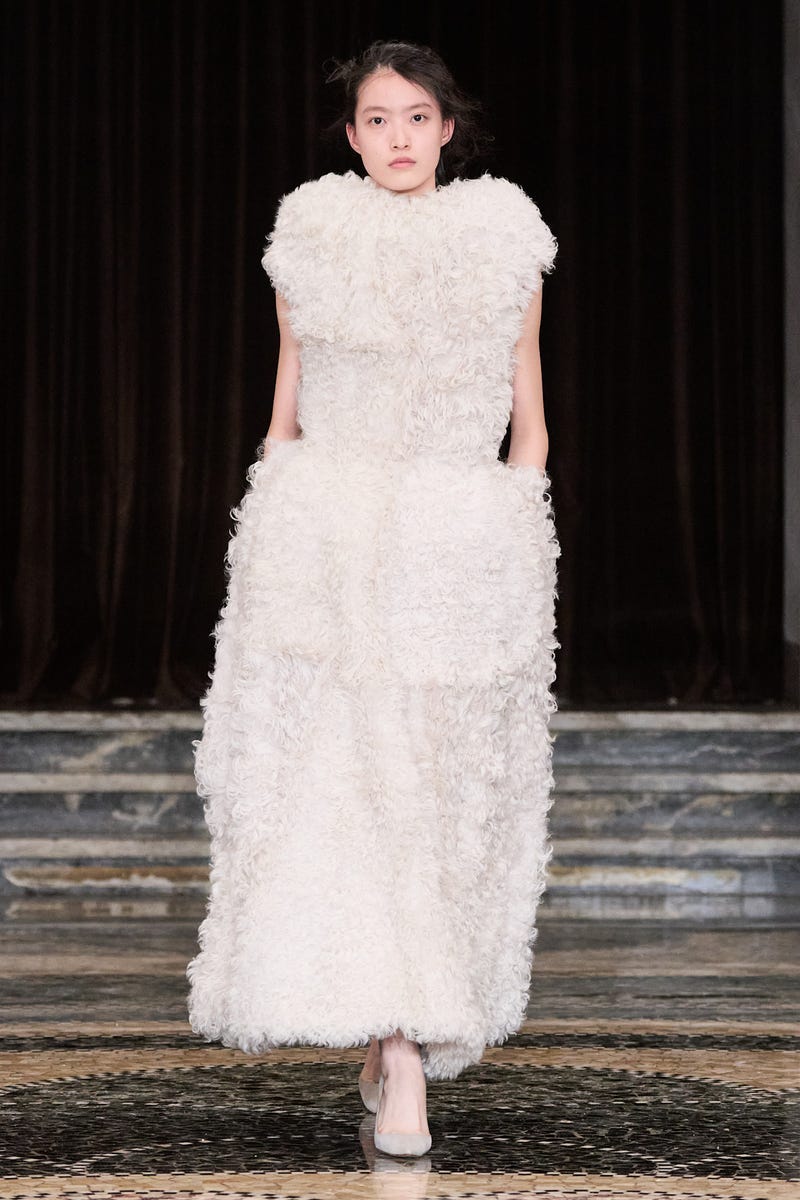
Gassanoff has done really cool shapes in his past two seasons. He thinks about draping fabric around a body by distorting or modifying the shape, but not in a way that’s disturbing. He usually tries to over-exaggerate maybe the shoulders or the hips. Growing up, there were sculptures leftover from the Soviet Union that usually depicted a woman’s body in a manner that is quite structured with metal or with concrete. He is definitely influenced by that. Other than that, there are shapes that are really informed by the fabrics he uses.
He works with the shapes that the material gives him. When he collaborates with the communities, he doesn’t push them to make something specific. They send him some photos or he sees something when he visits. They say, “Can you make this bigger? Can you make this smaller?” And so on. After that shape arrives, they see what they can do with it. But it’s their contribution.
Runway Show and Milan Experience
Gassanoff always wants to step up his runway show but doesn’t want to overdo it. He doesn’t have pressure from any outside investors looking for commercial success or fast growth at the moment, so he has the freedom of creativity. Even though it’s difficult, he is really happy doing it this way. He is happy to be able to develop freely with these rigid, heavy fabrics that he uses. And he can do his shapes without anyone telling him to do a lighter version to sell it.
Of course, there are parts of the collection with coats, dresses, etc., that can be easily wearable every day, but it’s not usually the focus on the runway because he limits it to 30 looks to tell the story properly. This season, the collection is mainly about those craftswomen that he works with. The expectations are high this time, so let’s see how it’ll go.
Navigating Milan
Working and showing in Milan is not easy because there is not much space for the younger generation. Everyone is quite concentrated on big names because there are many big-name establishments that do huge shows with commercial stakes. Also, everything is done really slowly here, but you get used to it. Other than that, it’s amazing that you have access to a huge textile industry with people who are able to make incredible things. Everyone comes here to do their samples, to do their collections. You can find anything—artisans, fabrics, factories—and that is a huge plus.
Future Hopes for the Brand
Gassanoff’s hopes for his brand include expressing himself and continuing to collaborate with these communities. His biggest dream is to be able to continue making limited amounts and selling made-to-order. This is a system he started in his way of working, working with traditional techniques, lots of handmade pieces—to produce less of something that has extreme value. These clothes become collectible pieces. He would love to be able to expand this a little more so that the brand can sustain itself and be able to sustain the communities that he works with.
He would also like to expand into other regions. At the moment, he’s working with Azerbaijan because it’s home, but he would love to explore Central Asia, to explore the Balkans, and beyond. He believes that what they do now is quite organic. It’s challenging, absolutely, but it’s very valuable. He believes that it can be an alternative future.


