
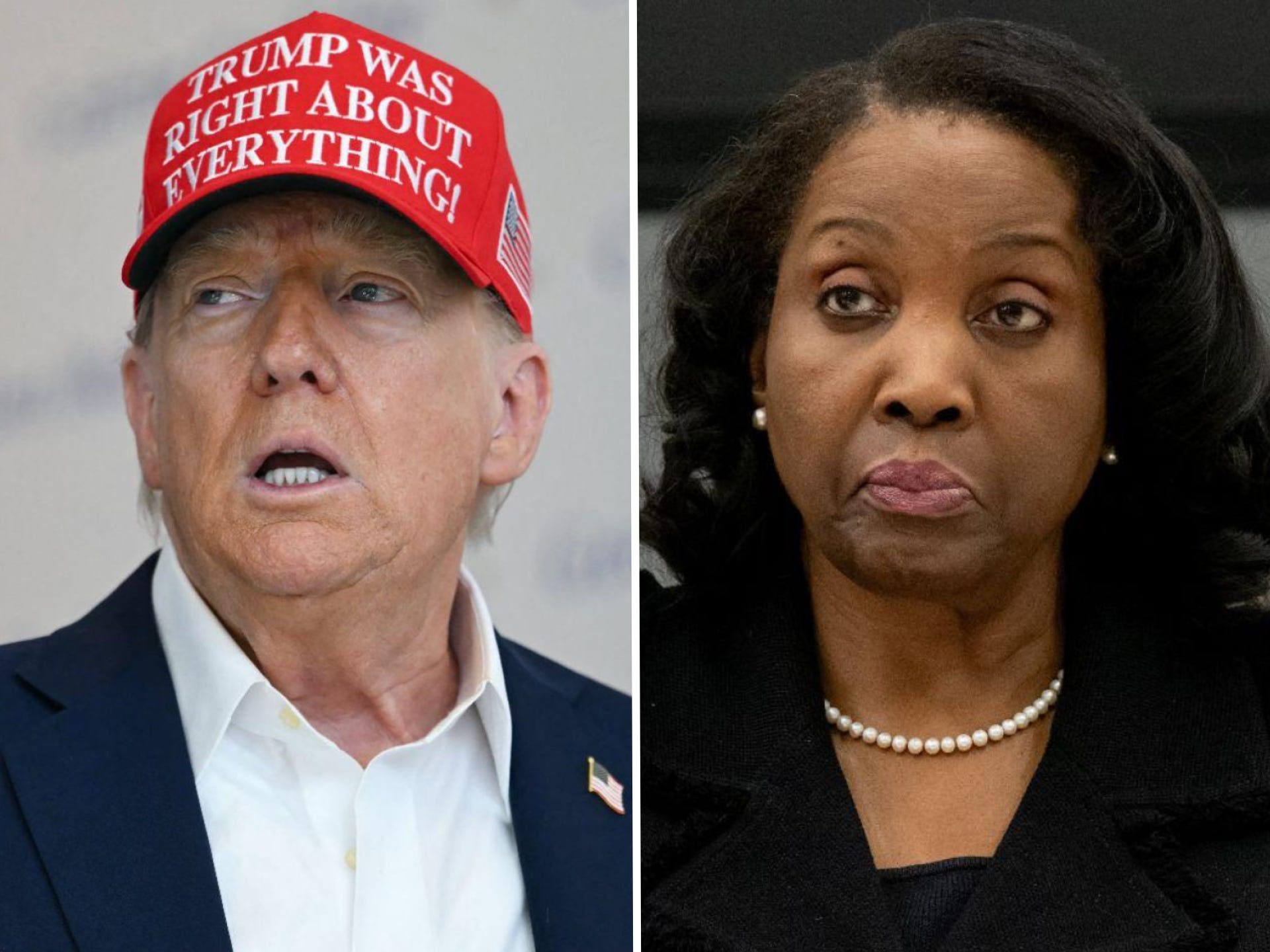
Trump’s Attempt to Remove Fed Governor Sparks Legal and Political Controversy
President Donald Trump recently announced on his social media platform, Truth Social, that he was removing Federal Reserve Governor Lisa Cook from her position. This move comes after months of public criticism directed at the Fed’s chair, Jerome Powell, and marks a significant escalation in tensions between the White House and the central bank.
Trump cited allegations made by Bill Pulte, the director of the Federal Housing Finance Agency, as the basis for his decision. In a letter posted on Truth Social, Trump stated that he was removing Cook “for cause,” effective immediately. However, Cook has firmly rejected this claim, asserting that there is no legal or factual basis for the removal.
Cook’s lawyer, Abbe Lowell, emphasized that Trump has no authority to fire her. He stated, “President Trump has no authority to remove Federal Reserve Governor Lisa Cook. His attempt to fire her, based solely on a referral letter, lacks any factual or legal basis.” Cook herself responded to the news by saying that Trump “purported to fire me ‘for cause’ when no cause exists under the law, and he has no authority to do so.”
The controversy has raised serious concerns about the independence of the Federal Reserve, one of the most critical institutions in the U.S. financial system. Investors reacted swiftly to the news, with the U.S. Dollar Index falling as much as 0.4% before recovering slightly. Benchmark 10-year Treasurys also declined, while safe-haven assets like gold saw a small increase, rising to around $3,378 per ounce.
The Legal Battle Over Cook’s Removal
Pulte, in a letter posted on X (formerly Twitter) last week, accused Cook of making false statements regarding mortgage agreements. According to Pulte, Cook had mortgages on two properties in different states and described both as her primary residence. This allegation forms the foundation of Trump’s decision to remove her, though it remains unclear whether these claims are substantiated.
Trump’s letter to Cook stated, “Pursuant to my authority under Article II of the Constitution of the United States and the Federal Reserve Act of 1913, as amended, you are hereby removed from your position on the Board of Governors of the Federal Reserve, effective immediately.” However, this assertion has been met with strong resistance from Cook and her legal team.
Cook, who was appointed by President Joe Biden in 2022, is the first Black woman to serve on the Fed’s board. Prior to her role at the Fed, she was a professor at Michigan State University. Her removal has sparked a broader debate about the limits of presidential power over independent agencies.
A Potential Supreme Court Conflict
Trump’s attempt to fire Cook puts him on a collision course with the Supreme Court. While the Court has previously allowed Trump to temporarily remove members of other independent agencies, such as the National Labor Relations Board and the Merit Systems Protection Board, the situation with the Federal Reserve is unique. The Fed is structured differently, with specific provisions that allow for the removal of governors only for cause.
In a recent opinion, the Supreme Court noted that the Fed follows a “distinct historical tradition” and is considered a “quasi-private entity.” This distinction may influence how the Court rules on Trump’s attempt to remove Cook. However, the outcome of the legal battle remains uncertain.
Implications for the Federal Reserve
The Fed is scheduled to meet in the coming weeks, and its Open Markets Committee has procedures in place to handle situations where a governor is unable to participate. It is still unclear how the Fed will navigate this crisis, particularly given the high stakes involved.
Meanwhile, Fed Chair Jerome Powell has reaffirmed the central bank’s commitment to making decisions based solely on economic data and the needs of the broader economy. During a recent speech at the Jackson Hole Economic Policy Summit, Powell emphasized that the Fed would not be influenced by external pressures, stating, “We will never deviate from that approach.”
Despite the uncertainty surrounding Cook’s removal, the Fed has maintained its focus on maintaining stability in the financial system. However, the ongoing conflict between the White House and the central bank raises important questions about the balance of power and the independence of key institutions in the U.S. government.


