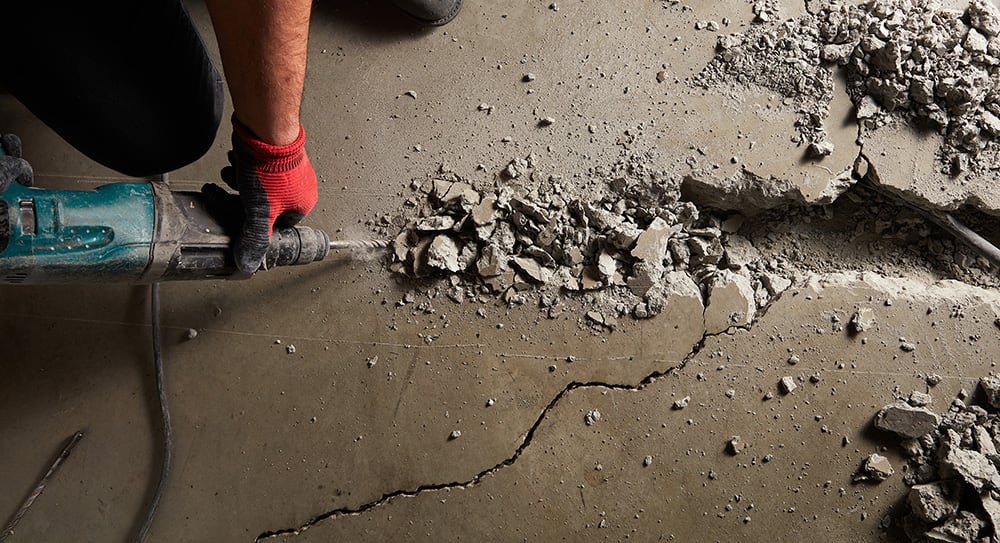
At 2 p.m. on the 4th, a man in his 40s, Mr. A, armed with a weapon, went upstairs in an apartment in Ssangyong-dong, Seobuk-gu, Cheonan. He attacked a man in his 70s, Mr. B, who lived directly above, and Mr. B, who fled to the apartment management office with stab wounds, eventually died. At the time, interior construction work, including on the balcony, was reportedly underway at Mr. B’s home. Police arrested Mr. A on suspicion of murder, believing he committed the crime due to dissatisfaction with noise from the interior construction.
Mr. A is not the only one who has resorted to violence over interior construction noise. In August, a man in his 40s, Mr. C, was arrested by police on charges of special threat after brandishing a weapon at a neighboring household in an apartment in Jungnang-gu, Seoul, complaining about construction noise. On the 5th, Judge Jeong Soon-yeol of the Busan District Court’s Criminal Division 11 sentenced a man in his 30s, Mr. D, who threatened workers at an interior construction site due to noise from upstairs, to six months in prison on charges including special threat. Truly, interior construction has become a matter of life and death.
◇‘Housegram’: Everyone is Renovating
Demand for home interior renovations exploded during the COVID-19 period, when people spent more time at home due to remote work. The domestic interior market, which was worth 9 trillion Korean won in 2000, grew to 60 trillion won by 2022 (Construction and Economy Research Institute of Korea). Online, a culture of “online housewarming parties” targeting the public has taken root, where people showcase their homes. Known as “Housegram,” searching the hashtag on Instagram yields 5.89 million posts. Mr. Park (38), a company employee living alone in a 59-square-meter (approximately 18 pyeong) apartment in Seodaemun-gu, Seoul, renovated his home three years ago. Mr. Park said, “Previously, I didn’t invest much in my home, thinking, ‘I’ll decorate it nicely after marriage.’ But after the COVID-19 period, I realized that home is where I spend the most time. I gathered my courage and spent about a month renovating.”
Startups like ‘Ohouse’ and ‘Aptmentary,’ based on interior design, also grew during this period. ‘Ohouse’ connects interior companies and sells home appliances and furniture based on “online housewarming parties” such as “How We Renovated Our 24-Pyeong Apartment.” Last year, its sales reached 287.9 billion Korean won, and net profit was 5.26 billion Korean won, up 22.3% and 127.4% year-on-year, respectively. ‘Aptmentary,’ which ushered in the “era of 3 million Korean won per pyeong interior design,” is also growing rapidly. The company, particularly popular in Gangnam’s three districts, saw sales increase 70-fold from 900 million Korean won in 2016 to 64.5 billion Korean won last year and recently expanded to Hong Kong.
A real estate agent in Gangnam, Seoul, said, “Recently, how much time can be secured for interior work before moving in has become a key issue between sellers and buyers.” In such cases, it is important to coordinate details such as when to pay the balance, how to handle management fees, and who is responsible if defects occur.
◇Anyone Can Renovate with Resident Consent
The problem lies in the noise. Recent interior construction goes beyond simple tasks like wallpapering or installing sinks, resembling new construction sites with partition wall removals, bathroom tile and woodwork, and electrical installations. Engineered wood flooring, commonly used nowadays, is firmly adhered with glue, requiring specialized machinery for removal. Floor removal and installation, adjacent to the ceiling of the floor below, cause not just loud noise but also vibrations and tremors akin to an earthquake, as reported by residents downstairs.
Legally permissible noise levels are up to 65 decibels (dB) on weekdays from 9 a.m. to 6 p.m.—louder than a telephone ring (60 dB) but quieter than a busy street (70 dB). However, even if exceeded, it is not easy for individuals to gather evidence and file reports. Mr. Jeon (61), who lives in a 20-year-old apartment in Jongno-gu, Seoul, said, “Three households in the same building have done interior work in the past three months.” Measuring noise with a mobile app, he sometimes recorded peaks of 70 dB, but he endured by going to a nearby cafe for hours, thinking, “The reporting process is complicated, and the work will end in a few weeks anyway.”
Most interior construction requires only a report to the apartment management and resident consent. While varying by apartment, construction is generally allowed if more than 60% of residents agree. According to interior companies, although noise is unwelcome, achieving a 60% consent rate is not difficult. There is a general understanding that “we can also renovate whenever needed,” and people avoid confrontations with new neighbors.
Some residents still refuse consent due to noise. A company official said, “Most households are dual-income and away during the day, or they don’t open the door to strangers, so we leave consent forms at the door and ask them to sign and return.” However, some crumple or tear the forms and leave them at the door.
◇Requests to Avoid Construction Before CSAT
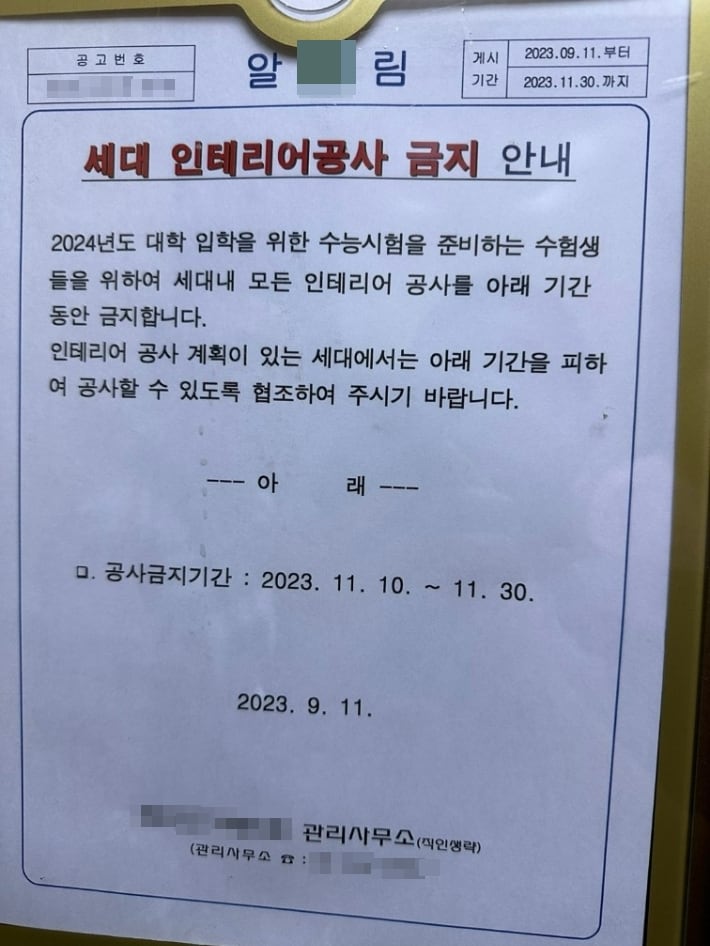
In some apartment complexes, especially in academic districts like Daechi, Yeoksam, and Dogok-dong, it is an unwritten rule to avoid interior construction before the College Scholastic Ability Test (CSAT). For several years, notices like “Please refrain from interior construction until the CSAT” have been posted in elevators. Third-year high school students often return home early about one to two weeks before the CSAT to study, and residents request consideration. Nowadays, even without notices, there is a atmosphere of voluntarily minimizing construction during exam periods.

Construction noise also affects pets left alone. While people go to work or school, pets cannot. A few years ago, an online community post went viral: “When I said I was doing interior work, they asked for pet hotel fees.” The post described a request from downstairs for 3 million Korean won in pet hotel fees—150,000 Korean won per day for 20 days—because their dog was sensitive to noise. While most reacted that the demand was excessive, many pet owners worry about their animals enduring noise and vibrations in empty homes. Ms. Lee (35), who lives in Eunpyeong-gu, Seoul, said, “During the upstairs’ interior work, I saw via home camera that my dog was startled. I later sent the dog to my parents’ home to avoid the noise.”
◇Detailed and Courteous Construction Reduces Conflict
Director Pyo Seung-beom of the Joint Housing Culture Research Institute said, “The more detailed and courteous the construction, the less conflict between neighbors.” He advised specifying schedules like, “On [date] from 1 p.m. to 3 p.m., we will remove the floor, which may cause loud noise,” and sharing them in advance. Construction companies often change schedules without notice, but since this is a mutual agreement, they must adhere to it.
Director Pyo added, “The most infuriating interfloor noise is unexpected, catching residents off guard.” Advance notice allows people to plan, such as going out during that time, avoiding extreme conflict. It is also advisable to avoid construction during periods when people stay home more, like exam seasons. “Noise perception depends on sensory organs, which can be more sensitive or subjective depending on the situation,” he said.
Construction sites should also minimize noise. Workers should avoid leaving doors open for convenience or playing loud music. Preparing small gifts for adjacent neighbors can also help.