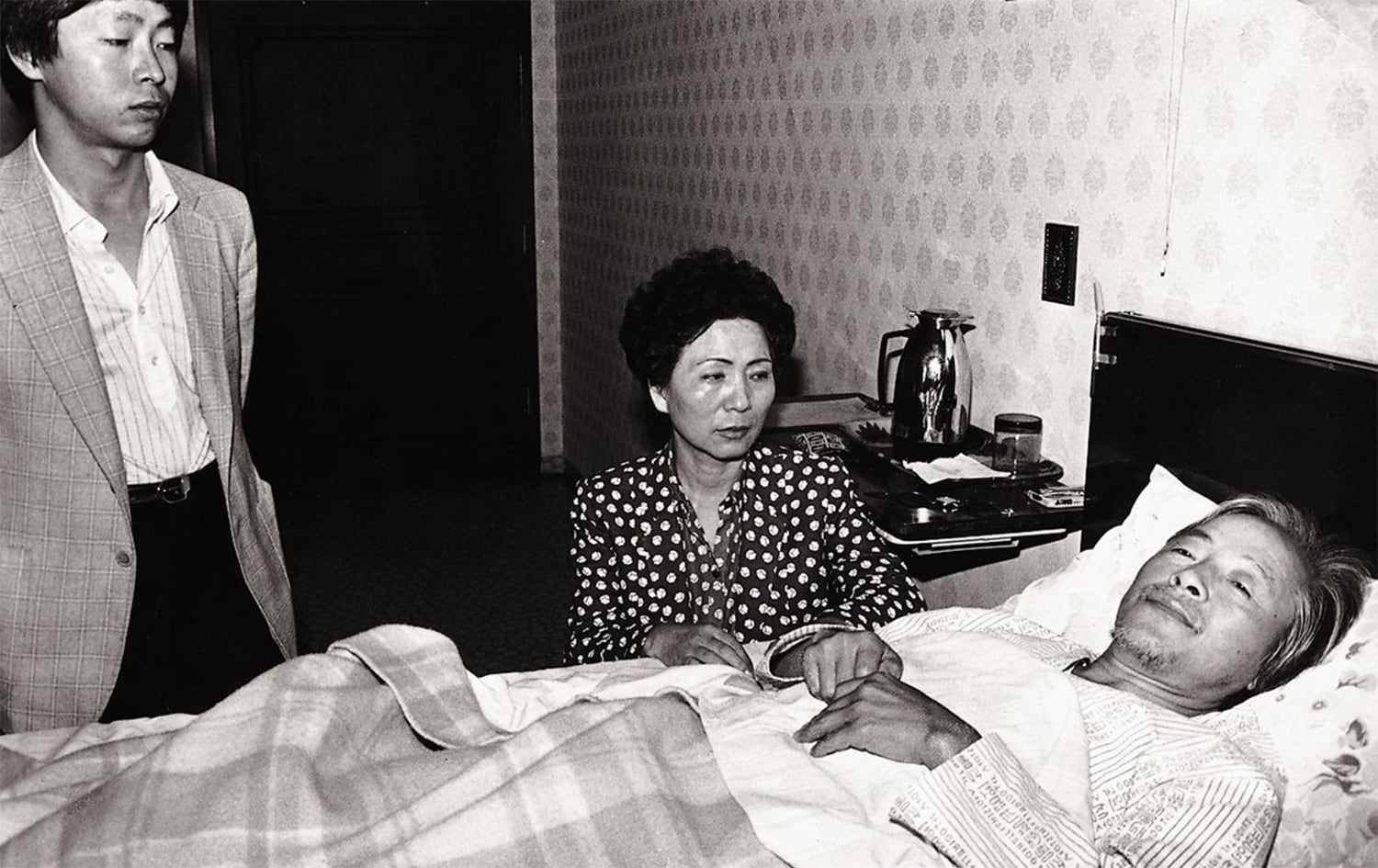
The Hunger Strike of Kim Young-sam: A Defiant Stand for Democracy
Kim Young-sam, a prominent opposition leader in South Korea, embarked on a hunger strike at his home in Sangdo-dong, Seoul, on May 18, 1983. This act marked the third anniversary of the Gwangju Democratization Movement, a pivotal moment in the country’s struggle for democracy. His second house arrest, which began on June 1, 1982, had lasted nearly a year. YS informed foreign media of his hunger strike and expressed his resolve in his diary, stating, “If I become a martyr for the people and democracy of this country, I will consider myself happy.”
The Struggle Continues
On May 29, Kwon Ik-hyun, secretary-general of the Democratic Justice Party, visited YS to inform him that his house arrest would be lifted, allowing him to travel abroad. However, YS rejected the offer and continued his fast for 23 days until June 9. After the hunger strike, YS jointly issued a statement with Kim Dae-jung (DJ), who was in exile in the U.S., on August 13, ahead of National Liberation Day, calling for an anti-dictatorship struggle. YS then formed the National Democratic Alliance (Minjungchuyihoe) with DJ’s Donggyo-dong faction and joined the democratization movement.
Diary Entries from a Defiant Leader
The 1983 diary of YS spans from April 28 to October 16, offering a glimpse into his thoughts and experiences during a tumultuous period.
May 28, 1983
It has been nearly 11 months since my house arrest began illegally on June 1, 1982. I received many calls today: from Park Yong-man, Kim Dong-young, Moon Bu-sik, and Kim Young-myung, head of the Hallelujah Children’s Soccer Team.
May 5, 1983
The Asahi Shimbun of Japan called. They said they received a call asking to confirm whether it is true that I am processing procedures at the Ministry of Foreign Affairs to go to the United States with my family. It is truly absurd. It is a story not worth a moment’s consideration. At 1:50 p.m., a civilian passenger plane from Communist China made an emergency landing on the central front.
May 6, 1983
The Communist Chinese civilian aircraft was hijacked by six kidnappers, including one woman, who demanded to be taken to Taiwan, and made an emergency landing near Chuncheon. The plane was traveling from Shenyang, Manchuria, to Shanghai, and it was confirmed that 105 passengers were on board.
May 7, 1983
Around 12:30 p.m., Shen Tu, director of the Communist Chinese Civil Aviation Administration, arrived in South Korea with a delegation of 33—marking the first visit since the establishment of the Communist Chinese regime—to discuss the repatriation of passengers, crew, the aircraft, and the hijackers.
May 14, 1983
While under house arrest for nearly two years under a dictator, I realized much in terms of religion. Truly, humans should live for the people and neighbors. I can endure this pain because I am following my conscience, fighting for justice, and for the people’s freedom.
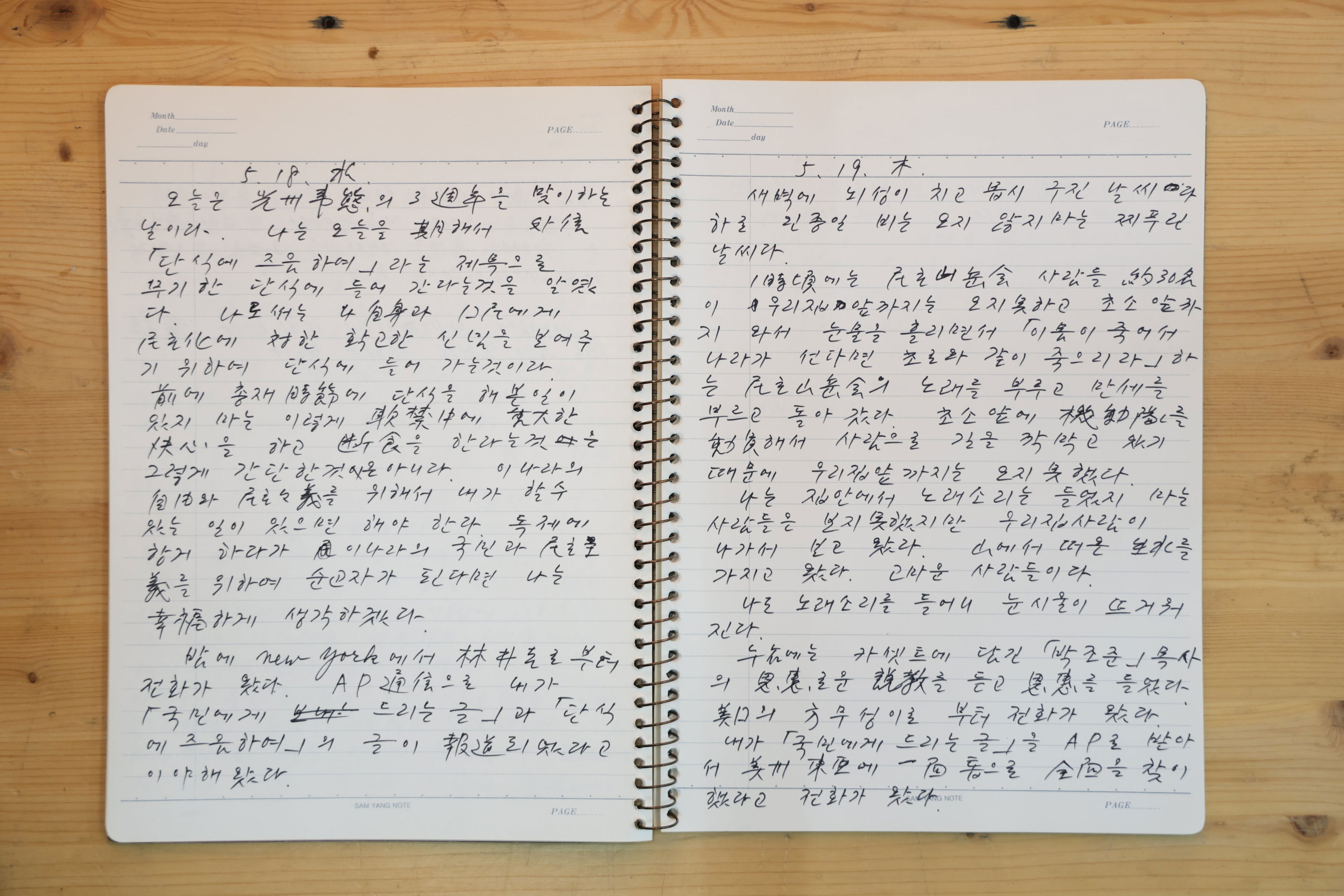
May 17, 1983
I did something historic today. For nearly a month, I devoted all my strength to writing “A Message to the People” and released it to foreign media. AP covered it in a long article, and Reuters in a short one. After releasing it, I felt immensely relieved. I consider it an honor to become a martyr under this dictatorship’s oppression.
May 18, 1983
Today marks the third anniversary of the Gwangju Incident. I informed foreign media that I am beginning an indefinite hunger strike under the title “On the Occasion of the Hunger Strike.” If I become a martyr for the people and democracy of this country while resisting dictatorship, I will consider myself happy.
May 19, 1983
Around 1 a.m., about 30 members of the Democratic Mountain Climbing Association came as far as the checkpoint in front of my house, singing their song, “If my body dies and the country rises, I will die like dew,” and shouting slogans before leaving. They could not reach my house because riot police blocked the road. Hearing their song, my eyes grew hot.

May 22, 1983
I also received a call from my father. I lied to him, saying I was no longer fasting.
May 24, 1983
Today marks the seventh day of my hunger strike. My weight has dropped significantly, and I feel weak. Sometimes I experience dizziness and a mild fever.
May 25, 1983
Today is a day I will never forget. Around 9 a.m., 300 police officers under the command of the Noryangjin Police Station chief completely surrounded my house and forcibly transported me to Seoul National University Hospital in an ambulance. Doctors came with treatment and food, but I firmly refused everything.
At 9:30 p.m., Kwon Ik-hyun arrived. He said Chun Doo-hwan is concerned about my health and requested me to end the fast. I categorically refused.
May 27, 1983
At 9:30 p.m., Kwon Ik-hyun came and left again. He said my fast has reached 10 days, and 90% of my goals have been achieved, so I should accept treatment and food for my health. Of course, I firmly refused. I also told him that the regime cannot maintain power without democracy.
May 29, 1983
Today marks the 12th day of my hunger strike. News from the U.S. is pouring in. Starting Monday, many overseas Koreans will begin a hunger strike in front of the U.S. State Department. In the evening, Kwon Ik-hyun came and left again. He notified me that my house arrest would be lifted at midnight. He said I am free to go anywhere—Britain, Japan, or the U.S. He added that all this was Chun Doo-hwan’s decision.
June 1, 1983
About 70 people gathered at the Korea Hotel at 10 a.m. and issued a Democratic National Salvation Declaration. It supported my five demands and urged me to end my fast. I said I appreciate their intentions but cannot bend my will.
June 3, 1983
Today marks the 17th day of my hunger strike. Yun Po-sun and Cardinal Kim Soo-hwan visited. Yun requested me to stop fasting for my health, and the cardinal held me for over 10 minutes without speaking. He prayed twice and asked me to take care of my health.
June 5, 1983
Yesterday, about 70 people demonstrated in front of the White House and the South Korean embassy. Kim Dae-jung participated. It was reported on U.S. TV.
June 7, 1983
Today marks the 21st day of my hunger strike. In the morning, I received a call from the U.S. Senator Kennedy called the South Korean ambassador yesterday for a long time, urging him to accept my demands for my safety and make it public.
June 9, 1983
Today marks the 23rd day of my hunger strike. At 9:30 a.m., I held a press conference. Of course, I could not attend directly, so I had a statement read instead. Surprisingly, Korean newspapers reported that I ended my 23-day fast. The Chosun Ilbo and Dong-A Ilbo covered it relatively well, with the Chosun Ilbo doing the best job.
June 10, 1983
Dear fellow citizens (summary of statement):
I announce the suspension of my hunger strike with a heavy heart today. I am not ending my fast to live disgracefully. Rather than dying while sitting, I will die fighting on my feet. I have already resolved to die and will lead the democratization struggle with the courage and conviction to choose death. My struggle has not ended; it has just begun. One day, I want to shout “Long live democracy” with the people. For that, I will walk the path of hardship given to me. June 9, 1983. Kim Young-sam
June 15, 1983
A week has passed since I ended my fast. Kim Deok-ryong, my secretary, was taken to the KCIA on the 13th, and there is no news of him as of today. This proves it is a barbaric country.
June 26, 1983
Moon Bu-sik was detained for 10 days yesterday. This brings the total to six people—including my secretary—who have been imprisoned or detained due to my hunger strike.
June 30, 1983
Today is a historic day for me. It has been 43 days since I began my fast on May 18 and 37 days since I was forcibly moved to the hospital. I held a press conference at 8:30 a.m. Korean newspapers reported it. For the first time, my house arrest was covered. I boarded a car amid applause from party members and camera flashes, feeling overwhelmed with emotion.
July 3, 1983
Today is Sunday. I was able to go to church for the first time in 14 months. Many congregants waited to see me outside the church. They are grateful people.
July 7, 1983
I visited Kim Dong-young’s home and talked with Lee Min-woo for over two hours about the Democratic People’s Council. We seriously reviewed it from various angles. It should proceed openly for the country’s democratization, not privately.
July 12, 1983
Kim Cheol and Representative Choi Hyung-woo visited in the morning. In the afternoon, I ate noodles with hardworking party members and talked. About 20 members, including Senior Advisor Lee Kyoung-hwan and Kim Jong-soon from Busan, came up and had fruitful discussions about democracy.
July 13, 1983
I am pleased that the Mainichi Shimbun of Japan detailed my press conference on its Monday, July 11, edition, covering nearly two-thirds of the front page.
July 19, 1983
Representative Kim Sang-hyun came for lunch and discussed unifying with Kim Dae-jung’s faction before leaving.
August 1, 1983
At 10 a.m., I left Seoul for the Dogo Hotel. It has been a long time since I traveled with my family. My wife, Hyun-cheol, and Hye-suk joined me, and we arrived in Dogo after two hours, enjoying the beautiful scenery.
August 4, 1983
I received a call from Lim Jeong-gyu in New York. He said my press conference was reported in a large article on page 2 of the August 2 New York Times.
August 7, 1983
This government shocked the people again by issuing an air raid alert. A Communist Chinese MiG-21 pilot defected. I am truly frustrated thinking about how much they will hype and propagandize this.
August 13, 1983
At 8:30 a.m., I held a historic press conference at home. At the same time, Kim Dae-jung held a joint press conference in Washington. I do not know about other outlets, but Japanese newspapers reported it as front-page top news.
August 18, 1983
Representative Kim Sang-hyun came for lunch and we talked. In the evening, there was a prayer meeting for the release of detainees hosted by the NCC at a Christian hall. I gave a speech for the first time in a long while and read the joint press conference statement with Kim Dae-jung. I was warmly welcomed.
August 21, 1983
Aquino was assassinated by soldiers as she stepped off a plane in the Philippines. I am truly shocked that such a thing could happen. It is a tragedy and misfortune for humanity fighting for justice. Dictatorship must perish.
August 23, 1983
A politician dies for the country—it is an honor. Aquino will remain an eternal hero in Philippine history and among its people. While the Philippine people, global democrats, and peace lovers mourn, her death is glorious for her personally.
September 1, 1983
A tragic incident occurred today. A KAL flight was shot down by a Soviet missile, killing all 269 passengers and crew. It is natural for the world to be angry at the communist dictatorship that attacks unarmed planes with missiles. Such incidents happen because they do not respect human rights.
September 6, 1983
I paid respects at the KAL flight memorial altar in Yeouido. Many people welcomed me.
September 27, 1983
I held a press conference at 9 a.m. Lee Min-woo, Lee Ki-taek, Kim Nok-young, Kim Cheol, Park Han-sang, Hwang Nak-ju, Hong Young-gi, Kim Myung-yun, Lee Jong-nam, Park Yong-man, Jo Yeon-ha, Park Chan, Kim Sang-hyun, Choi Hyung-woo, Kim Sang-jin, Kim Dong-young, Park Chan-jong, Park Jong-ryul, Moon Bu-sik, Jeong Jae-won, Kim Dong-wook, and Ahn Pil-soo signed the statement. I think they did a great job for the country’s democratization.
October 9, 1983
News came that many people in Chun Doo-hwan’s delegation to Burma were killed. It is unfortunate. Such incidents prove the need for democracy.
October 11, 1983
I visited the memorial altar for the deceased with Lee Min-woo, the party leader, and about 20 others.

Related posts:

Mother Suffers Daily Allergic Attacks After Drinking Contaminated Coffee Syrup


Challenges of Climate Change in Africa and Lessons from China’s Green Revolution

Senate joint committee finally holds hearing on Ivanhoe deal

True measure of leadership lies not in power, privilege, pageantry – Tinubu at book presentation