The Rise of Green Finance in Ghana
In August, the Bank of Ghana introduced its Sustainable Banking Principles, encouraging banks to support projects that protect the environment while driving economic growth. At the same time, the world’s largest climate fund, the Green Climate Fund (GCF), reported that more than $12 billion had been committed to green projects globally. These developments highlight that the resources needed to build a cleaner and more resilient Ghana are already available. The real challenge lies in accessing them.
Green finance refers to money that is used in ways that protect the environment and combat climate change. It involves investing in projects that help nature rather than harm it, such as planting trees, using solar power, recycling, or building clean transportation systems. In essence, green finance is about making profit with a purpose—ensuring environmental protection alongside economic growth.
Why Green Finance Matters for Ghana
Ghana is already experiencing the impacts of climate change. Coastal erosion, droughts in the north, rising energy costs, food insecurity, and unemployment are all pressing issues. These challenges underscore the need for new, innovative ways to finance sustainable growth. Globally, over $1.3 trillion flows into sustainable finance and climate-related investments each year. Institutions like the World Bank, African Development Bank (AfDB), and GCF are actively seeking strong proposals from countries like Ghana. Governments, businesses, and individuals alike can position themselves to benefit from these opportunities.
Key Areas for Green Finance in Ghana
There are several practical areas where green finance could transform Ghana’s economy:
- Energy – Expanding solar and wind power can reduce electricity costs, decrease reliance on imported fuel, and create jobs in renewable industries.
- Agriculture – Green loans for irrigation, climate-smart seeds, and mechanization can help farmers secure reliable harvests despite changing rainfall patterns.
- Transport – Financing electric buses or trains can cut traffic pollution and reduce dependence on imported fuel.
- Waste Management – Green funding can support recycling plants, composting facilities, and biogas initiatives, turning waste into valuable resources.
- Forestry & Land Use – Carbon credit programs can incentivize communities to protect forests while earning income from international buyers.
For ordinary Ghanaians, this isn’t just abstract. Imagine your local school powered by solar panels, your bank offering green bonds you can invest in, or your business cutting electricity costs through a renewable energy loan.
Mechanisms of Green Finance: How the Money Flows
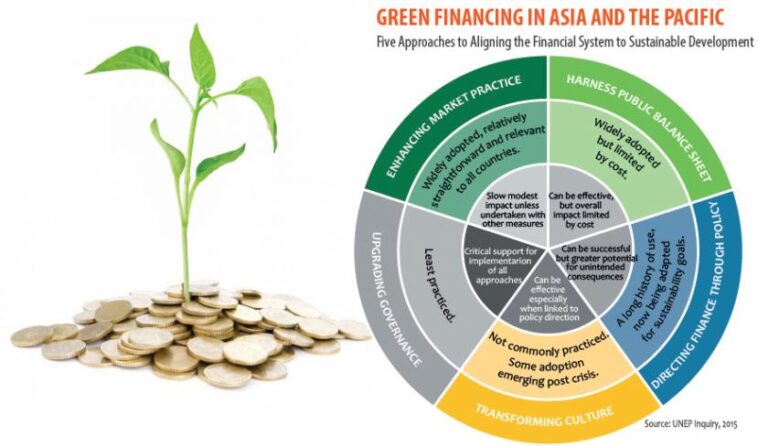
Green finance comes alive through practical tools and partnerships. Here’s how the money actually moves:
-
Green Bonds – These are special bonds issued by governments, banks, or companies to raise funds for environmentally friendly projects. The money is strictly used for green initiatives like renewable energy, waste management, or sustainable transport. Nigeria issued Africa’s first sovereign green bond in 2017, using it to finance solar power and afforestation projects. Ghana can follow this model by issuing green bonds to fund solar mini-grids in rural areas, electric bus systems in cities, and large-scale reforestation along degraded forest belts.
-
Green Loans & Credit Lines – These are loans offered on favorable terms to businesses or households that meet sustainability goals. For instance, Consolidated Bank Ghana’s SME loan schemes could be adapted to support energy-efficient equipment, solar installations, or recycling machinery, while the Development Bank Ghana (DBG) can open a dedicated green credit window for renewable energy startups and climate-smart agribusinesses. This would help local entrepreneurs access capital to grow green enterprises that create jobs and reduce environmental harm.
-
Carbon Markets & Credits – These are systems that allow countries, companies, or communities to earn money by reducing or removing carbon emissions. For example, if a community plants trees or protects forests, the amount of carbon those trees absorb can be measured and sold as “carbon credits” to countries or businesses that want to offset their emissions. Ghana is already pioneering this. In 2023, Ghana signed the first Article 6 carbon trading deal with Switzerland, creating a framework for selling verified emission reductions. This can bring in millions of dollars in foreign exchange while rewarding climate-smart projects like renewable energy, reforestation, and clean cooking initiatives. For local communities, this means jobs and direct income from protecting nature.
-
Climate Funds & Grants – Global institutions like the Green Climate Fund (GCF), Global Environment Facility (GEF), and Adaptation Fund provide concessional financing for climate projects. These funds are accessible not only to government ministries but also to private companies, NGOs, and development partners. Ghana recently secured $120 million in GCF support to strengthen agriculture and water resilience in the northern regions; proof that well-prepared proposals can attract significant global funding.
-
Public–Private Partnerships (PPPs) – Governments can use guarantees, incentives, or risk-sharing arrangements to attract private investment into clean energy and sustainable infrastructure. For example, mini-grid projects in the Volta and Northern regions could be jointly financed by the Energy Commission, Electricity Company of Ghana (ECG), and private renewable energy developers. These partnerships can expand access to electricity while reducing the fiscal burden on government.
-
Insurance & Risk-Sharing Mechanisms – These are financial tools that help people, businesses, or governments share or transfer the risk of losses caused by climate-related events such as floods, droughts, or storms. In simple terms, they make sure that when disasters strike, no one bears the full cost alone. Green finance can make such products more affordable and widespread. For example, expanding the Ghana Agricultural Insurance Pool (GAIP) with climate-linked insurance can protect farmers against failed harvests, helping them bounce back faster from droughts or floods. It ensures financial stability for farming communities and strengthens Ghana’s food systems against climate shocks.
Lessons from Elsewhere
Malaysia in the 1970s was not too different from Ghana today; a developing country dependent on commodities like rubber and tin, seeking to industrialize and attract investment. But it made smart financing choices: channeling funds into infrastructure, renewable energy, and export-oriented industries. Today, Malaysia is a manufacturing and green technology hub. Ghana, too, can rise if we use tools like green finance to turn today’s vulnerabilities into tomorrow’s strengths.
The Road Ahead
Green finance is more than a global trend; it is a survival strategy. For Ghana, it offers a chance to:
- Lower debt pressures by using concessional green funding.
- Create new industries and jobs in renewable energy, transport, agriculture, and waste management.
- Build resilience against climate shocks while raising living standards.
The opportunity is on the table. Billions of dollars are waiting to be accessed. The only question is whether Ghana, government, businesses, and citizens alike, will step forward to claim it.


