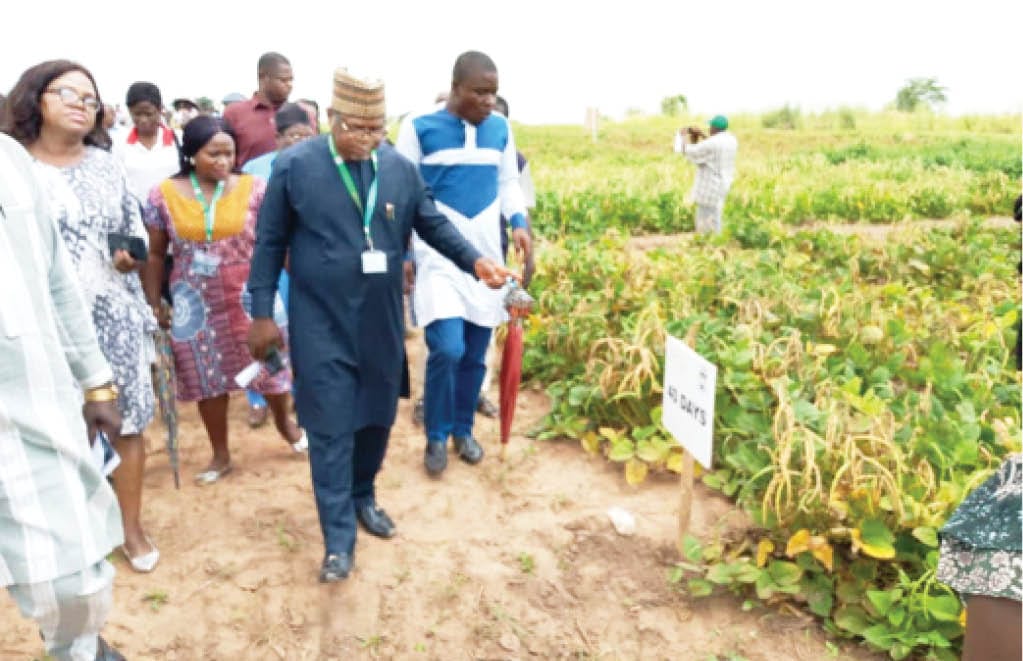
Farmers in Benue State Face Uncertain Cowpea Harvest
As the rainy season gradually comes to an end, farmers in Benue State are bracing for a mixed outcome from their cowpea harvest. The transition from wet to dry conditions has brought both hope and concern among local farmers, who are now preparing for the next phase of agricultural activities.
Our correspondent spoke with several cowpea farmers across the state, revealing a wide range of perspectives on this year’s harvest. While some remain optimistic about achieving a good yield, others express concerns over the impact of persistent rainfall in October, which may affect production negatively.
Margaret Elijah, a cowpea farmer in Otukpo, shared her worries about the current state of her crop. Despite planting at the right time and applying necessary chemicals, she noted that disease and pest infestations have taken a toll on her fields. “The rain appears to have ceased in my area, but my crop, which is now podding, shows disturbing infestations,” she said. “I planted the crop at the right time, as I always do, and applied necessary chemicals; however, it’s not turning out well. So, I’m likely not going to have a good harvest.”
Peter Agera, a Makurdi-based cowpea farmer, described his situation as a “mixed bag.” He explained that one of the varieties he planted—40-day type—was affected by excessive rainfall during its flowering stage. “The pesticides we normally apply to ward off insects were consistently washed away by the rain,” he said. “For instance, we would spray today, and the rains would wash it off the following day, which affected the crop.”
However, Agera remains cautiously optimistic. He mentioned that other varieties, which are currently flowering, may fare better as the rains recede. “Cowpeas do not like too much rain, except for some varieties meant for the rainy season. But this particular one is a dry season variety, so the excessive rainfall in October actually affected those that were supposed to produce during this period. Looking ahead, those now flowering do not have any issues because the rains are going down.”
Desmond Terngu, whose cowpea farm in Katsina-Ala is nearing harvest, believes this year’s production will be better than the previous season. “As far as I can see, my cowpea is doing well on the farm and will soon be ready for harvest,” he said. “I planted the crop at the right time and applied all agronomic practices. The plant is podding, and everything seems fine.”
Vitalis Tarnongu, Chairman of the Federation of Agricultural Commodities Association of Nigeria (FACAN) in Benue, also expressed optimism about the harvest. “Now that the rains are gradually exiting, we’re entering the harvest window,” he said. “I’m expecting a fairly good harvest, especially if the rain stops at the right time. Cowpea doesn’t like too much rain at the pod-maturing stage. If it continues to rain, it can lead to pod rot, flower drop, or even mold development, which reduces the quality and quantity of the harvest.”
Tarnongu advised farmers to start harvesting immediately when pods turn brown and dry, adding that delaying can cause shattering and seed loss. He also emphasized the importance of regular inspection after harvest for pest attacks and proper storage using sealed bags or natural insect deterrents like neem leaves.
Expert Advice on Agronomic Practices
Teryima Iorlamen, a Seed Systems Principal Investigator at the Joseph Sarwuan Tarka University (JOSTUM), provided additional guidance to farmers. He stressed the importance of adhering to best agronomic practices and harvesting in phases, beginning as pods mature rather than waiting for uniform maturity.
“Irregular planting times and continued rainfall have led to challenges for some farmers,” Iorlamen said. “People who followed our instructions and planted when we advised them have no problems now; their crops are no longer expecting any rain. If the rain stops at this point, it’s the best time for us because when a crop matures under rainfall, the seed quality is not as good as when there’s no rain.”
He added that water affects seed quality, as high moisture levels encourage microorganisms, diseases, and pests. “Cowpea is a sun-loving crop, which is why we plant it a bit late so it can flower and pod around this period,” Iorlamen explained.
Iorlamen also highlighted the importance of reducing rainfall during the critical growth stages. “At this stage of cowpea growth, it’s important that the rain stops or at least reduces. For those who followed our recommendations based on NIMET’s forecast, we are not expecting more rains again.”
Innovations in Storage
To address post-harvest challenges, Iorlamen recommended the three-bag technology solution. “The three-bag technology helps to store cowpea properly without any fear of spoilage. The bag is air-tight. If the usage of this technology is well adhered to, the cowpea can stay in the store for two years, and nothing will happen to it.”
He noted that before this technology was adopted, farmers often relied on chemical treatments to prevent weevil infestations, which sometimes led to rejection in export markets. “The application of chemicals on cowpea in a quest to curb wastages also leads to the rejection of the product in the export markets,” he said.


