Fernando Alonso’s Criticisms and F1’s Response
During the Singapore Grand Prix, Fernando Alonso expressed his frustration over a slow pit stop that caused him to drop from eighth to 15th place. After his engineer, Andrew Vizard, informed him that there were 34 laps remaining, Alonso responded with a sharp remark: “If you speak to me every lap, I will disconnect the radio.”
Alonso was not entirely pleased with the attention his radio outburst received in Singapore. He took to X to comment: “With pole position secured for the private radio broadcast, time to fine-tune the main coverage and bring all the on-track excitement to the fans!”
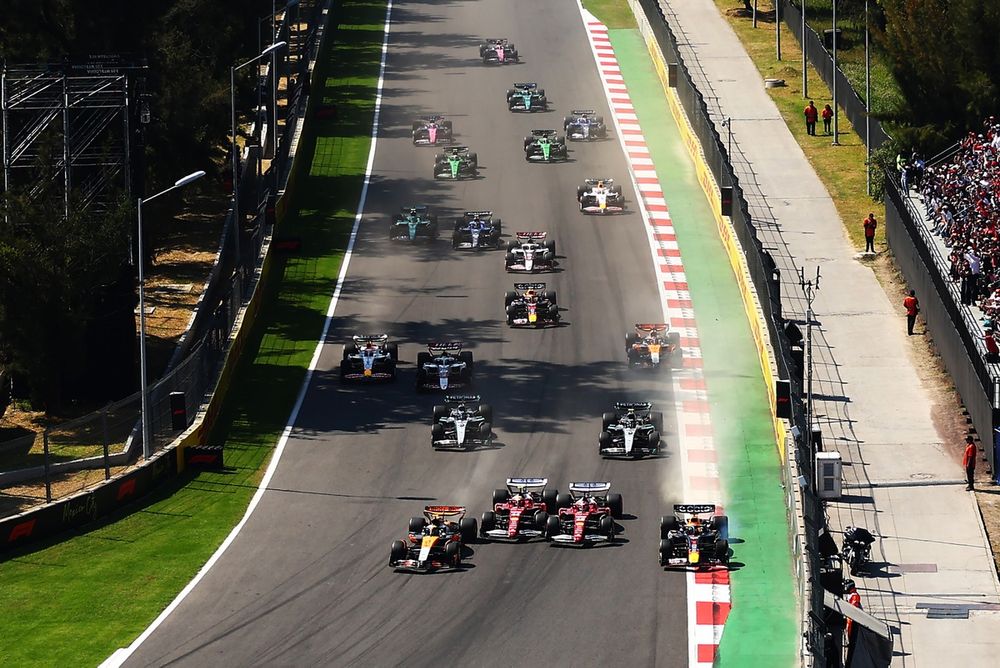
His criticisms continued two races later during the Mexico Grand Prix. Alonso was unhappy that several drivers managed to cut the first corner at the start without giving back a position.
“They broadcast it all in the radio that we do, privately,” Alonso said following the skirmish on the opening lap of the Mexico GP. “Hopefully they broadcast this and they see the turn one, two. Hello? Did it not broadcast turn one, two?”
The double world champion’s comments did not make it into the live feed. However, F1’s director of broadcast and media, Dean Locke, emphasized in an exclusive interview that his team is not a mouthpiece for drivers.
“We have a responsibility to tell the story fairly and accurately — so we don’t publish anything that is misleading or has other intentions,” Locke said. “Fernando is incredible; what he can do in that car and then still have time to think about it is admirable. But we are not his mouthpiece.”

“Our goal is to stay honest in the story and get the fans involved,” Locke added. “It’s great what kind of stories we can tell, how we can show the race from the perspective of two teammates and things like that. But we have to be careful, because sometimes a driver is critical of his team without knowing all the facts.
“Then we have to guard against misrepresentation. We want to bring excitement, take the fans into the cockpit and show who the driver really is — but without overdoing it or sensationalising it. I also remember that Fernando used to do his on-board radio in Italian, and when we subtitled it all into English, he stopped doing that. So yes, sometimes there are other intentions behind such things. We try to deal with that wisely.”
Driver Feedback and Broadcast Challenges
Alonso isn’t the only driver who has criticized F1’s coverage. Fellow Spaniard Carlos Sainz also voiced concerns after the Singapore Grand Prix, expressing dissatisfaction with the focus on “celebrities and girlfriends” in the broadcasts, which he felt detracted from the racing action.
Sainz had a strong performance in Singapore, making five overtaking moves that were barely shown on screen. This led to questions about how much contact F1’s Media and Technology Centre in Biggin Hill has with the Grand Prix Drivers’ Association and whether teams and drivers provide feedback on the broadcasts.
“That’s a good question, because they didn’t actually know what our options were to, for example, bleep, mute or filter what’s being said,” Locke explained. “About a year ago, I went to a driver briefing to explain how the onboard radio process works so they understand that we are trying to protect them and show them in the best way possible how exceptional they are as athletes.”

Regarding the footage included in a race broadcast, Locke says F1 “sometimes” gets feedback from the teams or people around a driver, “but honestly not often,” he adds. “I think some of the comments about that were taken a bit out of context,” Locke adds in relation to Sainz’s remarks. “During that race, for example, we showed a shot off-track three times, and not even during the action itself. We do have a responsibility to show the whole atmosphere of the event: what happens on the track, but also around it. That includes footage of the grid, the fans, or the podium afterwards.”
This, Locke explained, is to ensure that F1’s broadcast appeals to its diverse audience, which includes people who tune in for the race and others that want to soak up “the whole experience around it”.
“If we only showed close-ups of cars on the track, you wouldn’t even know what track we’re at,” he said. “We are fortunate that many circuits really have their own vibe — think Abu Dhabi, Austin or Monza — and we need to convey that atmosphere. That’s something stadium sports, like soccer, have less of.
“A Manchester United stadium is visually similar to many other stadiums, but every F1 event has its own character. So we have to capture the event as best we can, in every way we can. But at the core, it’s all about the action on the track, that’s what it’s all about. The more intense that action, the better.”
Focus on the Title Fight
As the season finale approaches, F1 management must also consider the title fight. “There are solid battles going on at the moment, for example with the McLarens, so we have to be fully tuned into that and convey that well to the fans,” Locke explains. “But again, the action on the track is the priority. However, often a lot is happening at once and the team works very hard every week to puzzle out exactly how we can best show that.”
This happens not only during the race, but also before the race. As an example, Locke cites the Mexican Grand Prix. “For example, there was a lot of discussion about the first corner in Mexico, because we knew something could happen,” he said in reference to the opening lap drama that often hits the race. “The question then was: should we take a wider camera shot so we can also show the run-out lanes? All our directors and producers work full-time, so they can evaluate after each race what went well and what could be better.”
According to Locke, some improvements have already been made this year to show those battles on track, including picture-in-picture. For example, on the big screen, the main duel can be highlighted while on a smaller screen, the graphics for the intermediate position show a different fight.
“Some of the innovations we’ve introduced this year help us show more fights and stories at the same time,” Locke said. “Qualifying is a good example: we now have three independent time clocks and can use the bar on the left side of the screen to tell the story of ten drivers all within fractions of each other on their final lap of Q3.
“As I mentioned earlier, the same goes for picture-in-picture images and similar techniques. This allows us to occasionally picture the leader, even if they are driving relatively quietly in the lead, while also following the other stories. The richer the story we tell, the better — but the action on the track always remains the most important.”

Formula 1
Carlos Sainz slams TV focus on “celebrities and girlfriends”, F1 responds

Formula 1
Going live: how F1 TV became a billion-dollar business


