The Hidden Crisis of Illegal Gold Mining in Ghana
Gold mining has a long history in West Africa, with economies historically built around the precious metal. However, today, a significant portion of Ghana’s gold revenues is lost to the informal and untraceable trade.
In medieval times, the name “Ghana” referred to the ruler of the Ghana Empire, or “King of Gold.” The country’s colonial-era name, “Gold Coast,” also highlighted the importance of gold in the region. Yet, the way gold is mined today and who benefits from it has become a major point of contention.
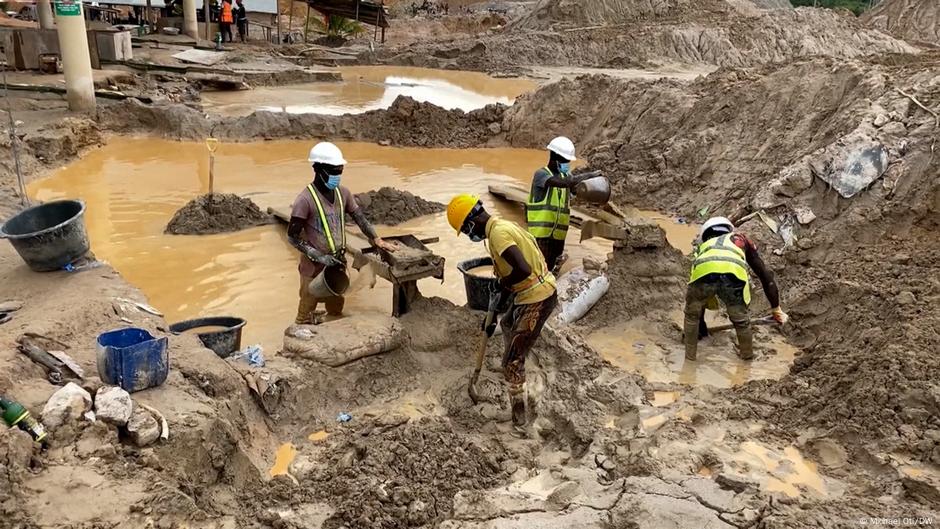
Record-breaking commodity prices and climate change have contributed to an increase in galamsey, a term used to describe illegal artisanal mining. It is estimated that this practice employs over a million Ghanaians. However, it has led to numerous environmental, agricultural, and health problems.
Awula Serwaa, co-founder of Eco-Conscious Citizens, highlights the severity of the issue:
“In Ghana, we face what I call an existential threat. Our own survival is being challenged by the poisoning of our water bodies, the destruction of our forest reserves and farmlands. Our water is not safe. Our food is not safe.”
While the practice used to focus on abandoned goldfields, modern artisanal mining now involves sophisticated earth-moving equipment. This has resulted in dangerous conditions, such as open pits where people, including children, have fallen and drowned.
Environmental and Economic Consequences
Ghana’s cocoa industry has also suffered, despite the country being the second-largest exporter of cocoa beans after Ivory Coast. Although the government maintains price controls to support farmers, raising the price per tonne of cocoa by more than 60% in dollar terms in mid-2025, it has not been enough to prevent some farmers from selling their land to informal miners.
Lucia Bird of the Global Initiative Against Transnational Organized Crime (GI-TOC) explains:
“Climate change means that in many of these regions, including northern Ghana, agricultural yields are diminishing.”
The gold sector is increasingly vulnerable to infiltration by organized crime. The GI-TOC research highlights a new dimension: the tri-border area between Ghana, Ivory Coast, and Burkina Faso has become a resource hub for Jama’at Nasr al-Islam wal-Muslimin (JNIM), an al-Qaeda affiliate. Goods like fuel and motorbikes are trafficked from Ghana’s ports to the Sahel, with markets in Ghanaian border towns selling cattle stolen in conflict zones.
Bird notes that while there is no conclusive evidence that JNIM directly finances gold mining, the sector remains vulnerable. “Because of the structure of the gold mining economy – artisanal gold flows north, financing coming south – it all makes it vulnerable to infiltration by JNIM.”
Legal and Environmental Challenges
Solomon Kusi Ampofo, an expert in natural resource governance, emphasizes that mining without a license is largely illegal in Ghana. He states:
“In Ghana, you cannot mine without the consent of people who have interests in that land.”
He argues that addressing and prosecuting those who allow land to be used for illegal operations could help mitigate the problem. However, illegal mining affects legal operations, government revenues, and the environment.
Small-scale gold miners are supposed to pay 5% royalties on gross gold production, but they often do not. At the point of export, they should pay 1.5% of the value of the gold, but the government receives very little from this sector.

Stabilizing Effects and Community Struggles
Despite the challenges, the GI-TOC research suggests that gold mining can have a stabilizing effect. Fighters may turn to gold mining instead of engaging in cattle rustling or kidnapping for extortion. However, some gold mining areas have become hubs for illicit activities such as drugs and arms trafficking.
Ghana has attempted to control artisanal gold mining, which is seen as beneficial to communities, without alienating them. PasarModern.com interviewed gold miners in the Talensi District of Ghana’s Upper East Region, which borders Burkina Faso. Mounds of brown earth litter the landscape, with water-filled craters interrupted by metal panning bowls and hand shovels.
Richard Kplemisor, one of the miners, says:
“There is so much unemployment in the constituency, in the district and in the community.”
Joseph Mbasakiya adds:
“Majority of my friends, they’ve left. But I don’t want to be suffering in someone else’s community. I can find gold here.”
Government Losing Ground
An older man, Michael Asaah Seidu, speaks about the frustrations his community faces in attaining mining permissions legally.
“The process is so tedious. We have some of our elder brothers in the Talensi District who have legal licenses, but currently they are expired and they have gone to all the appropriate authorities, agents, ministry to renew it, and they don’t want to renew it for them.”
According to Seidu, concessions have instead been given to a Chinese mining company. “The Chinese people don’t even employ people from the Talensi. They employ people from the south. We can’t sit idly by – we have families and school fees to pay.”
He hopes the government will reduce the cost and bureaucracy around mining licenses for local people:
“In that case, I think destroying the environment will be reduced.”
A Call for Action
Critics argue that Ghana’s government is losing ground quickly. Awula Serwaa calls illegal miners “terrorists,” stating:
“I call them terrorists, because even in wartime, when you poison water, it’s a war crime.”
She believes there is not enough “political will” to gain control of the artisanal mining boom and that political authorities and law enforcement are “complicit.”
Ampofo suggests that security forces need to be deployed to protect sensitive water bodies and that licensing processes must be addressed. “You cannot give out a license to a miner when there is no proof of geological investigations, economic viability of the area, and their finances.”
For Serwaa, time is running out:
“If the government chooses to act now, robustly and swiftly, we will deal with it. But if we wait too long, it will become even more difficult than it is.”


