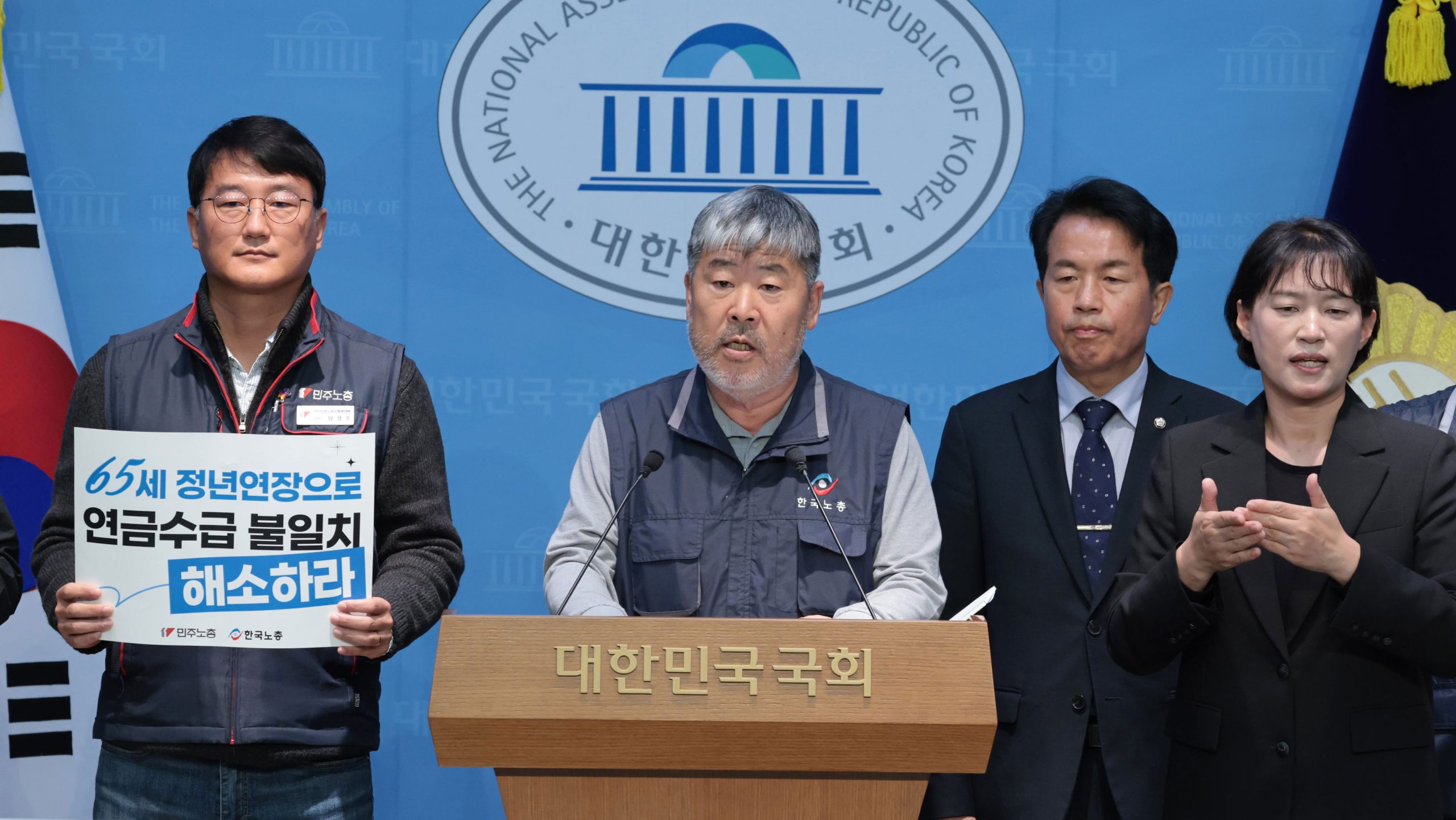
Labor Unions Push for Immediate Passage of Retirement Age Extension Legislation
The Korean Confederation of Trade Unions and the Federation of Korean Trade Unions recently visited the National Assembly to formally demand the passage of legislation that would extend the legal retirement age to 65 within this year. The unions have been actively engaging with various stakeholders, including the Democratic Party of Korea’s Special Committee on Retirement Age Extension, the Democratic Party, the Korea Enterprises Federation, and the Korea Federation of SMEs. However, they are now urging lawmakers to move forward with the legislation without further delay.
At a joint press conference held at the National Assembly’s communication center, Yang Kyung-soo, chairman of the Korean Confederation of Trade Unions, and Kim Dong-myeong, chairman of the Federation of Korean Trade Unions, emphasized the importance of passing the legislation in 2025. They stated that the extension of the retirement age should align with the pension payout start age, which is a critical national task.
Key Proposals and Challenges
According to sources familiar with the matter, a leading proposal under discussion involves gradually extending the legal retirement age by one year at a time until it reaches 65. This approach would also temporarily introduce the business sector’s proposed ‘re-employment after retirement’ system. The special committee is currently discussing when the extension from 60 to 61 years should begin and how many years should pass between each incremental increase.
The impact of extending the retirement age to 65 has raised concerns about youth employment. Analysts suggest that gradual one-year extensions could lead to significant challenges in the job market. If the retirement age is increased, younger workers may find it harder to secure employment, especially in sectors where seniority-based wage systems are prevalent.
Political Momentum and Business Sector Concerns
Within the ruling Democratic Party, there is strong momentum to process the retirement age extension bill within this year. Delaying the legislation until next year could shift focus to local elections, potentially slowing down progress on the bill. Additionally, the business sector’s opposition to a uniform retirement age extension could gain traction if the legislation is delayed.
Kim Joo-young, a member of the Democratic Party’s special committee, emphasized the need to discuss the matter swiftly to achieve the legislative goal within the year. Kim Byung-kee, the party’s floor leader, also stressed the importance of concluding discussions on retirement age extension early, reinforcing the stance to pass the bill this year.
Compromise Proposal and Controversies
The Democratic Party’s special committee, launched in April, has held discussions for about seven months with various stakeholders. While the labor sector advocates for a uniform extension to 65 years, the business sector proposes selective re-employment after retirement at age 60. A compromise proposal combining elements from both sides is reportedly gaining traction. It suggests gradually increasing the retirement age by one year every few years from a specific point until it reaches 65, while implementing the business sector’s ‘re-employment after retirement’ system until the retirement age reaches 65.
However, the labor unions have criticized the business sector’s ‘re-employment after retirement’ proposal as “an unfair employment system where employers hire only preferred individuals on a contract basis and cut wages at their discretion.” Despite this, some argue that the re-employment system is necessary to prevent income loss during the gap between retirement and pension payouts.
Economic Impact and Social Concerns
The economic impact of extending the retirement age remains a key concern. The ‘re-employment after retirement’ system under discussion is temporary, and there has been little analysis of its cost implications, such as wage reductions. In particular, many companies maintain a seniority-based wage system, where longer tenure leads to higher pay. Extending the retirement age would inevitably reduce new hiring.
A November 2023 forum hosted by the Presidential Committee on Ageing Society and Population Policy presented research showing that when the retirement age was raised from 55 to 60, youth employment (ages 15–34) decreased by 16.6%. The business sector warns that “extending the retirement age without wage cuts will increase labor costs for companies, worsening employment issues” and “youth employment could decline, and polarization in the job market could intensify.”
Conclusion
Experts agree that small and medium-sized enterprises would struggle more with the cost burden if the retirement age is extended. This means the benefits of the extension would likely be enjoyed mainly by regular workers at large corporations and public institutions. The labor unions stated, “In our society, decent policies have been pioneered by large corporations and public institutions and then generalized.” Some interpret this as an admission that large corporations and public institution employees would primarily benefit. Few countries maintain a seniority-based wage system while legally setting a specific retirement age, as South Korea does. The U.S., UK, and Australia have abolished mandatory retirement ages altogether.


