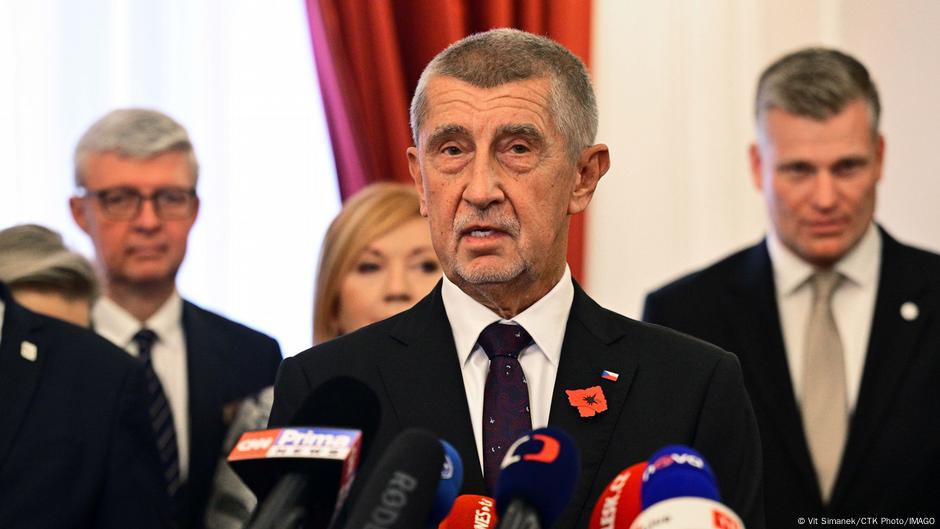
Czechia’s Populist ANO Party and the Future of Public Media
Czechia’s populist ANO party, led by billionaire Andrej Babis, has emerged as the dominant force in the recent general election. The party is now seeking to form a government with two far-right partners, raising concerns about the direction of the country’s policies, particularly regarding public media.
The centrist ANO party secured the most votes in the parliamentary election held in early October, positioning itself as the key player in the upcoming government formation. Alongside the far-right Freedom and Direct Democracy party (SPD) and the radical-right Motorists for Themselves party, ANO is shaping a coalition that could significantly influence Czechia’s political landscape.
Earlier this week, Babis presented the coalition’s program to President Petr Pavel, outlining the agenda for the new government. While ANO holds the majority of parliamentary seats, it will need support from its far-right allies to pass legislation. This partnership has raised alarms among critics who fear that the far-right parties’ demands could amplify Babis’s authoritarian tendencies.
Stance on Ukraine and International Relations
One of the most contentious aspects of the new government’s platform is its approach to Ukraine. International media have highlighted claims from Babis’s opponents that he may lead Czechia into an anti-Western, pro-Russian alliance with leaders such as Hungary’s Viktor Orban and Slovakia’s Robert Fico.

ANO has pledged to reduce support for Ukrainian refugees and halt the outgoing government’s initiative to supply ammunition to Ukraine. The manifesto also emphasizes strengthening ties with the Visegrad Group (V4), which includes Poland, Hungary, and Slovakia.
Despite these shifts, Babis is not known for his affinity toward Russia. He consistently asserts that EU and NATO membership are “unquestionable” for Czechia. His election victory was fueled by promises of increased social support and lower taxes, appealing to voters disillusioned by years of austerity under the previous center-right government.
Attitude Toward EU Policies
The new government is expected to align with its illiberal neighbors in opposing EU policies on immigration and climate change. However, the extent to which Babis will challenge Brussels remains uncertain. During his first term as prime minister (2017–2021), Babis maintained a balance between engaging with European leaders like France’s Emmanuel Macron and expressing Euroskeptic views domestically.

His agrochemicals conglomerate, Agrofert, operates across the EU and may serve as a check on any potential obstructionist tendencies toward the EU.
Threats to Public Media
Critics are particularly concerned about the new government’s plans for public media. The incoming administration has proposed scrapping the license fees that fund Czech Television (CT) and Czech Radio (CRo), replacing them with state financing.
This move is seen as a way to bring public media under greater government control, making them dependent on a budget that could be altered at will. Vaclav Stetka, a leading expert on media in Central and Eastern Europe, warned that this could lead to editorial interference and a loss of independence.

An open letter from prominent figures involved in the 1989 Velvet Revolution called the proposal “a proposal to liquidate public media,” highlighting the threat to democracy.
Concerns About Autocratic Tendencies
Babis has previously faced accusations of attempting to gain control over CT during his first term as prime minister. In the run-up to the recent election, he promised to reform what he described as “untransparent institutions that are being misused for the benefit of this government.”

His plan to merge CT and CRo into a single entity is seen by analysts as a strategy to exert control over leadership and management. Both Stetka and Marina Urbanikova from Masaryk University argue that this restructuring would likely serve political interests rather than deliver cost savings.
Lessons from Neighboring Countries
Developments in neighboring countries provide a cautionary tale. Hungary’s Viktor Orban and Slovakia’s Robert Fico have both taken steps to restructure public media, leading to concerns about editorial interference. Urbanikova noted that merging public service media was one of Orban’s first moves toward consolidating power.
Stetka pointed out that while Czechia may face similar challenges, its democratic institutions are more robust than those in Hungary or Slovakia. The president, for instance, has the authority to reject certain ministerial appointments, ensuring the independence of democratic institutions.

Additionally, Czechia’s upper house of parliament can act as a check on the government, and public media has a strong tradition in the country.
Potential for Resistance
Public broadcasters have long been targets of political interference in the region. However, past attempts in Czechia have often backfired. Twenty-five years ago, a government bid to take control of CT failed amid widespread protests.
Babis himself faced massive demonstrations during his last term in office, with a quarter of a million people demanding his resignation. Given this history, it is unlikely that he will risk repeating such a scenario.
Ultimately, the future of Czechia’s public media and democratic institutions will depend on the balance of power within the new government and the resilience of its citizens.

Related posts:

Fiction park: He was the best in class. He still wasn’t good enough

Gagan Thapa takes oath as Congress president, vows to regain public trust

Inside knowledge that has locals gripped by fear after gran’s body found decomposing in cattle dip

New property purchase disclosure rule in Japan sparks fears it may curb foreign investment

Dino-mite treasures: inside Singapore’s Fort Knox storing playthings of ultra-rich