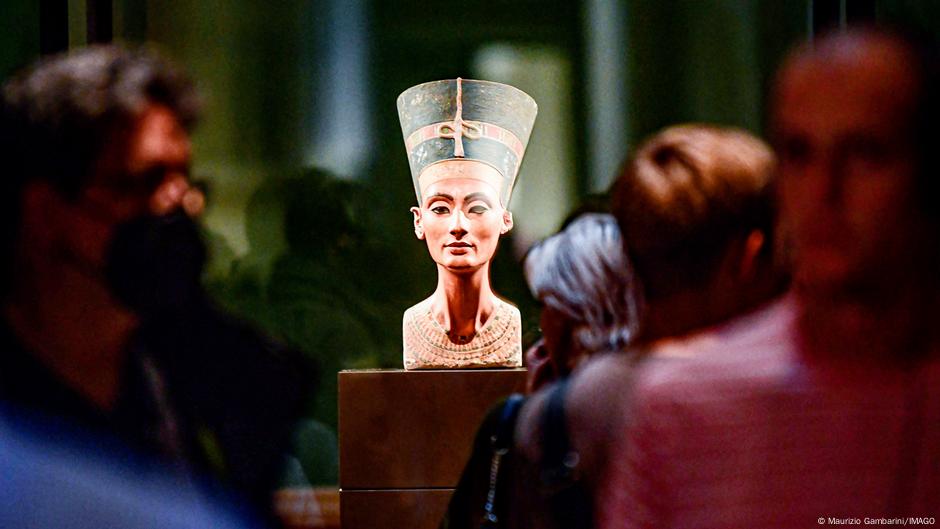
The Nefertiti Bust and the Call for Restitution
The Grand Egyptian Museum, which recently opened its doors to the public, has reignited a long-standing debate over the return of the famous Nefertiti bust. This iconic artifact, currently housed in Berlin, has become a symbol of cultural heritage and historical dispute.
Nefertiti, whose name translates to “the beautiful one has come,” is one of the most recognized figures of ancient Egypt. As the Great Royal Wife of Pharaoh Akhenaten, she played a pivotal role in the religious transformation of the time, promoting the worship of the sun god Aten. However, her fame today largely stems from the discovery of the painted stucco-coated limestone bust in 1912 by a German archaeological team led by Ludwig Borchardt.
The bust was brought to Berlin and is now considered the star attraction of the Neues Museum, part of the UNESCO-listed Berlin Museum Island. Its presence in Germany has sparked growing calls for its return to Egypt, especially with the opening of the Grand Egyptian Museum in Cairo.
Growing Calls for Restitution
Restitution claims for the Nefertiti bust have been ongoing since its discovery. Now, with the new museum in Cairo, these calls are gaining momentum. Visitors are being asked to sign a petition initiated by Egypt’s former Minister of Tourism and Antiquities, Zahi Hawass.
The petition aims to re-ignite the conversation about the return of the bust to Cairo and elicit a dignified response from German authorities. Despite multiple ignored calls for dialogue, the petition emphasizes the need for meaningful engagement on this issue.
A spokesperson for the German culture minister stated that questions regarding cultural property protection in relation to Egypt fall under the jurisdiction of the Federal Foreign Office. Both the Federal Foreign Office and the Prussian Cultural Heritage Foundation have not responded to requests for comment.
However, the foundation’s position remains unchanged: Germany wants to keep the Nefertiti bust.
Legal Acquisition or Ethical Dilemma?
Stefan Müchler, spokesperson for the Prussian Cultural Heritage Foundation, claimed that the bust was legally taken out of Egypt as part of an excavation authorized by the Egyptian Administration of Antiquities. He noted that the division of finds at the time was customary, and there is no restitution claim from the Egyptian government.
Monica Hanna, an Egyptian researcher and heritage campaigner, contests this claim. Her research suggests that Ludwig Borchardt intentionally downplayed the value of the bust when dividing the finds. His notes reveal that he was aware it depicted Queen Nefertiti, yet he described it as “a painted royal princess.”
German historian Sebastian Conrad argues that the ethical validity of the law itself should be questioned. He highlights that the law existed under the unequal power relations of the imperialist era, with Egypt essentially an English colony at the time. From today’s perspective, he believes such laws are not legitimate.
Historian Jürgen Zimmerer draws parallels to the restitution of artworks taken from Jews during the Third Reich. He emphasizes that while the laws were formal, they were unjust, and Germany should not profit from such injustices.
Restitution Attempt Blocked by Hitler
Monica Hanna also questions Germany’s claim that there is no restitution request from the Egyptian government. She points out that Egypt had already requested the return of the bust shortly after it was displayed in Berlin in 1924.
In 1925, Egypt threatened to ban German excavations unless the bust was returned. James Simon, the philanthropist who financed Borchardt’s excavations, argued for an exchange of pieces with Egypt. However, his efforts were eventually purged from Germany’s official narrative.
Simon’s planned exchange did not happen, nor did the following attempt in 1933. Nazi leader Hermann Göring hoped to secure Egypt’s political allegiance by returning the bust, but Hitler, a great admirer of Nefertiti, blocked the project. “I will never relinquish the head of the queen,” he said.

Survived WWII in a Plastic Bag
Germany has argued that the bust is too fragile to be transported back to Egypt. While admitting he is not an expert on this question, historian Sebastian Conrad points out that the bust survived World War II in a plastic bag stored in a salt mine in Thuringia before being transported to Wiesbaden.
This history raises questions about the feasibility of moving the artifact.
Alternatives to Holding the Original
Berlin is currently engaged in the restitution of colonial objects, notably through the return of the Benin Bronzes to Nigeria. However, Nefertiti is a unique piece. Conrad and Zimmerer believe alternatives exist, such as exhibiting a reproduction of the bust alongside the history of the find and the restitution efforts.
Conrad acknowledges that what would be missing is the so-called aura of authenticity. Zimmerer questions whether a Berlin museum should profit from this “aura,” considering it is tainted by colonial injustice. In his view, it shouldn’t.


