Nepal’s Agriculture Sector Faces Repeated Climate Challenges
Nepal’s agriculture sector has once again faced significant challenges due to extreme weather events, including floods and inundations. These incidents have caused substantial financial losses for farmers and the broader economy, raising concerns about the future of the country’s fragile agricultural system.
This year’s heavy and erratic rains have swept away crops across multiple provinces, intensifying fears about the stability of Nepal’s agricultural framework. Experts are warning that the increasingly late and uneven monsoon rains indicate growing climate instability. Farmers report that the recurring cycle of drought during transplantation and rain during harvest has made farming paddy—Nepal’s main cereal crop—an increasingly risky endeavor. The crisis has been exacerbated by chronic fertilizer shortages and rising production costs, making farmers more vulnerable than ever.
The Ministry of Agriculture and Livestock Development estimates that the heavy rainfall in early October alone caused losses of around Rs3.5 billion in the agriculture sector. This figure does not include damage from late October rains, which officials say were also significant. Mahananda Joshi, a senior agro-economist at the ministry, noted that preliminary estimates show the early October rains damaged crops worth Rs3.5 billion, with full data on both periods yet to be released.
According to the ministry, Koshi, Madhesh, and Bagmati provinces were the hardest hit, with paddy and vegetable crops suffering the heaviest losses. On October 27, heavy pre-winter rains submerged harvest-ready paddy in several Tarai districts, destroying months of labor. In many areas, paddy left in the fields to dry after harvest was washed away, leaving farmers with little to no income for the year.
“It’s rare for pre-winter rains to bring this kind of destruction,” said one farmer from Saptari. Paddy is typically transplanted in June and harvested in October or November, making this year’s timing particularly devastating.
Paddy is Nepal’s single largest agricultural commodity, supporting millions of households and playing a vital role in controlling inflation and stabilizing the economy. The country has 1.43 million hectares of land suitable for paddy cultivation. However, experts fear that repeated weather shocks—first drought, then floods—could shrink output, further weakening an economy already struggling with low productivity.
“Nepal’s agriculture has seen a new pattern—drought during transplantation and floods during harvest. This is serious,” said watershed expert Madhukar Upadhya. He explained that rising air pollution could be altering rainfall patterns. “Research shows aerosols can delay rainfall. Clouds form but do not release rain until they become too heavy, causing erratic downpours later. That might be what we’re seeing in Nepal.”
The problem is not confined to Nepal. Neighboring Bangladesh and India have also suffered heavy crop losses this season due to erratic rains. “The situation is dire,” said Upadhya. “Farmers are leaving agriculture altogether. This could trigger high inflation because demand for food is rising while production is shrinking.”
According to government data, 95 percent of Nepal’s 1.37 million hectares of farmland was planted with paddy this year. Transplantation was completed on 1.3 million hectares, leaving around 70,000 hectares fallow—most of it in the Madhesh province.
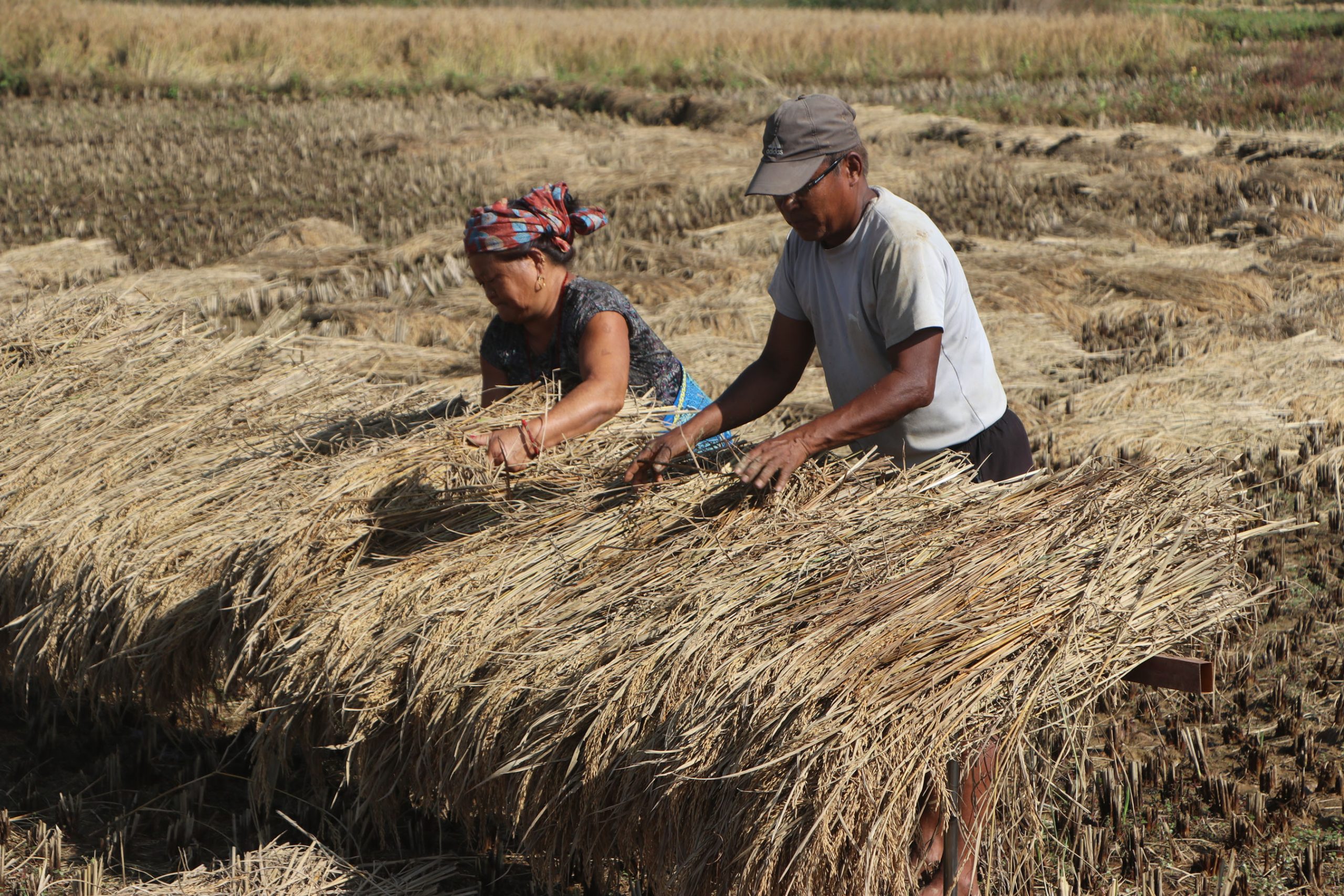
For farmers like Mannu Pariyar from Jumla, the damage has been devastating. “The harvested paddy is soaked in water. Neither the grains nor the straw are usable,” he said. Even if the soaked crop is dried, traders refuse to buy it because of its poor quality. Farmers have tried to protect their harvests with plastic sheets or by carrying unthreshed bundles home, but in many areas, waterlogged fields have made saving the crop impossible.
Awadh Kishor Mahato, a farmer from Bardibas, said the rain destroyed his family’s entire annual food supply. “We were already a month late planting because of the dry spell. Then, just when the crop was ready, it was ruined,” he said. Mahato, who usually produces 200 quintals of paddy, said his yield was already low this year, and whatever remained has now been washed away.
Experts warn that these recurring shocks could push Nepal closer to food insecurity as more farmers abandon agriculture. The country’s growing dependence on food imports from India—despite frequent export bans by New Delhi—illustrates the depth of the problem. Two decades ago, in 2001, Nepal imported food and farm products worth only $11.84 million from India. By 2021, the figure had skyrocketed to nearly $1 billion, driven largely by remittance-fueled consumption.
India has repeatedly restricted exports of essential staples—wheat, rice, sugar, onions, and paddy—citing domestic needs. These policies directly affect Nepal, which relies heavily on India for food and fuel. The 2015 blockade, when India halted fuel supplies, remains etched in public memory. During the 2008 global food crisis, India had also banned non-basmati rice exports, which hit Nepal hard. Though the restriction was lifted in 2011, new export controls on non-basmati rice in July 2023 again sent prices soaring by over 30 percent in Nepal.
“The scale of food imports has become a full-blown emergency,” said Upadhya. “If this continues, food may become unavailable even if you have money. You must grow what you eat.”
Agricultural economist Yowan Kumar Sunuwar from Ramechhap said shifting monsoon rains have become a major threat to farmers. “Those who regularly follow weather updates were able to save their paddy,” he said. “But others who didn’t have access to such information suffered severe losses.”
The Agriculture Ministry has directed provincial offices to compile data on the damage. According to Joshi, the information officer at the ministry, paddy output could drop by 5-7 percent compared to last year’s production of 5.95 million tonnes. While the quantity of paddy grown may not fall drastically, the quality has deteriorated due to flooding, which means farmers will get lower prices for their harvest.
For a country where agriculture still employs over 60 percent of the population, the implications are dire. “Lower farm output means higher food prices, more imports, and greater strain on foreign reserves,” said Upadhya. And as more farmers lose faith in agriculture as a viable livelihood, Nepal’s dream of food self-sufficiency seems to be slipping further away each year.


