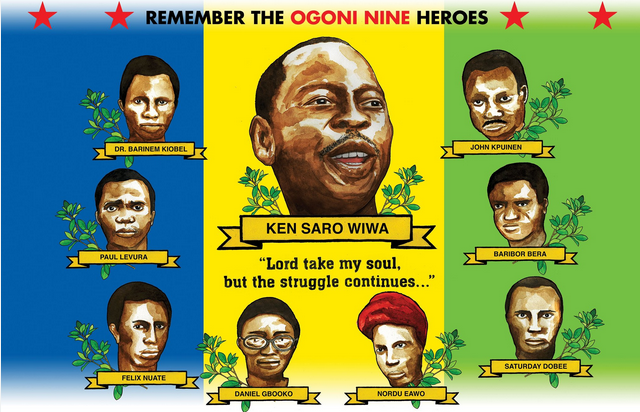
The Ogoni Nine: A Legacy of Resistance and Injustice
The execution of the Ogoni Nine, nine environmental activists from the Ogoni people in Nigeria, marked a dark chapter in the history of human rights and environmental justice. Thirty years have passed since their brutal execution by the Nigerian military government in 1995 for their peaceful protests against the destructive practices of oil giant Shell in the Niger Delta. This anniversary coincides with the start of the UN climate talks (COP 30) in Brazil, drawing global attention to the ongoing struggle for environmental protection and justice.
The Ogoni Nine and Their Fight
The Ogoni Nine were members of the Movement for the Survival of the Ogoni People (MOSOP), led by Ken Saro-Wiwa, a prominent writer and activist. They organized peaceful demonstrations to draw international attention to the devastating effects of oil spills, gas flaring, and pollution in the Niger Delta. Their efforts highlighted the environmental and social damage caused by the fossil fuel industry, which continues to affect millions of people in the region.
Despite their peaceful activism, the Nigerian government, under a military regime, launched a violent campaign to suppress the protests. The Ogoni Nine were arrested, tried in a blatantly unfair process, and ultimately executed on 10 November 1995. They were wrongfully accused of involvement in a murder, but their real crime was challenging the environmental destruction caused by Shell and other oil companies.
Pardon, Not Exoneration
In June 2024, the Nigerian government issued a pardon for the Ogoni Nine. While this move was welcomed by Amnesty International, it did not fully address the injustice they faced. Isa Sanusi, Amnesty International’s Nigeria Country Director, emphasized that the Ogoni Nine deserved full exoneration rather than a mere pardon. He pointed out that the activists were executed for a crime they did not commit, and their families have endured immense suffering over the past three decades.
Amnesty International’s extensive research revealed that Shell played a role in encouraging the Nigerian military to suppress the MOSOP protests. The organization found that Shell provided support to the authorities, even after they committed human rights violations and targeted Ken Saro-Wiwa and other activists. This collaboration gave the Nigerian government and oil companies a license to crack down on environmental protests and intimidate local communities.
Legal Battles and Environmental Devastation
The impact of oil spills and leaks in the Niger Delta has been catastrophic. For over 60 years, oil companies like Shell have been responsible for widespread environmental degradation, affecting the health and livelihoods of millions of people. Poorly maintained pipelines, wells, and inadequate clean-up efforts have polluted farmlands, waterways, and drinking water, leading to long-term harm to communities.
Communities such as Ogale and Bille have taken legal action against Shell, demanding cleanup efforts and compensation for the damage caused. Their case is scheduled to be heard in March 2027 at the UK’s Royal Courts of Justice. These legal battles highlight the ongoing struggle for justice and accountability in the face of corporate negligence.
The Role of Shell and International Response
In 2018, Amnesty International shared its findings with the International Crimes Unit of the Netherlands Public Prosecution Service to determine if Shell bore criminal responsibility for its role in the military crackdown on MOSOP. According to a private letter addressed to Amnesty, the Dutch authorities found that Shell’s request for assistance in securing its operations in 1994 “knew or should have known” that the Nigerian military would use disproportionate force. However, they declined to open a criminal investigation due to a lack of evidence.
Despite this, Amnesty argues that the evidence gathered was sufficient to warrant an investigation into Shell’s potential criminal responsibility. The organization calls on Shell to engage in meaningful consultation with affected communities and develop a comprehensive remediation plan that aligns with international human rights standards.
Global Attention and the Future of Environmental Justice
With the start of COP 30, the world is focusing on the urgent need to transition away from fossil fuels and protect the environment. Amnesty International is urging governments to commit to a fast, fair, and funded phase-out of fossil fuels and a just transition to sustainable energy. The organization also emphasizes the importance of involving affected communities in decision-making processes and ensuring that their voices are heard.
On 12 November, Amnesty will release a new report titled Extraction Extinction: Why the life cycle of fossil fuels threatens life, nature, and human rights. This report highlights the dangers of fossil fuel extraction and includes a dedication to the Ogoni Nine and a detailed case study on oil pollution in the Niger Delta.
Commemorating the Ogoni Nine
To honor the legacy of the Ogoni Nine, Amnesty UK and Justice 4 Nigeria will hold a candle-lit vigil outside Shell’s headquarters in London. The event, scheduled for 10 November, will feature poetry readings and speeches to commemorate the activists and all environmental human rights defenders around the world.


