Political Divisions within Nepali Congress
Kathmandu, Nov. 11 – For over a month and a half, the Nepali Congress, the largest party in the dissolved House of Representatives, has been deeply divided on whether to hold its party convention before or after the snap elections scheduled for March. This issue has created sharp divisions between two factions within the party: the establishment camp led by Acting President Purna Bahadur Khadka and the rival camp led by senior leader Shekhar Koirala, along with general secretaries Gagan Thapa and Bishwa Prakash Sharma.
The party is also undecided on whether to organize a special convention or a regular one. Amid this internal debate, the party now faces a third challenge: whether to support calls for the restoration of the House, which was dissolved soon after former Chief Justice Sushila Karki was appointed Prime Minister on September 12, following youth-led protests known as the ‘Gen Z uprising.’
Currently, the case against the House’s dissolution is under consideration at the Supreme Court. The top court received 10 petitions challenging the dissolution the day it resumed limited service after a hiatus of over a month, during which its buildings were burned down by protesters during the unrest.
After Chief Justice Prakash Man Singh Raut questioned during a recent hearing if lawmakers felt the House dissolution was unconstitutional, why they did not register a petition at the Supreme Court, leaders inside the Congress and UML began a quiet signature campaign for the cause.
President Ramchandra Paudel dissolved the House upon the recommendation of Prime Minister Sushila Karki, according to the demands of representatives of Gen Z protesters. Elections were then announced for March 5. Since then, the Nepali Congress has supported the elections but has criticized the dissolution as unconstitutional.
Meanwhile, the CPN-UML, the second-largest party in the dissolved House, has opposed the dissolution and called for its restoration. Calls for House restoration within Congress have not been overt.
A New Signature Campaign
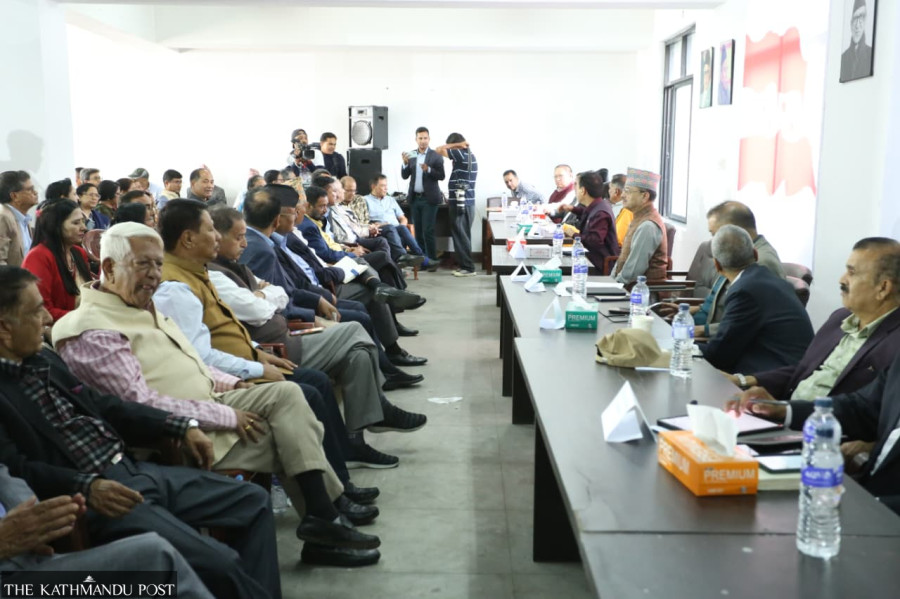
Amid this, some Nepali Congress lawmakers organized a gathering in Kathmandu and decided to launch a signature campaign in favor of House restoration. Their aim is to pressure the party leadership to officially support the restoration. “With a limited mandate and time, the dissolved House can be restored to address the demands of Gen Z and agendas like constitution amendment,” said one Congress lawmaker.
After some Congress leaders started the signature campaign without the party’s official decision, General Secretary Gagan Thapa issued a video message on Monday, asserting that the party’s priority is the election, not the restoration of the House.
On the other hand, some UML leaders have urged Congress lawmakers to put pressure within the party for House restoration to strengthen their cause and influence the Supreme Court, which is currently hearing the case against the dissolution.
However, a Congress lawmaker stated that no decision has been made yet to file a petition on behalf of the dissolved Parliament. Chandra Bhandari, a former Congress lawmaker, supports calls for House restoration. In an interview, he said the House should be restored for a limited period to discuss five specific agendas for constitution amendment.
“First, we have to revisit the current provincial structure,” Bhandari said. “We should strengthen the local bodies by giving them more resources; the elected representatives in all local bodies should be unaffiliated to any political party; the structure of the federal government should be changed; and we have to revisit the current provisions of selecting lawmakers under the proportional representation category.”
Heated Debate Ahead
It now appears that Congress will witness a heated debate on the issue at the ongoing central working committee meeting of the party, and the party leadership will be forced to form a position regarding it.
Two former lawmakers from Congress told the Post that they are in discussion with UML lawmakers to file a petition in the Supreme Court jointly. If the party doesn’t take an official decision on this matter, they could go to the court as individuals and file a petition, they said. “We will wait and see.”
“Given the crisis that the country is facing, we have to change the constitution,” one of the former lawmakers said. “We should amend the constitution by incorporating the grievances of the people, and only then should we go to the elections.”
Regarding his proposed five-agenda proposal, Bhandari said that these are not UML’s demands. “These are the messages of the Gen Z movement and the requirements of the country,” Bhandari said. “If we are able to do this, then we can go to the elections.”
Those involved in the signature campaign said that as many as 40 lawmakers out of 87 have already stood in favor of House restoration. But the majority of the Congress top leaders have been advocating for elections. Since party president Sher Bahadur Deuba is currently undergoing treatment in Singapore, it is not clear whether he has backed the signature campaign.
Parallel Campaigns Within the Party
Speaking to the Post, Shyam Ghimire, the chief whip of the party in the dissolved House, said that they had launched the signature campaign since the Nepali Congress Central Work Execution Committee meeting had already declared the dissolution of the House unconstitutional and undemocratic. “The signature campaign seeks to urge the party to take political and legal steps toward restoring the House,” he said.
Ghimire added that their campaign has nothing to do with UML’s campaign for the same purpose. “There’s a difference between the signatures collected by the UML and the ones we collected,” he said. “The UML is gathering signatures to go to court, while we collected them only to pressure the party to remain united.”
Once the House is restored, Ghimire said, the process of amendment in the constitution, given the broader political agreement, can be completed within one week to 15 days.
Meanwhile, there is a parallel campaign ongoing inside Congress in favor of elections. Some Congress leaders, including General Secretary Gagan Thapa, former deputy prime minister Prakash Man Singh, and central working committee member Nain Singh Mahar, have expressed support for the March elections. Thapa, while issuing a video message on Monday, said that the election scheduled for early March will bring a new parliament and “also set the current constitution on the right path.”


