The Gulf Stream and the Atlantic Meridional Overturning Circulation (AMOC)
Scientists have raised alarming concerns that the Gulf Stream, a critical component of the Atlantic Meridional Overturning Circulation (AMOC), is on the brink of collapse. This could lead to catastrophic consequences for the northern hemisphere, potentially plunging it into a new ice age. Researchers from China and San Diego have discovered a “key fingerprint” hidden beneath the ocean’s surface, indicating that the AMOC has been weakening for decades.
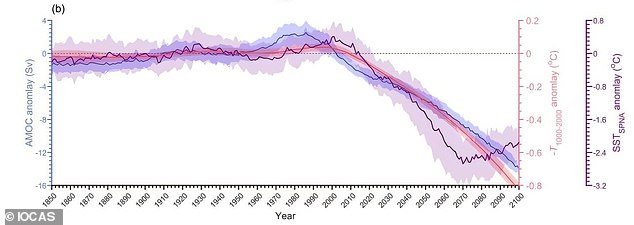
The “distinctive temperature fingerprint” is located at mid-depth — between 3,280ft to 6,560ft (1,000-2,000 meters) below the ocean’s surface — and could signal a collapse later this century. The Gulf Stream is just one part of the broader AMOC system, which is often referred to as “the conveyor belt of the ocean.” It transports warm water from the tropics northward, helping to keep Europe, the UK, and the US east coast relatively mild.
The engine driving this conveyor belt lies off the coast of Greenland, where melting ice from climate change releases more freshwater into the North Atlantic, slowing down the entire system. If the AMOC were to collapse, large parts of Europe could face a deep freeze, with some areas in the UK potentially dropping to as low as -30°C.
Understanding the AMOC
The AMOC plays a crucial role in regulating global climate by transporting heat from the equator to higher latitudes. Warm water moves northward near the ocean’s surface, releasing heat as it reaches the North Atlantic. As this water cools and becomes saltier, it sinks and flows back southward in deeper layers, eventually rising again through upwelling to complete the cycle.
Climate scientists agree that the AMOC brings enough warmth to the northern hemisphere to maintain its current climate conditions. However, if the AMOC slows or collapses, it could trigger a dramatic shift in weather patterns, leading to extreme cooling in Europe and North America.
Recent climate models suggest that the AMOC has been weakening due to the release of greenhouse gases from human activity. Despite this, there remains debate about whether and when the circulation has slowed over the past century.

New Insights from Scientific Research
A team of researchers from the Institute of Oceanology of the Chinese Academy of Sciences (IOCAS) and the University of California, San Diego, conducted a study analyzing observational data, climate models, and ocean simulations to track the AMOC’s future behavior. Their findings revealed an “observationally detectable fingerprint” in the North Atlantic’s mid-depth, where temperatures were found to be unusually warm. This warming is a sign that the AMOC is currently slowing down.
“The robust physical mechanism and reliable detection make [this fingerprint] a valuable metric for AMOC monitoring in a warming climate,” the researchers stated.
Using the Massachusetts Institute of Technology General Circulation Model (MITgcm), they simulated how AMOC-related signals, such as energy waves, spread toward the equator. The results showed that an AMOC slowdown triggers subsurface warming in the subpolar North Atlantic, generating energy waves known as “baroclinic Kelvin waves.” These waves travel along the western boundary of the North Atlantic and cause warming at mid-depth.
Further analysis using climate models confirmed that this mid-depth warming is highly correlated with changes in the AMOC over the coming decades. Observational data dating back to 1960 also shows a clear mid-depth warming trend since the early 2000s, suggesting that the AMOC likely began to weaken in the late 20th century.

Why Mid-Depth Temperatures Matter
Temperature variations at mid-depth are considered a more reliable indicator of the AMOC’s strength than surface temperatures, which are influenced by atmospheric variability such as solar radiation and volcanic eruptions. Most existing AMOC indices rely on surface measurements, which can be misleading.
“The new proxy proposed here complements existing surface proxies and allows a more reliable diagnosis of AMOC change, to the best of our knowledge,” the researchers explained.
The study, published in Communications Earth & Environment, warns that the equatorial Atlantic serves as a critical crossroads for the AMOC. A significant slowdown could lead to dramatic regional climate changes, including extreme cooling in Northern Europe and shifts in rainfall patterns across the tropics and subtropics.
The Impact of Global Warming on Ocean Currents
Global warming is accelerating the melting of glaciers, particularly in Greenland, which adds more freshwater to the North Atlantic. This influx of freshwater disrupts the density-driven currents that power the AMOC, potentially leading to its collapse.
If the AMOC were to fail, the consequences would be severe. Jonathan Bamber, a professor of Earth observation at the University of Bristol, warned that the climate of northwest Europe would become unrecognizable, with winters becoming much colder and precipitation decreasing significantly.
Could Europe Face an Ice Age?
As concerns about the AMOC’s stability grow, questions remain about what the future holds. Could the collapse of the Gulf Stream plunge Europe into a modern-day ice age? What chilling consequences await if Earth’s vital ocean currents falter? Scientists warn that without the AMOC, the northern hemisphere could experience prolonged periods of bone-chilling temperatures and increased snowfall.


