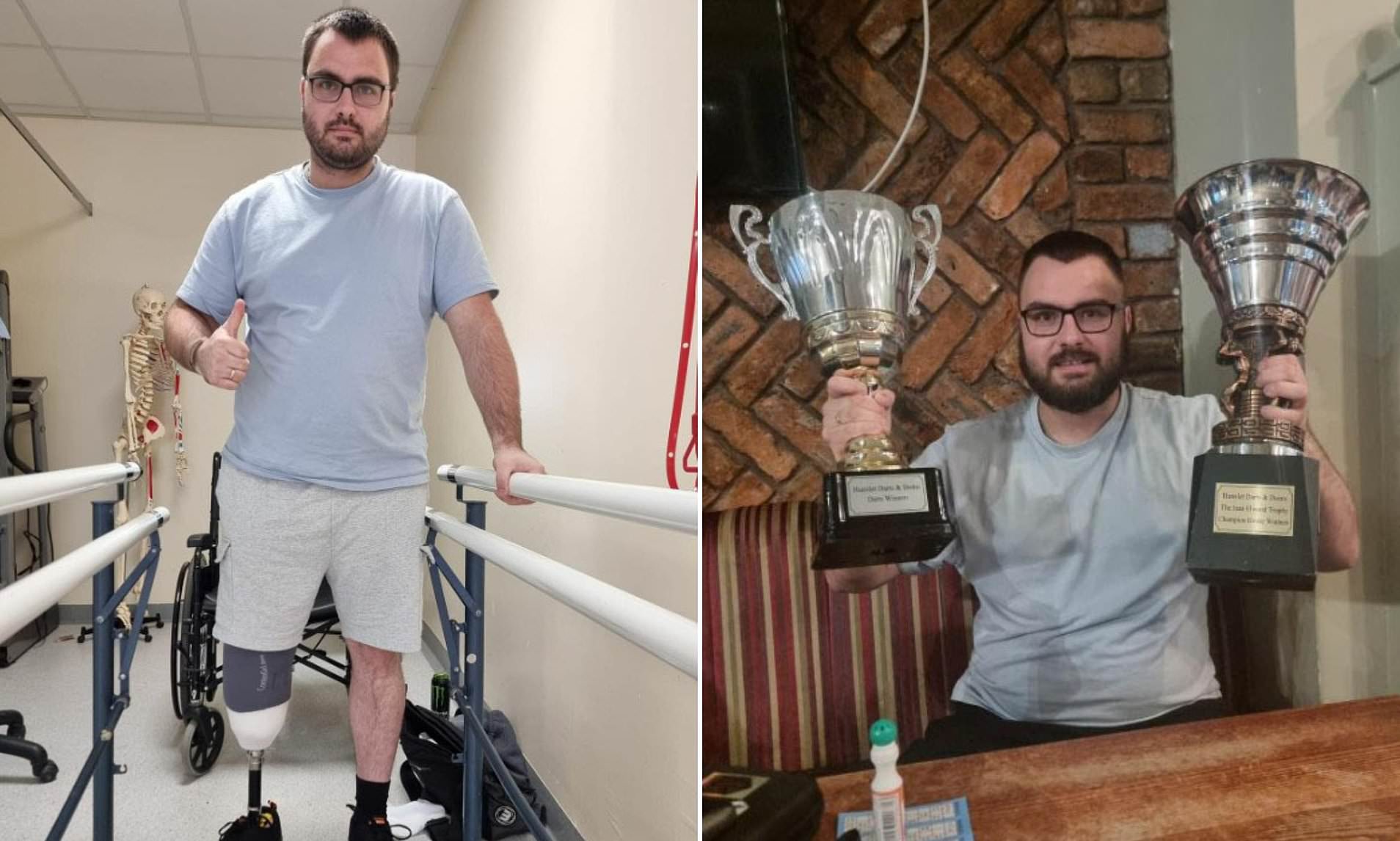
The Case of Aaron Haley: A Disputed Amputation and Compensation Claim
A disabled darts player, who had his leg amputated after being injured at work, has lost a £1 million compensation claim. The judge ruled that the amputation was not necessary for medical reasons, but rather a personal choice.
In March 2019, Aaron Haley suffered a severe injury to his foot when he was hit by a forklift while working for Newcold Ltd, a cold storage company based in Wakefield. This incident led to significant damage, including a burst fracture to the calcaneus and the need for a skin graft and a prolonged hospital stay.
Mr. Haley, who later became a professional disabled darts player under the name Aaron ‘The Rattler’ Haley, pursued a compensation claim against his former employer. However, he decided to have his leg removed below the knee, which increased the potential payout from around £500,000 to over £1 million.
Newcold Ltd contested this increased claim, arguing that the amputation was unnecessary. They pointed to surveillance footage showing Mr. Haley walking “normally” before the operation and noted that he regularly played Airsoft, a physically demanding combat simulation game, in the weeks prior to the surgery.
Judge Darren Walsh ruled that the amputation was not clinically necessary and was a personal choice. He found that the surveillance evidence showed Mr. Haley walking normally and engaging in physical activities, which contradicted his claims of unbearable pain and functional limitations.


Despite the ruling, the reason behind Mr. Haley’s decision to undergo the amputation remains unclear. The judge acknowledged the mystery surrounding the claimant’s motivation but stated that the defendant had not provided sufficient evidence to determine the exact reason.
The court heard that Mr. Haley had initially suffered a serious crushing injury, leading to significant degloving and a burst fracture. Although the risk of amputation is low, experts agreed that there was a small chance that his injury could result in such a procedure.
Mr. Haley argued that the persistent pain and restricted movement made the amputation necessary. However, the judge found that the surveillance footage contradicted these claims. For instance, a video showed Mr. Haley walking casually and normally on a trip to Leeds Police Station, while another captured him playing crazy golf and moving freely.


The judge also noted that Mr. Haley used a crutch only once, on the day he was due to see a doctor related to his damages claim, and even held it in the wrong hand. Furthermore, Mr. Haley admitted to continuing to play Airsoft right up until his surgery, which experts considered an unusual hobby for someone considering an amputation.
He engaged in various leisure activities, including tenpin bowling, snooker, darts, and Airsoft, all of which required him to be on his feet. Despite his claims of severe pain, the judge concluded that Mr. Haley was effectively functioning normally in the months leading up to the amputation.

The judge emphasized that Mr. Haley himself first mentioned the idea of amputation during NHS appointments and proceeded without exhausting other treatment options. He also refused to try using a hot water bottle to relieve his pain.
While the judge acknowledged that Mr. Haley had not fully recovered and experienced some ongoing pain, he found that his condition had improved significantly. As a result, the amputation was deemed a deliberate act, not a consequence of the accident.

In conclusion, the judge determined that Mr. Haley’s decision to undergo the amputation was unreasonable and broke the chain of causation with the defendant’s negligence. Therefore, he is not entitled to the £1 million-plus payout for the amputation, although he still receives damages for the initial injury.


