“Oh, because of a lyric mistake.”
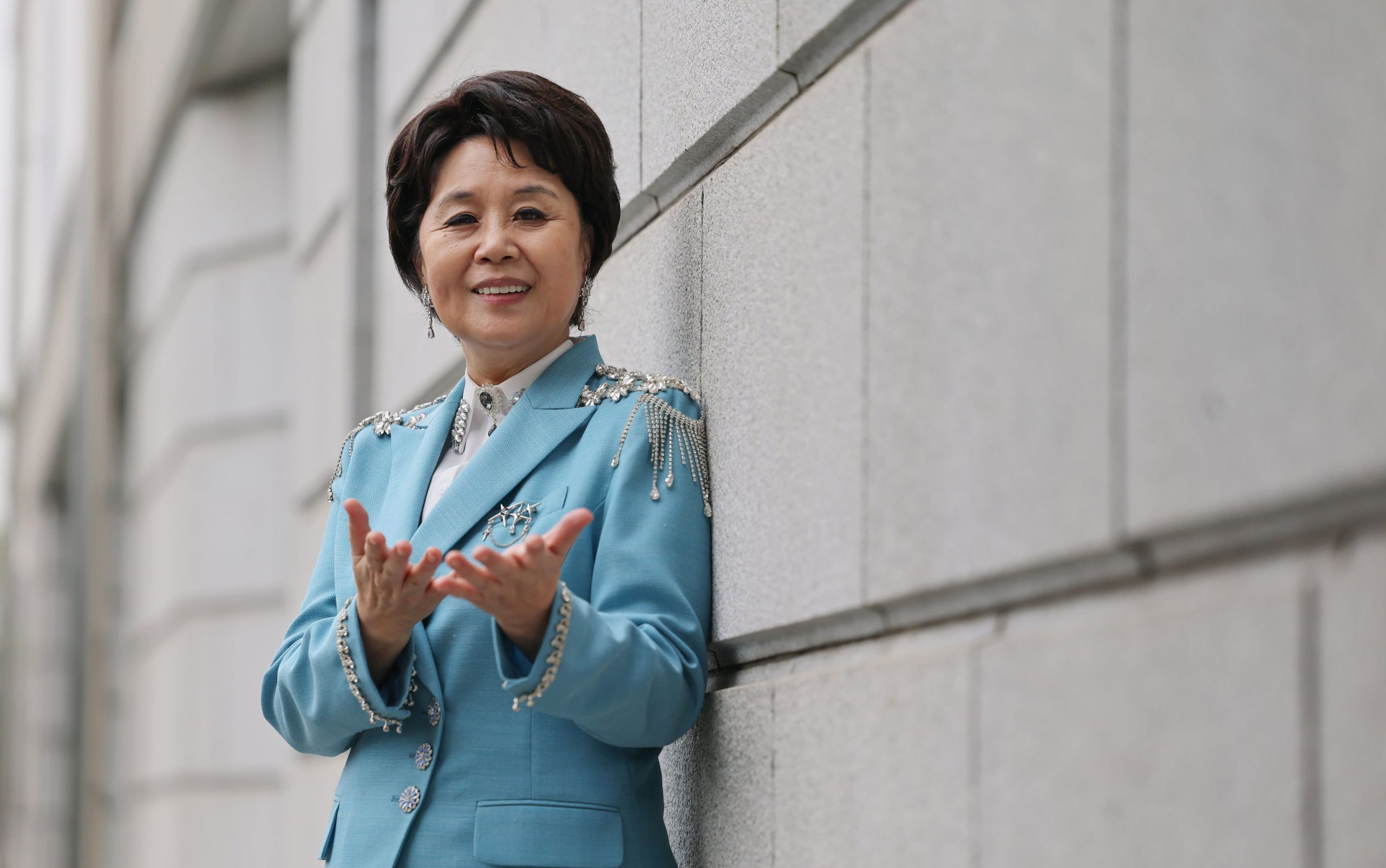
Singer Sim Soo-bong, 70, met at the KBS Annex Building in Yeouido, Seoul, was upset after a music show recording. She explained that the production team’s mistake in the instrumental section caused her to miss a verse. However, the live broadcast footage the reporter watched showed no issues. Upon hearing this, she smiled broadly, saying, “Then that’s a relief.” Even after 47 years since her debut, she radiated passion and laughter like a girl.
Sim will hold her solo concert ‘Flower Path’ at the Art Hall Mac in Mapo Art Center, Seoul, at 8 p.m. on the 25th. It is an extension of her 45th anniversary tour, which began last year. She will continue her year-end performances in Chuncheon (29th), Yeongcheon (December 9th), Chungju (December 27th), and Jeonju (December 28th). “Since last year, I’ve counted and realized I’ve held 35 nationwide performances,” she said. “Even as time passes, singing and composing songs still excites me.”
47 Years Since Debut…“Singing and Composing Still Excites Me”
She gained recognition by winning the MBC University Song Festival under the name “Sim Min-kyung, a third-year student at Myongji University.” The video of her confidently playing the piano and passionately singing her self-composed song ‘That Person Back Then’ without any signs of nervousness is still regarded as a legend in the music industry. However, she recalled, “I was ashamed because I didn’t win in the finals and lived with the memory of being frustrated as a singer for a long time.” In her teens, she also played drums on the US Eighth Army stage. Though she was called “Korea’s Karen Carpenter” for singing while playing drums, she switched to piano after her band master advised, “It’s hard for a woman to carry heavy instruments, so try changing.”

These days, she said, “I’m trying to return to my debut-era voice, but it’s not easy. My vocal tone is now a semitone higher than back then.” She added, “Many people think I intentionally use nasal tones from the beginning, but that’s a misunderstanding. A doctor said my facial bones have large resonant spaces.” “I used to feel my nasal tone was strange and tried to change it by shouting. Recently, I watched the university song festival video again and realized it was a very distinctive voice. I wish I had emphasized it more. Everything matures and reflects after time (laughs).”
Sim’s self-composed songs often express longing for love and carry a Korean sense of han (a deep, collective sorrow). “99% of my songs are in minor keys,” she said. “The essence of Korean pop music is comforting and representing the pain and sorrow in the lives of ordinary people.” “I lost my father early and grew up with my single mother, always carrying loneliness and sorrow in my heart, which I soothed through music.”
Her famous confession song ‘Binari’, dedicated to her husband Kim Ho-kyung, 67, a former radio PD, originally had the title ‘Lonely Love’. Kim, who accompanied the interview, said, “I shouted for an encore eight times after hearing the song for the first time.” Sim laughed, saying, “The lyrics ‘Heaven, let me love this person forever’ were my way of praying for love.”
Sim, who wrote numerous hits like ‘I Only Know Love’ and ‘I Hate You’, said, “I tried to create songs that are not hostile to anyone, are inclusive, and possess bold beauty.” Her 2023 release ‘Married Couple’s March’ has the same chord progression in verses 1 and 2 but shifts to a major key and bold atmosphere. “It expresses the non-smooth journey of two strangers becoming one,” she explained. She also said, “I often incorporate real-life stories and personal emotions into my songs.” “Maybe due to a lack of imagination, I rarely write songs about things that didn’t happen. Melodies suddenly drop from the sky.” She added, “Lyrics are painfully harder to write than composing. I can write a song in five minutes, but I revise adjectives hundreds of times. It can take three months.”
A Unique Family Heritage
Her unique roots also influenced her music. Her family has carried an artistic spirit for four generations: her great-grandfather Sim Pal-rok, a piri master; her grandfather Sim Jeong-soon, a pansori master of the Junggoje style; her uncle Sim Sang-deok, who was the teacher of gayageum master Hwang Byung-ki; and her father Sim Jae-deok, a folk song collector. “I think my father had me to pass down the traditional Korean music DNA. Without my family’s influence, my pop music career might not have existed,” she said.
A Difficult Memory to Share
October 26th remains a sensitive memory. “Though there were no official banned songs, activities were blocked during the Fifth Republic right after October 26th, making it hard to make a living,” she said. That’s why her 1984 hit ‘Men Are Ships, Women Are Harbors’ was “a grateful song that brought me into the spotlight with the nation’s enthusiasm.” She added, “I endured a lot of hardships, but now I’m truly okay. From now on, I want to sing only stories of giving love, like ‘A Million Roses.’” “The lyrics of that song—no matter how much someone angers me or hurts me, give love generously and leave—have become the answer to my life.”
Sim hesitated to speak about being adopted as a witness in the recent retrial of former Central Intelligence Agency Director Kim Jae-gyu. “My feelings from that time are already condensed into the lyrics of my song ‘Mugunghwa,’” she said, her expression appearing pained. Her husband Kim Ho-kyung, who was watching, added, “It’s time to stop mentioning that story. It’s a trauma we’ve only just escaped.”
When Sim released her first memoir in 1994, she said, “I want to be loved as a complete natural person and singer, not as ‘that woman, Sim Soo-bong.’” Thirty years later, this ‘Flower Path’ tour is that performance. “At every concert, I share my sorrows, sing, and receive comfort. I feel something inside me slowly healing,” she said. Her goal for the remainder of her life is clear: “I want to write a song like ‘A Million Roses’ as an original, not a cover. As long as my health allows, I’ll keep composing and performing. With songs that are masterpieces anywhere in the world, even in our pop genre.”


