A Revival of Ancient Rituals in Patan
When visitors step into the Patan Museum, one of the first attractions they encounter is Keshavnarayan Chowk, home to the centuries-old Keshavnarayan Temple. This temple is believed to have been constructed during the Lichchhavi period in the 5th century. The statue of Keshavnarayan, which stands as a central figure in the temple, dates back to the 9th or 10th century based on its artistic features.
For many years, daily worship at the temple was a common practice, but this tradition ceased for about 40 years. Despite this, annual rituals such as Krishna puja and Mataya jatra continued as usual. The decision to revive daily worship began with informal discussions among community members. Over time, more people became involved, leading to a significant change in 2020.
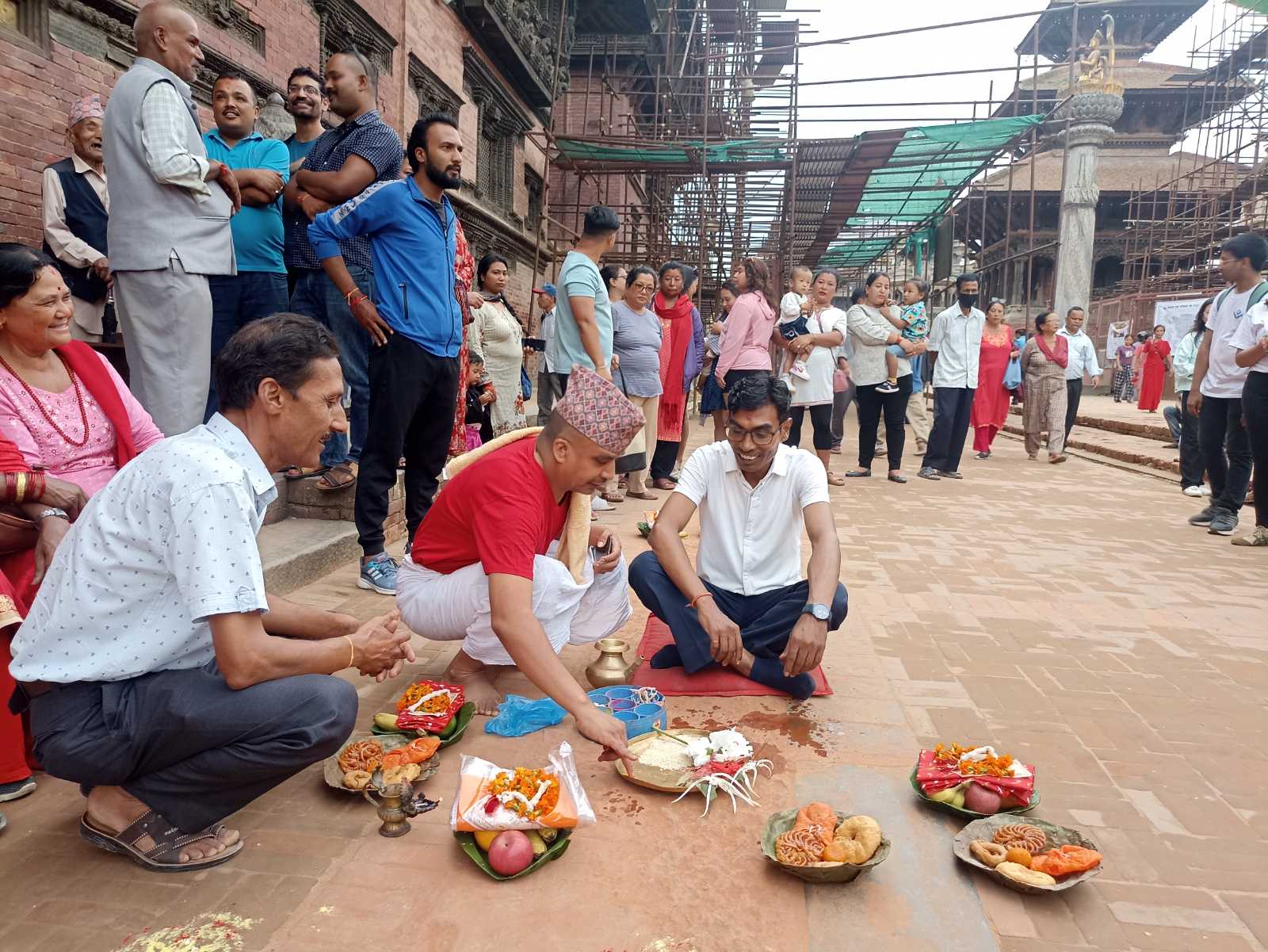
On the day of Jestha Purnima, the temple witnessed the resumption of daily worship. The event started with a special Kshama Puja (ritual of forgiveness) and a hom ritual (fire offering). According to Suresh Man Lakhe, a museum officer at Patan Museum, community support and guidance from elders played a crucial role in making this revival possible. “Even though we don’t quite know why the worship had stopped in the first place, we are glad to start it again,” Lakhe said.
The priests who now perform the daily and special rituals at the temple come from a long line of priests who have served in this profession for generations. One such priest is Shivesh Sharma, who refers to himself as a “family priest.” His grandfather was the first in their family to serve as a priest here, and his uncle continues the legacy by performing rituals at the Banglamukhi Temple. Sharma’s upbringing was deeply rooted in traditional practices, and he became eligible to perform worship only after completing his Bratabanda ritual (a Hindu coming-of-age ritual).
Reviving the Worship of Sadashiva
In addition to the Keshavnarayan Temple, the traditional worship of Sadashiva (the eternal form of Lord Shiva) also faced a similar fate. According to historical records, in Nepal Sambat 535 (1471 BS), Shri Yankuli Varma, his wife Madan Lakshmi, and their son Jay Singh performed uninterrupted annual rituals on the day of Shiva Ratri Chaturdashi, including Panchamrit Snan (ritual bathing with five sacred elements), hom, and the offering of bel leaves.
However, the exact reason for the discontinuation of these rituals remains unknown. With the support of the museum and the priests of Patan Taleju Temple, daily worship was resumed on the day of Shivaratri in 2021, beginning with a special Kshama Puja. Currently, the Taleju priests conduct daily worship and perform the Panchamrit Snan every Shivaratri.
Niran Rajopadhyaya, one of the priests involved in the daily worship, starts the rituals at dawn and finishes them by noon. The Rajopadhyaya caste has historically served as priests, advisors, and spiritual gurus for the Newa ruling families. However, despite their rich lineage, Niran expresses concern about the future of their profession. “I continued what my forefathers started, but after me, there is no one to carry this forward,” he said.
Reviving Traditions at Tusa Hiti
Another significant site within the Patan Durbar Square is Tusa Hiti in Sundari Chowk. Built in 1627 AD, the Chowk and Tusa Hiti, constructed in 1647 AD, hold immense religious, cultural, and historical value. The Hiti, known as the ‘Royal Bath,’ was where Malla kings like Siddhi Narsingha Malla bathed. Historically, a special puja and Hom ritual were performed on the anniversary of its establishment. However, this tradition was interrupted for various reasons.
In April 2025, the museum, with the support of the Taleju priests, revived the tradition with special rituals. According to Lakhe, the museum officer, plans are to continue this tradition uninterrupted in the future.
Promoting Cultural Heritage
Other festivals and rituals have also seen a revival. Last year, a special worship of Narasingha and other deities was introduced by the museum when the Shree Narasingha Jatra arrived at Patan Durbar, adding a new layer to the city’s centuries-old religious traditions. The Jatra was initiated by King Siddhi Narasingh Malla around 1631 AD.
Overseeing all these revivals is the local Ward office. The Patan Durbar Square falls under Ward no 16 in Lalitpur Metropolitan City, and the office works with various bodies to revive and promote the cultural heritage of Patan.
Future Plans and Youth Involvement
In addition to reviving rituals and worship, the Ward Office is planning to promote the ancient Kartik Nach. This traditional dance drama, introduced by King Siddhi Narsingh Malla in the mid-17th century, is among Patan’s oldest and longest-running performances. “The recently held Kartik Nach was performed for ten days, but next year we are planning to run it for a whole month,” said ward chairman Nirmal Ratna Shakya.
To promote the dance, the Ward Office has started live-streaming it on Facebook, which has proven to be effective. Many viewers have joined the live sessions, showing enthusiasm and interest in the traditional performance.
Shakya also mentioned that the museum and the ward office are planning to make Mul Chowk a ‘no-shoe zone’ to preserve the sanctity of the place. The historical Chowk is inside the museum and houses the Taleju Temple.
The ward chairman noted that in recent times, the youths of Patan have shown great interest in reviving and promoting their culture. The Ward Office runs many training sessions for youths to learn traditional instruments and dances. “Recently, there was a small girl who joined our training, eager to learn about her culture. This enthusiasm will fuel Nepal’s cultural heritage promotion in the future,” Shakya said.


