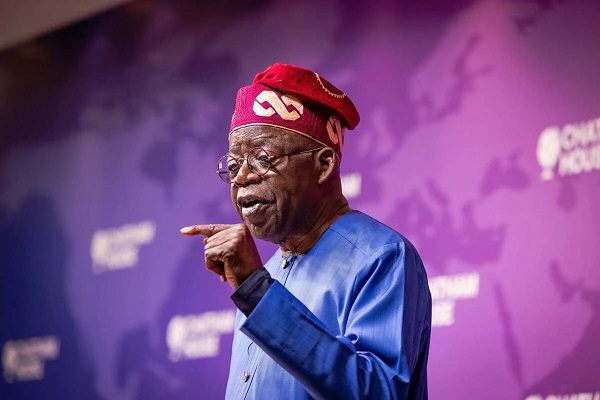
Nigeria’s Debt Dilemma: A Growing Concern
Despite recent statements by President Bola Ahmed Tinubu that Nigeria had stopped taking domestic loans, the National Assembly recently approved a fresh request from the federal government to borrow N1.15 trillion from the domestic debt market to fund the deficit in the 2025 budget. This decision followed the consideration and adoption of reports by the Senate Committee on Local and Foreign Debt as well as the House Committee on Aids, Loans and Debts Management.
In the House, the committee’s chairman, Abubakar Hassan Nalaraba, urged lawmakers to approve the report, explaining that the loan was intended to address the deficit gap created by the increase in the budget size over and above the prior approved revenue and borrowing plans. President Tinubu had earlier written to the National Assembly requesting the consideration and approval of the loan request, citing the provisions of Section 44, Subsection 1 to 2 of the Fiscal Responsibility Act, FRA, of 2007, which requires the approval of the National Assembly for all new borrowings by the Federal Government of Nigeria.
The president noted that the National Assembly passed a budget of N54.9 trillion, an increase of N5.25 trillion from the N49.74 trillion budget proposal by the Executive. This increase created a budget deficit of N14 trillion. However, the proposed borrowing approved in the budget was N12.95 trillion, which caused an unfunded deficit of N1.1 trillion. It is, therefore, necessary to increase the domestic borrowing limit in the 2025 budget by N1.147 trillion to close this gap.
Current Debt Profile
As of June 30, 2025, Nigeria’s total public debt stock increased to N152.39 trillion, according to the Debt Management Office (DMO). The new figure represented an increase of N3.01 trillion or 2.01 per cent from the N149.39 trillion recorded at the end of March 2025. In dollar terms, the debt profile rose from $97.24 billion to $99.66 billion, representing a 2.49 per cent increase within the three-month period.
Nigeria’s external debt stock increased to $46.98 billion (N71.85 trillion) in June 2025, compared to $45.98 billion (N70.63 trillion) in March. According to the report, the World Bank remains Nigeria’s largest external creditor, with $18.04 billion in outstanding loans – mostly from the International Development Association (IDA). This accounts for about 38 per cent of the country’s total external obligations.
Overall, multilateral lenders accounted for $23.19 billion, representing 49.4 per cent of the external portfolio. Other multilateral partners include the African Development Bank (AfDB), International Monetary Fund (IMFM), and the Islamic Development Bank (IsDB). Bilateral loans totalled $6.20 billion, led by the Export-Import Bank of China (Exim Bank) with $4.91 billion, while smaller exposures were owed to France, Japan, India, and Germany.
Domestic Debt
On the domestic front, total debt climbed to N80.55 trillion in June, up from N78.76 trillion in March – an increase of N1.79 trillion or 2.27 per cent. The report stated that N680,424,712,094.99 of FGN bonds issued to restructure states’ commercial debts is excluded from that amount. Also included under FGN Bonds was a securitized component of Ways and Means financing amounting to N22,719,000,000,000.00.
A portion of FGN Bonds issued in foreign currency (converted to naira) accounted for N1,402,905,358,752.50; this figure corresponds to a domestic US Dollar bond of USD 917.405 million, which the DMO notes was converted using a rate of N1,529.2105 per dollar. Treasury Bills were the second largest instrument, amounting to N12,764,078,815,000.00, which is 16.67 per cent of the domestic debt stock.
Other instruments recorded in the DMO report include FGN Sukuk (N1,292,557,000,000.00, or 1.69 per cent), FGN Savings Bonds (N91,533,172,000.00, or 0.12 per cent), and FGN Green Bond (N62,355,000,000.00, or 0.08 per cent). Promissory Notes (Pnotes), which are non-interest bearing, were reported at N1,731,358,298,643.85, forming 2.26 percent of total domestic debt.
Concerns Over Un sustainable Debt
Economists have raised concerns over the increasing debt profile, describing it as unsustainable. They pointed out that a large chunk of the loans, especially the external loans, was driven by naira devaluation. Dr. Muda Yusuf, CEO of the Centre for the Promotion of Private Enterprises (CPPE), said, “One important factor that amplified the debt number was the exchange rate.”
Umar Yakubu, Executive Director of the Centre for Fiscal Transparency and Public Integrity (CEPTI), noted that the sudden borrowing before the implementation of the 2025 capital budget is suspicious. He criticized the Senate for not carrying out due diligence whenever approving budgets by the National Assembly.
Dr. Wasiu Olasunkanmi Lawal, an economist with Al-Hikmah University, expressed concern over the National Assembly’s latest loan approval, warning that Nigeria’s continuous borrowing without clear fiscal direction poses serious economic risks. He emphasized the need for fiscal discipline and transparency in public finance management.
The Path Forward
Dr. Lawal offered a three-point advice: first, the government must drastically cut the cost of governance. Second, borrowing should only be done for projects that can generate twice the amount borrowed. Third, there must be fiscal discipline and transparency in public finance management.
He emphasized that unless fiscal prudence and institutional integrity are restored, the effects of borrowing and subsidy removal will continue to bypass the ordinary Nigerian. “Borrowing is not the problem but mismanagement,” he submitted. “Without fiscal discipline, transparency, and accountability, no amount of borrowing will improve the lives of ordinary Nigerians.”


