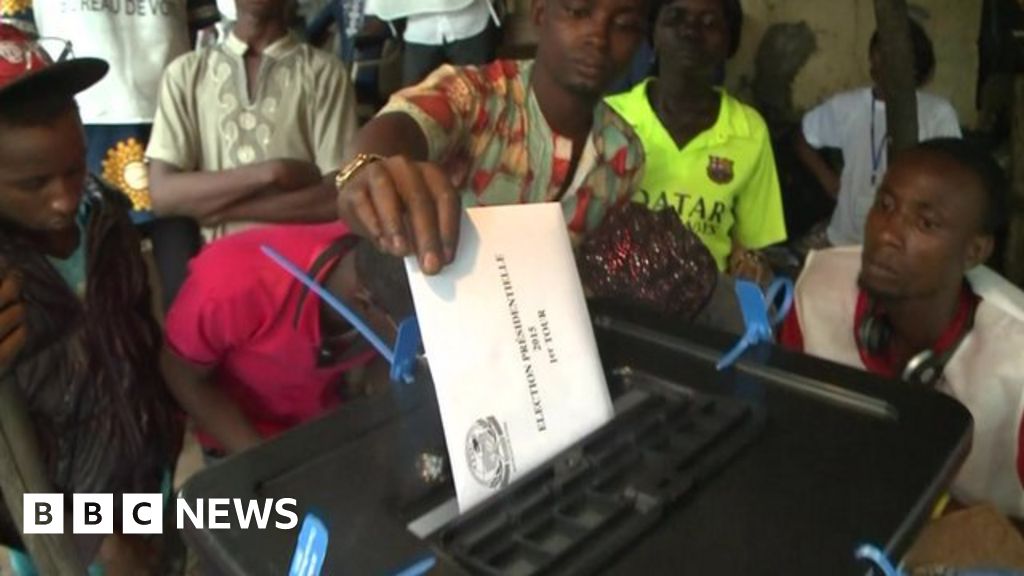
The Crisis of Electoral Legitimacy in Africa
Guinea-Bissau is preparing for its November elections, a moment that was once seen as an opportunity to demonstrate the country’s growing electoral resilience. However, the process has been repeatedly undermined by President Umar Sissoco Embaló, casting doubt on the legitimacy of the upcoming vote. This situation reflects a broader crisis across Africa, where democratic norms are eroding and incumbents are consolidating power through various means.
In recent months, several African nations have experienced elections that have reinforced the perception that incumbency, not competition, is the norm. In Cameroon, 92-year-old Paul Biya claimed an eighth consecutive term after officially winning 53.7% of the vote, which was widely denounced as fraudulent. In Tanzania, President Samia Suluhu Hassan was declared the victor with an implausible 98% of ballots cast in her favor following a poll marred by numerous irregularities. In Côte d’Ivoire, President Alassane Ouattara secured a fourth term with nearly 90% of the vote, despite the constitution’s two-term limit.
These outcomes have fueled public cynicism and highlighted a worrying erosion of democratic norms across the continent. Leaders are manipulating constitutions, neutralizing opponents, and hollowing out institutions meant to safeguard accountability. The situation in Guinea-Bissau is no different, as the country faces a deepening crisis of electoral legitimacy.
A Legacy of Instability
Guinea-Bissau’s modern electoral turbulence can be traced back decades. João Bernardo “Nino” Vieira returned to power in 2005 for a second stint, nearly a quarter-century after first seizing control via a 1980 coup. His rule was marked by conflict, including an 11-month civil war triggered by a rebellion from former army chief of staff Ansumane Mané. Vieira’s long first tenure ended in a second coup in May 1999, and his second term was cut short in 2009 when he was murdered by members of the armed forces.
Malam Bacai Sanhá emerged as Vieira’s elected successor but passed away in January 2012, leaving Raimundo Pereira as interim president. Within months, Pereira would be removed in yet another military coup. The 2012 upheaval halted a runoff election between Carlos Domingos Gomes Júnior and Kumba Ialá. The 2014 election brought José Mário Vaz to the presidency, defeating a candidate with close ties to the military. When Vaz completed his term in 2020, he became Guinea-Bissau’s first president to finish a constitutionally defined tenure.
Undermining the Process
Questions arose even before Vaz’s exit. After Umar Sissoco Embaló was declared the winner over Pereira in the 29 December runoff, Pereira challenged the results. Ignoring the ongoing legal process, Embaló arranged an inauguration ceremony for himself in February 2020. The African Party for Independence of Guinea and Cape Verde (PAIGC) accused Embaló of orchestrating a coup and appointed Cipriano Cassamá as an interim president.
Embaló then ordered the deployment of the military to state institutions, including the National Assembly. Cassamá stepped down on his second day, citing death threats. The supreme court ultimately declined to rule on the dispute after its chief judge fled the country, also citing death threats. The crisis was effectively resolved by the Economic Community of West African States’ (Ecowas) recognition of the Embaló government. Uncertainty, however, would continue to plague the new government.
In May 2022, three months after an attempted coup, Embaló dissolved and suspended parliament. The main opposition party, the PAIGC, formally regained parliamentary control in the June 2023 elections, setting the stage for continued confrontation between the presidency and the legislative majority. Embaló again pursued the dissolution of parliament in December 2023.
Although Embaló’s term officially expired in February 2025, the supreme court later ruled he could remain in office until 4 September. Even after that date, Embaló remained in office. These manoeuvres have heightened concerns about the erosion of constitutional norms.
Concerns Over the Broader Electoral Environment
Concerns over the broader electoral environment have also come to the fore. Legislative elections initially scheduled for late November 2024 were indefinitely postponed due to alleged funding and logistical challenges. Earlier, Embaló had declared he would not seek reelection, only to reverse course in March 2025. A mediation team deployed by the Economic Community of West African States, tasked with helping the sides agree to and honour an election timeline, abruptly withdrew following threats of expulsion from the Embaló government.
More recently, the PAIGC’s chosen presidential candidate, Domingos Simões Pereira, was barred from contesting the November election after the supreme court rejected his candidacy over the late submission of documents. For the first time in Guinea-Bissau’s history, the country’s oldest and most influential party will be excluded from the presidential race.
The country has fallen in the Electoral Democracy Index, provided by the Varieties of Democracy (V-Dem). As shown in the graph below, the decline even outpaces the drop witnessed after military coups in 2003, 2012, and the assassination of Vieira in 2009. The V-Dem data end in 2024, and thus do not yet capture the 2025 election cycle.
Performative Elections, Entrenched Power
What is unfolding in Guinea-Bissau is not an isolated crisis. It is part of a wider regional pattern in which leaders recognize that elections can be held, even celebrated, while hollowing out nearly everything that once made them meaningful. Critically, the recent coups in the region have been linked, in part, to popular frustration with flawed electoral processes.
Embaló has not entrenched himself with the personal longevity of Cameroon’s Biya or the institutional dominance of Tanzania’s CCM, but the mechanisms he has used to tilt the field look strikingly similar. The removal of viable opponents, the manipulation of constitutional timelines, the coercive use of the security sector, and the corrosion of judicial independence all signal a shift away from accountability.
Guinea-Bissau was for the first time in decades poised to demonstrate that democratic resilience could be strengthened. Instead, the 2025 election cycle risks becoming another example of how fragile gains can be reversed with impunity.

Related posts:

Fiction park: He was the best in class. He still wasn’t good enough

Gagan Thapa takes oath as Congress president, vows to regain public trust

Inside knowledge that has locals gripped by fear after gran’s body found decomposing in cattle dip

New property purchase disclosure rule in Japan sparks fears it may curb foreign investment

Dino-mite treasures: inside Singapore’s Fort Knox storing playthings of ultra-rich