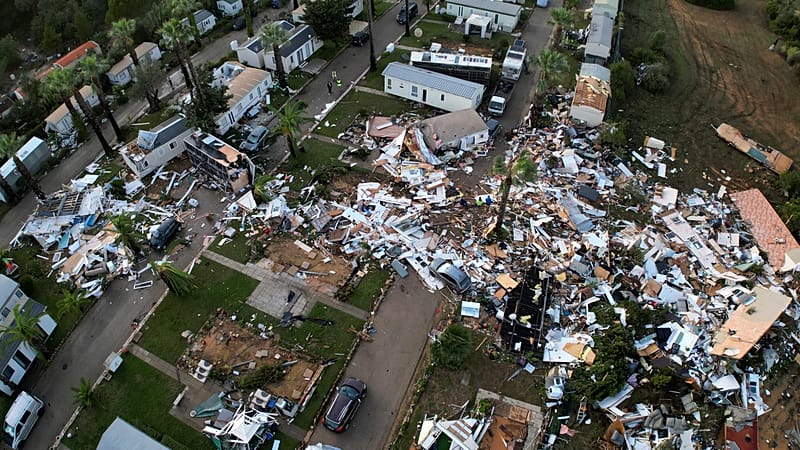
The Impact of Storm Cláudia
Storm Cláudia brought with it a series of severe consequences, including floods, falling trees, and widespread destruction. By Sunday, the storm had caused 4,017 incidents and claimed three lives, according to Portugal’s Civil Protection service. The Setúbal, Porto, and Algarve regions were among the hardest hit by the extreme weather, which included heavy rainfall and strong winds.
In the Algarve town of Albufeira, a tornado on Saturday morning resulted in the death of an 85-year-old British woman and caused significant damage to a hotel and a campsite. The images of the destruction spread across Europe, highlighting the severity of the event. However, the impacts of Cláudia were not limited to Portugal; the effects of the storm were also visible in Spain, Ireland, England, and Wales.
Understanding the Tornado in Albufeira
Speaking to Euronews, Paulo Pinto, a meteorologist at the IPMA (Portuguese Institute for the Sea and Atmosphere), explained that a tornado originating from a supercell or mesocyclone was identified in Albufeira on Saturday. In simplified terms, this phenomenon began as a thunderstorm cloud that acquired organized circulations of air within it. For a tornado to form, there must be differences in the horizontal wind in the lower atmosphere and at higher altitudes, known as wind shear. These differences ultimately result in the formation of a vortex that rotates along an approximately vertical axis and rises from the ground to the base of the parent cloud.

Climatologist Carlos da Camara from the University of Lisbon’s Dom Luiz Institute (IDL) added that the extreme weather phenomena in Portugal were the result of a “cold depression.” Unlike frontal depressions, which are characterized by the interaction between cold and warm air masses, cold depressions involve winds that almost make a counter-clockwise circle, creating a core of low pressure in the center.
Are These Phenomena Becoming More Common?
According to da Camara, cold depressions occur frequently in Portugal and are often responsible for floods and other weather events. He noted that these depressions are similar to the one that affected Valencia last year. In statistical terms, the increase in greenhouse gases leads to more energy being stored in the atmosphere, resulting in stronger winds and more frequent occurrences of such events.
However, da Camara believes that the question of whether tornadoes are becoming more common is difficult to answer. With the prevalence of mobile phones, tornadoes are now more likely to be recorded than in the past.
Can We Forecast Tornadoes?
Despite advancements in technology, including radars, satellite observations, and numerical models, forecasting tornadoes remains challenging. According to Pinto, insufficient observation at the level of the lower troposphere (0-1 kilometers above Earth’s surface) limits the ability to predict tornadoes. While it is possible to indicate the likelihood of a storm or depression, predicting the exact location and time of a tornado is still not feasible.

Da Camara supports the thesis that tornadoes are impossible to predict and that only favorable conditions can be identified. A simple rule that every meteorologist knows is that the smaller the scale of the phenomenon, the less predictable it is. Tornadoes, being extremely local phenomena, are much more difficult to anticipate.
Adélia Nunes, president of the Portuguese Association of Geographers, emphasizes that tornadoes are very localized phenomena and difficult to monitor. Prevention is structural and not specifically aimed at this type of phenomenon.
Problems with People’s ‘Civic Sense’
Despite all this, da Camara notes that one of the main problems is citizens’ lack of civic sense. People often disregard warnings and go to dangerous areas, such as cliffs, to take photos. This behavior is also observed during summer, when people may not consider the risks of rural fires.
Nunes speaks of a climate literacy problem, identifying a lack of risk culture. She argues that there is a need for a focus on risk prevention and risk literacy, which applies to any type of risk, whether it’s flooding or fire.
Building Without Regard for the Risk of Flooding
Carlos da Camara points out that there is another aspect that needs attention: infrastructure and prevention. Floods continue to occur due to deficiencies in cleaning and the lack of better sewers. He emphasizes the need for greater commitment to prevention.
Portugal has 63 areas at potentially significant risk of flooding, which could affect more than 100,000 inhabitants on mainland Portugal. Nunes believes that the potential to increase the number of areas at risk is great, given the increasing recurrence of extreme phenomena.

The University of Coimbra professor highlights that buildings are often constructed without considering risk maps. She stresses that risk mapping is fundamental for delimiting areas where urban growth should or shouldn’t occur. The central government needs to define the institutions that produce this mapping and the legal instruments that allow it to be operationalized.
Nunes explains that most municipalities at risk are located in the Tagus and Oeste regions, as well as around the Vouga, Mondego, and Lis rivers. She laments that cities will have to pay extra attention in the context of increasingly extreme phenomena, as the waterproofing of the soil leads to increased flooding risks.


