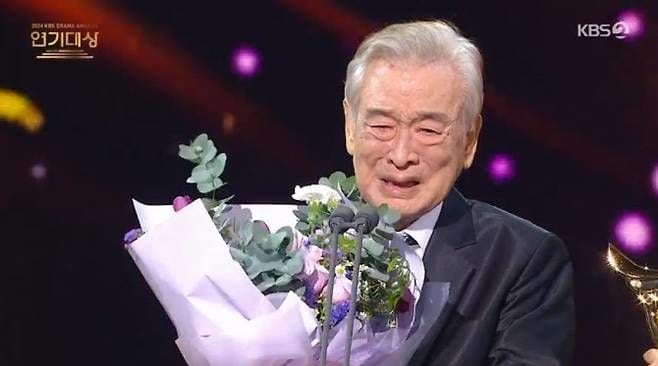
“You have done so much for me and helped me throughout my life. Thank you.”
Actor Lee Soon-jae, who was 91 years old, always put others before himself. He believed that one must learn more, give more, and always be prepared. For him, the audience came first, followed by the nation. Last year, when he received the Grand Prize at the KBS Acting Awards for Dog Knows Everything and spoke with tears in his eyes, the audience wept alongside him.
His first acting award in a career spanning nearly 70 years since his 1956 debut in the play Beyond the Horizon seemed long overdue. Yet Lee Soon-jae called it a “beautiful award” and expressed gratitude: “Thank you for evaluating my acting even after I turned 60.” Instead of focusing on his own glory, he apologized to his students, fearing his teaching might have suffered due to drama filming, and thanked all viewers for allowing him to continue acting.
From Dae-bal’s Father (What on Earth is Love) to Yadong Soon-jae (High Kick!) and Flower Grandpas (Grandpas Over Flowers), Lee Soon-jae, the “eternal active actor,” embraced every role. He passed away early on the 25th at a hospital, surrounded by family, after his condition worsened during rehabilitation for an illness. Even while hospitalized, he reportedly never let go of his scripts. “Art is eternally unfinished, and one must continuously challenge toward completion,” he once said. Though he never fully released his grip on acting, he had already established himself as an artist who perfected the “Lee Soon-jae” genre of performance. His funeral was held at Room 30, Asan Medical Center Funeral Hall in Bangi-dong, Songpa-gu, Seoul. His wife Choi Hee-jung, son Lee Jong-hyuk, and daughter Lee Jung-eun served as family representatives.
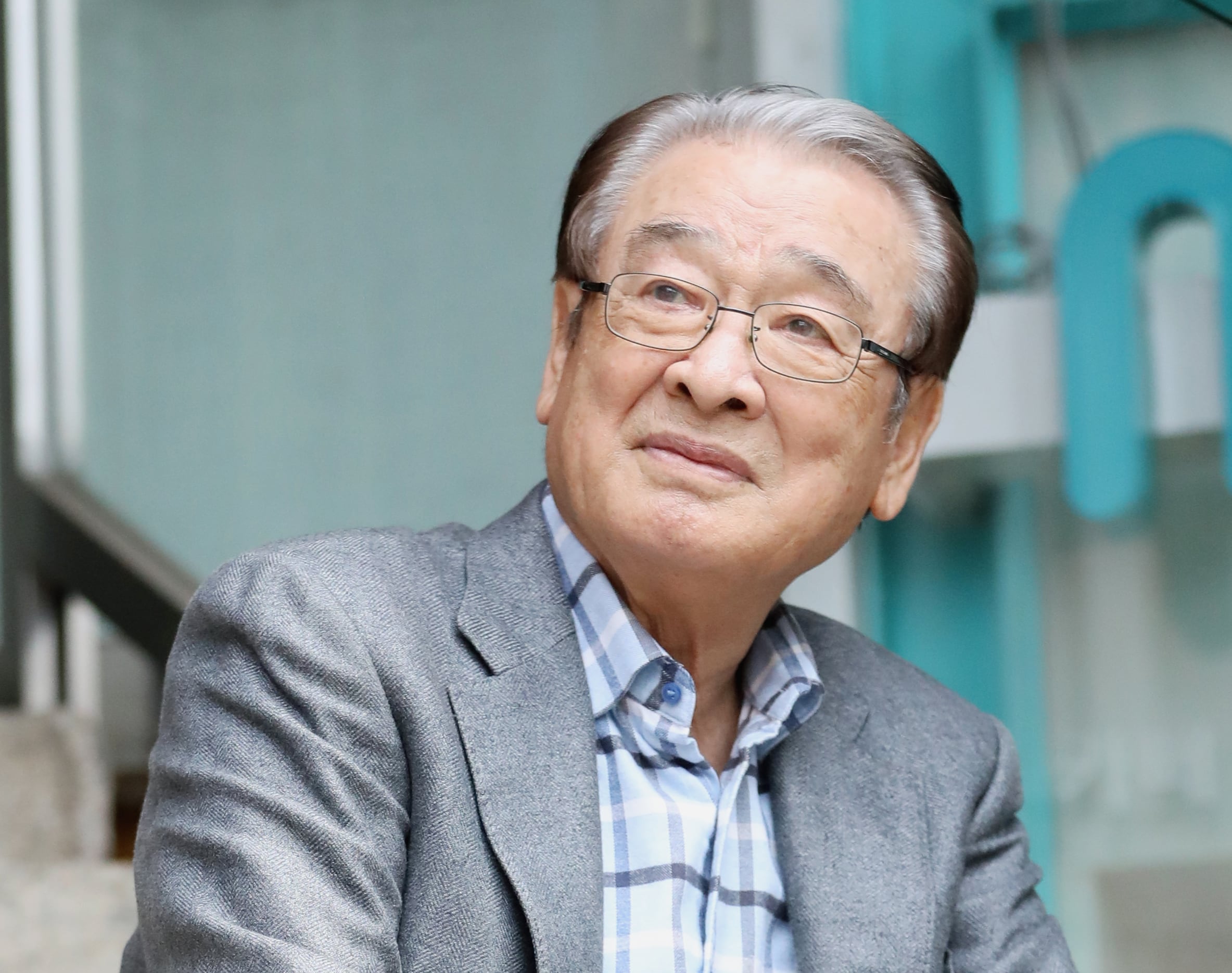
◇The Stage Continues, Even in Blood
Born in 1934 in Hoeryong, North Hamgyong Province, Lee Soon-jae moved to Seoul with his grandfather at age four. Though his grandfather Han Hak-ja was conservative, he instilled the value of caring for others. Lee experienced the Korean War during his time at Seoul High School. The scars of war and memories of abandoned children inspired his later dedication to volunteer work and giving back to children.
In 1954, he enrolled in the philosophy department at Seoul National University and fell into the “new world” of film after watching Laurence Olivier’s Hamlet. He discovered “art” in acting and devoured works by French director Jean-Louis Barrault. When he met Barrault, he spoke nonstop about his love for cinema: “I’ve seen everything by directors like Julien Duvivier, Luchino Visconti, and Roberto Rossellini. Great actors like Sophia Loren, Silvana Mangano, and Giulietta Masina—no classic I haven’t watched. Marcel Carné’s Thérèse Raquin is a must-see; the dialogue is poetry. But Olivier’s work gave me chills. It was true art. Back then, acting was seen as mere ‘entertainment,’ not art. Still, I had to do it.”
After graduating, he sought out Lee Hae-rang (1916–1989), a pioneer of modern Korean theater and leader of the Sinhyup Theater Troupe. He wanted to learn acting and hoped even a minor role might be offered. Lee Hae-rang’s “Dongbang Salon” was a hub for prominent playwrights, directors, and poets like Yu Chi-jin, Lee Jin-soon, Park In-hwan, and Kim Su-young.
Lee Soon-jae helped rebuild the Seoul National University Drama Club, which had nearly dissolved, and co-founded the Experimental Theater in 1960 with members including Kim Ui-kyung, Heo Gyu, Lee Ki-ha, Kim Seong-ok, Kim Dong-hoon, Lee Nak-hoon, Oh Hyun-kyung, and Yeo Woon-gye. He later described this as the “beginning of the small theater movement.”
True to his philosophy, he approached acting as both an artist and a professional, working harder than anyone. During a 2012 performance of Father, he tore the skin above his eye after colliding with a prop but finished the show, wiping blood away. His creed was: “An actor must perform until death.”
He continued acting until last year, when health issues forced cancellations. “When memory fails and NG after NG becomes a problem, that’s when to retire,” he said. For him, retirement was never an option.
◇“No Tolerance for Tardiness, Special Treatment, or Mispronunciation”
Though passionate about acting, the gap between romance and reality was vast. He once said he went hungry for his art. His first acting fee came in 1978 for Death of a Salesman. He turned to broadcasting for stability, joining TBC as a first-class talent in 1964. After TBC’s forced merger with KBS in 1980, he struggled initially. “I was offered the role of the Daewongun in the historical drama The Wind (1982). Few at KBS knew me, and the role required authoritative speeches. I quit smoking then—and never restarted.”
He hoped The Wind might earn him an award but received nothing. “I gave it my all,” he reflected. “But no award? What does that mean? The process mattered. Acting and directing can’t deceive the audience. They know. At least I quit smoking and became healthier.”
Strict with himself, he was equally demanding of juniors. As president of the Korea Broadcasting Actors Association in the 1970s–80s, he emphasized: “No tardiness, no special treatment, no mispronunciation.” He relearned pronunciation from dictionaries early in his career.
He was often the first to arrive at rehearsals and criticized the “side-script” production culture, advocating for pre-production systems now standard. Though vocal about improvements, he never cursed, saying, “Even in anger, I never uttered a harsh word.” He mentored aspiring actors at all hours, teaching at universities and, until recently, as a distinguished professor at Gachon University.
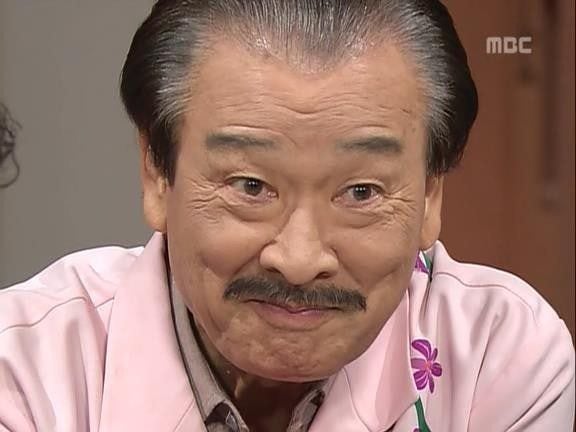
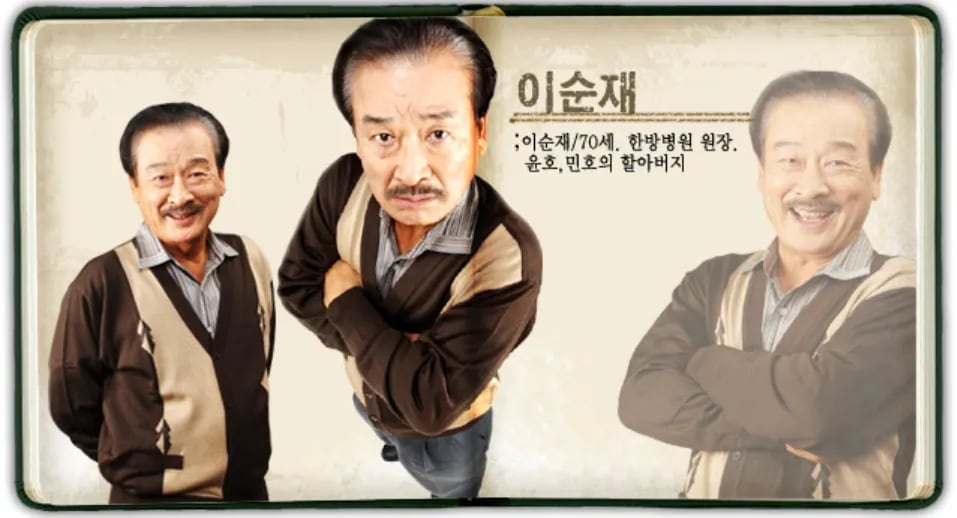
◇A Warm Father Who Spoke Truth
He believed criticism required flawless acting. He respected scripts and feared no challenge. In What on Earth is Love (1991), which achieved a 59.1% rating, he portrayed an authoritarian patriarch. In High Kick! (2006), he climbed roofs, watched adult videos, and delivered “high kicks” to defiant sons—exposing the hypocrisy of stern yet clueless men.
Called “a typical Korean father,” his roles mirrored his life. He regretted missing the births of his children due to acting. Overnight shoots and financial strain were common, but he thanked his wife for her endurance.
He rarely rested, starring in historical dramas like The Merchant, Jang Hui-bin, Immortal Admiral Yi Sun-sin, and Lee San, Wind of the Palace, as well as modern works like Heungbu’s Treasure. Even in old age, he performed in plays like Death of a Salesman, The Story of an Old Couple, Salut d’Amour, The Student and Mr. Henri, and King Lear, earning the nickname “Bangtan Nojon-dan” (Bulletproof Senior Group of Daehakro).
He briefly entered politics, winning a seat in the 14th National Assembly in 1992 as a Democratic Liberal Party candidate in Jungnang Gap, Seoul. He focused on culture and diplomacy, later serving as the first director of the Jungnang Culture Center in 1998. “Politics must connect with the public,” he said. “The first principle is national prosperity and people’s welfare. Why cling to power? Leadership that embraces the people is key.”
His first acting award, received last year at age 91, coincided with his debut drama I Will Become Human (KBS, 1961). Perhaps he spent his life teaching us how to live.
▲Born in 1934 in Hoeryong, North Hamgyong Province
▲Entered Seoul National University Philosophy Department in 1954
▲Debuted in the play Beyond the Horizon in 1956
▲Made television debut in I Will Become Human (KBS) in 1961
▲Served as 1st, 2nd, and 12th president of the Korea Broadcasting Actors Association (1971, 1972, 1978)
▲Received the TV Acting Award at the 9th Korea Broadcasting Awards (KBS drama The Wind, 1982)
▲Starred in What on Earth is Love (1991, 59.1% rating)
▲Elected to the 14th National Assembly (Democratic Liberal Party, Jungnang Gap) in 1992
▲Received the Merit Award at the KBS Acting Awards (1995 drama Men of the Bathhouse, 1996)
▲Appointed distinguished professor at Sejong University in 1998
▲Received the Special Acting Award at the MBC Acting Awards (drama The Legendary Doctor – Hur Jun, 2000)
▲Received the Merit Award at the SBS Acting Awards (2000)
▲Inducted into the MBC Hall of Fame (2002)
▲Received the Bogwan Cultural Medal at the Korea Popular Culture and Arts Awards (Ministry of Culture, Sports and Tourism, 2002)
▲Received the Grand Prize at the MBC Broadcasting Entertainment Awards (sitcom High Kick!, 2007)
▲Received the Merit Award at the 45th Baeksang Arts Awards (2009)
▲Received the Merit Award at the MBC Broadcasting Entertainment Awards (sitcom Roof-top High Kick!, 2009)
▲Received the Best Actor Award at the Chinese Golden Chicken Awards (film I Love You, 2011)
▲Appointed distinguished professor at Gachon University (2011–present)
▲Served as ambassador for the Welfare of Artists (Ministry of Culture, Sports and Tourism, 2016–2018)
▲Received the Special Award at the 27th Lee Hae-rang Theater Awards (2017)
▲Received the Eungwan Cultural Medal at the Korea Popular Culture and Arts Awards (2018)
▲Appointed ambassador for the Seoul Theater Association (2022–present)
▲Appointed ambassador for the Dream Theater Troupe (Korea Art & Culture Education Service, 2024)
▲Received the Grand Prize at the KBS Acting Awards (drama Dog Knows Everything, 2024)
▲Received the Performer Award at the 37th Korea PD Awards (drama Dog Knows Everything, 2025)


