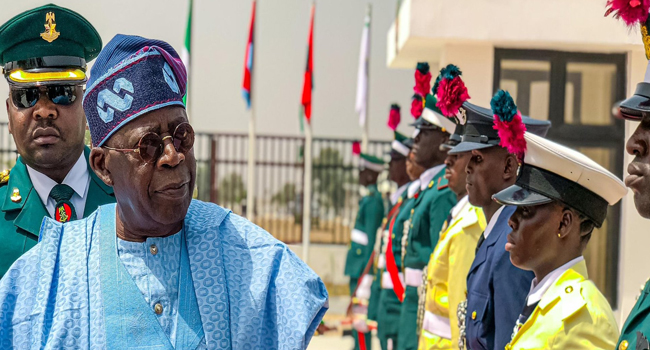
President Bola Tinubu’s Strong Stance on Security and Multilateralism
President Bola Tinubu, represented by Vice President Kashim Shettima, delivered a powerful message during the first plenary session on “Peace, Security, Governance and Multilateralism” at the 7th African Union–European Union Summit in Luanda, Angola. He emphasized that Africa’s security challenges must be addressed through state-led efforts rather than reliance on private military and security contractors.
Tinubu warned that the involvement of such private actors often complicates conflict resolution and undermines national sovereignty. He argued that coordinated responses from African governments are essential to tackle terrorism, transnational organized crime, and other regional threats.
He highlighted Nigeria’s alignment with its long-standing approach to regional peace missions under ECOWAS and the AU, emphasizing that these frameworks have proven effective in maintaining stability across the continent. Tinubu also pointed out that the global shift away from multilateralism has created a more fragile security environment, but he praised the EU for continuing to engage Africa on a “continent-to-continent basis.”
A Call for Reform and Regional Cooperation
Tinubu reiterated Nigeria’s commitment to strengthening peace and democratic stability across Africa, stating that the country is “more prepared than ever” to work with the EU to build “a stable, just and prosperous world.” He called for comprehensive reform of the global governance system, including the need for Africa to have permanent seats on the UN Security Council with veto-wielding authority.
He urged the EU to co-create peace and security initiatives alongside African partners, anchored on African-led frameworks. This, he said, would be a pathway to achieving sustainable stability across the continent.
Tinubu also shared positive developments in Nigeria’s fight against Boko Haram, noting that over 250,000 individuals affiliated with the group had surrendered following the government’s kinetic and non-kinetic measures. He stressed the importance of addressing armed conflict, illicit weapons, climate pressures, irregular migration, and political instability through stronger cooperation.
Strengthening Regional Stability
The Nigerian leader acknowledged the EU as one of the AU’s most reliable partners since the creation of the African Peace and Security Architecture in 2002. He noted that regional instability, if left unchecked, fuels terrorism, insurgency, banditry, and transnational organized crime.
To address this, Tinubu highlighted the effectiveness of the Multinational Joint Task Force in the Lake Chad Basin as an example of African-led cooperative security. He also mentioned the recent Sea-Lift Agreement between the Nigerian Navy and the AU Standby Force, which enhances Africa’s rapid deployment capabilities for peace operations and humanitarian support.
On the issue of irregular migration, Tinubu proposed structured labor pathways, such as Nigeria’s Technical Aid Corps for cooperation within the Global South and Business Process Outsourcing. He emphasized the need to convert mobility into safe, orderly, and productive pathways that benefit both continents.
Addressing Unconstitutional Changes of Government
Tinubu expressed concern over the resurgence of unconstitutional changes of government in Africa, which he said undermines the democratic foundations of the African Union. He called on the European Union to work closely with African partners to address the structural drivers of these crises.
Nigeria and its neighbors have initiated the Regional Partnership for Democracy, an initiative aimed at strengthening constitutional order, countering extremist narratives, combating disinformation, and supporting governance reforms across West Africa.
Calls for Emergency Measures
Meanwhile, Prof. Bolaji Akinyemi, Chairman of the Governing Council of the Nigerian Institute of International Affairs, called on President Tinubu to declare a nationwide state of emergency on security, backed by extraordinary measures. Security fears have spiked following incidents such as the killing of an Army Brigadier General and the abduction of over 300 pupils.
Akinyemi recommended suspending the military retirement laws mandating exit after 35 years of service or upon attaining 60 years of age. He also urged a nationwide recruitment drive into the Nigerian Armed Forces to strengthen military presence across the country.
He further suggested that constitutional immunity for governors should be suspended so they can be held accountable if terrorist groups continue to operate freely in their domains. States where terrorism persists may be placed under temporary military administration.
Finally, Akinyemi called for the establishment of a military tribunal to prosecute terrorists and their collaborators, urging decisive action to safeguard Nigeria’s sovereignty and security.


