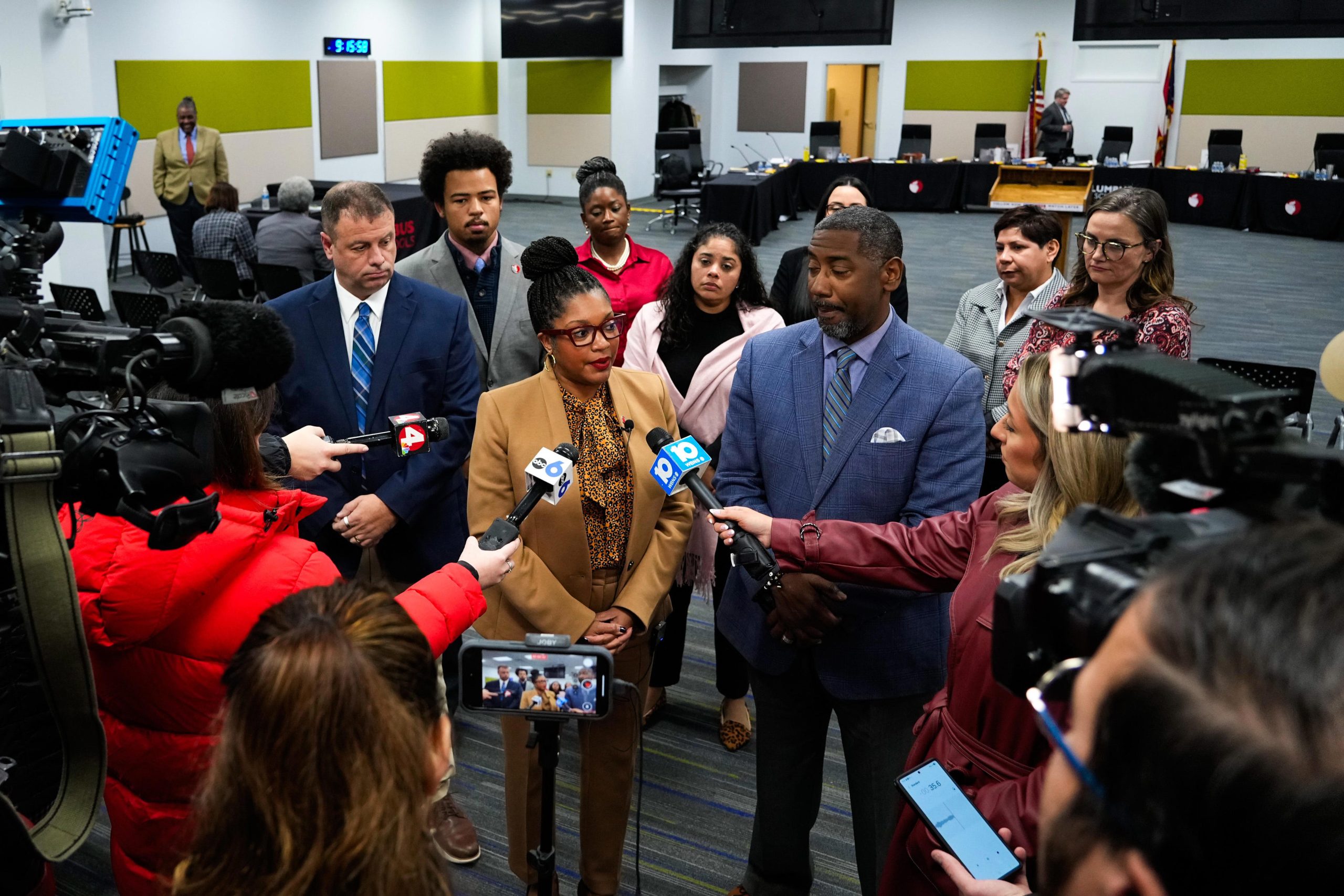
The Columbus City school board voted Dec. 2 to slash jobs, cut district programs and close four buildings in order to patch a $50 million hole in its budget, capping a months-long process.
However, the board did not vote to remove school bus transportation for high school students after contentious discussion and two failed votes to do so.
In total, the approved cuts amounted to roughly $50.4 million. Superintendent Angela Chapman said “the entire process has weighed heavy on our hearts and minds.”
“We know we’re talking about jobs, we are talking about the livelihoods of our employees, we are talking about reducing supports to our schools at a time when we know our students need more,” Chapman said. “We take these decisions very heavily and they weigh on us. This is just the beginning.”
During the meeting, more than 100 parents, community members and district employees were in attendance, with many of them expressing their concern about a number of the proposed cuts during public comment.
In August, the board approved a resolution to cut as much as $50 million from its budget as it faces an over $100 million deficit. Over the next three months, the board outlined options it should consider in making cuts.
At the board’s Nov. 18 meeting, Superintendent Angela Chapman shared a review of the recommendations, including proposals to cut as many as 445 jobs, with hundreds of cuts coming from teaching and staff positions, eliminating transportation for some students and closing more schools. The options totaled $61.9 million, giving the board choices about what cuts to enact.
Board President Michael Cole said to the media that the cuts represented “real, deliberative transparent conversation about what our issues are.”
“We need to come together as a community, not just internally, but I see the light at the end of the tunnel,” Cole said. “This is a can-do city, this is an opportunity city.”
Board votes to cut jobs, programs, close schools
The board approved two budget cuts to administration, faculty and staff. Personnel costs, including pay and benefits, make up over 83% of the district’s budget and are the largest source of expenses.
The board voted unanimously to cut up to 56 central administrators and up to four school-based administrators for the 2026-2027 school year. Members also voted unanimously to cut $25.9 million in district faculty and staff effective for the 2026-2027 school year, after lowering the amount from $34.6 million. It is unclear how many positions the figure represents and Treasurer Ryan Cook said those figures would need to be worked out in coming months.
Chapman has until Jan. 31, 2026 to identify which positions will be cut.
The board also voted unanimously to close several buildings:
- Duxberry Parks Arts Impact Elementary school will be closed and moved to another, unspecified location by the 2027-2028 school year.
- Fairwood Alternative Elementary School will close after this school year.
- Como Elementary School will close during the 2027-2028 school year
- Columbus Gifted Academy will close during the 2027-2028 school year, but the program will be moved to another, unspecified school building
The board also voted to cut $8.8 million in programs and to discontinue K-8 transportation for students who lottery into a non-100% lottery school. Both measures passed unanimously.
Votes on busing for high schoolers proved contentious
Both measures to cancel busing for high school students failed after contentious debate about whether doing so without a concrete plan was a wise decision. The board had indicated that the district might provide passes for high school students to travel aboard Central Ohio Transit Authority (COTA) buses.
Board Member Christina Vera said that “the fact that we don’t have a plan in this moment is very concerning.
“What does it look like to put a 14-year-old right out of eighth grade standing at a bus stop at six in the morning? COTA is not going to alter their time or pickups to accommodate our schedule,” Vera said. “And I have asked where COTA is in this conversation, I have asked where our elected officials are.”
The vote to stop busing high schoolers failed 5-2, with only board Vice President Jennifer Adair and member Sarah Ingles voting in favor.
During the vote to remove high school transportation and provide high schoolers COTA passes, Adair became frustrated and said that if they cut transportation and spent general fund money to provide COTA passes to CCS students, they would also have to provide them to charter and nonpublic students. Under state law, if a charter or nonpublic student needs to be transferred more than once, CCS would be required to transport them using a school bus.
“That means we cannot get our academic program, and that means we lose more of our people,” Adair said to applause from the audience. “I do not think we need to be buying COTA passes for charter-nonpublic students, I do not think we need to be routing yellow buses when they cannot get to their school.”
The second vote ultimately failed 4-3, with Adair, Ingles, Vera and Tina Pierce voting against the measure.
Instead, the board voted unanimously to approve a work group that would direct the superintendent to work collaboratively with COTA and other central Ohio leaders to develop a plan for using mass transit to bus high schoolers and provide regular updates. COTA already provides free bus passes to CCS students.
Union leaders: CCS job cuts are a ‘quick fix’
Lois Carson, president of the Ohio Association of Public School Employees, which represents janitors, bus drivers, and other district staff, said that the decision to cut district employees was a “quick fix.”
“It was easier for the board tonight to cut staff tonight than cut some of the other recommendations,” Carson said. “We need to look at the big picture, the whole thing – we need staff in buildings to take care of the needs of our children.”
John Coneglio, president of the Columbus Education Association, which represents teachers, counselors and other educators, said that no organization “cuts its way to success.”
“If the district is going to consolidate, what is their plan to attract and retain students?” Coneglio said. “I think this board is incapable of making any really tough decisions, and the easiest decision for them was to cut staff.”
Why is the district making these cuts?
According to financial projections, the district will run out of money by fiscal year 2029. Presently, the district has more than $300 million in reserve cash.
The discussion around $50 million annual budget cuts comes amid a variety of pressures on the district, including less-than-expected funding from the state, federal funding uncertainty and inflation.
While district voters approved a $100-million levy in 2023, Chapman previously said that levy added just over $38 million into the district’s operating fund. The rest was allocated to a permanent improvement fund.
CCS also faces a growing penalty from the state for noncompliance related to the transportation of charter and nonpublic students. In fiscal year 2025, the penalty is projected to be assessed at $10 million, and from fiscal year 2026 to 2029, the transportation penalty is projected at $15 million, according to data presented on Aug. 13.
Read more of our coverage of CCS budget cuts here:
Cole Behrens covers K-12 education and school districts in central Ohio. Have a tip? Contact Cole at cbehrens@dispatch.com or connect with him on X at @Colebehr_report
This article originally appeared on The Columbus Dispatch: Columbus school board votes to slash jobs, close schools to save $50M

Related posts:

Fiction park: He was the best in class. He still wasn’t good enough

Gagan Thapa takes oath as Congress president, vows to regain public trust

Inside knowledge that has locals gripped by fear after gran’s body found decomposing in cattle dip

New property purchase disclosure rule in Japan sparks fears it may curb foreign investment

Dino-mite treasures: inside Singapore’s Fort Knox storing playthings of ultra-rich