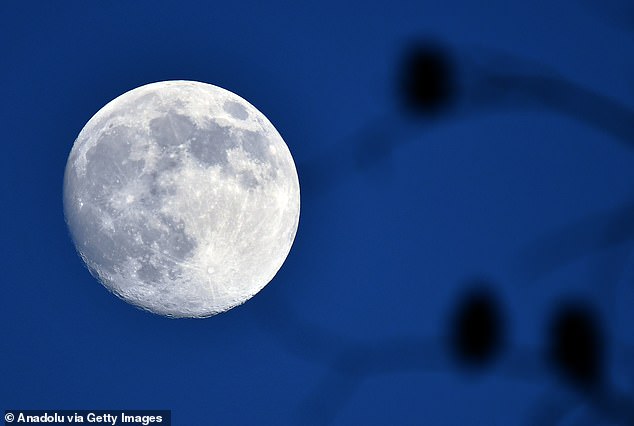
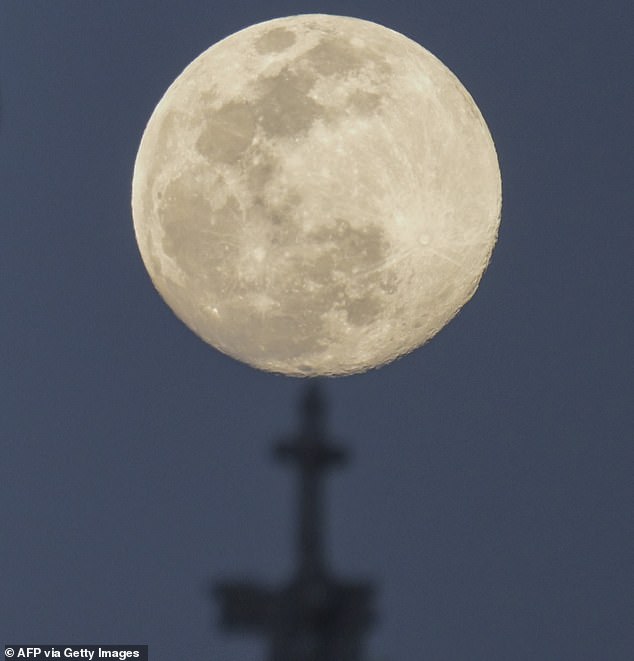
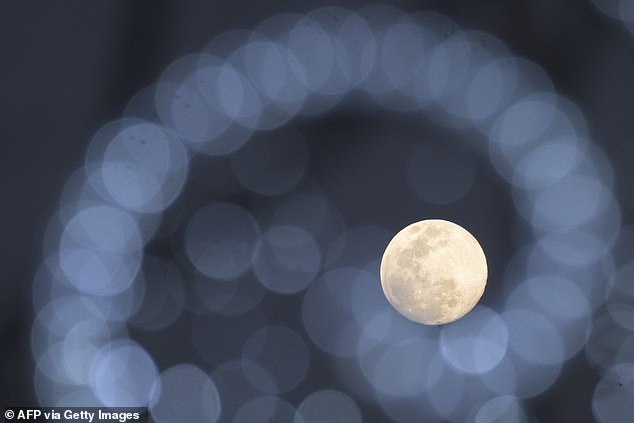
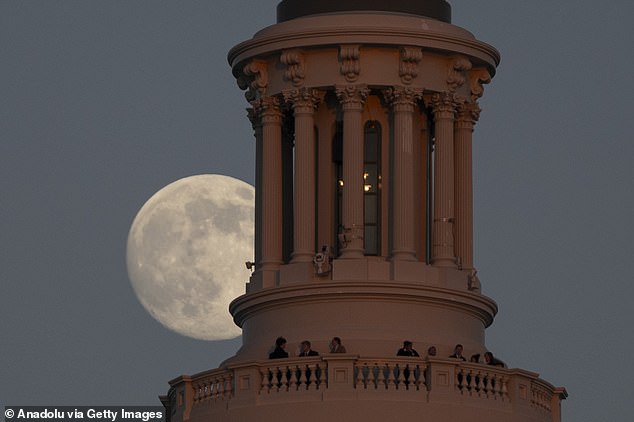
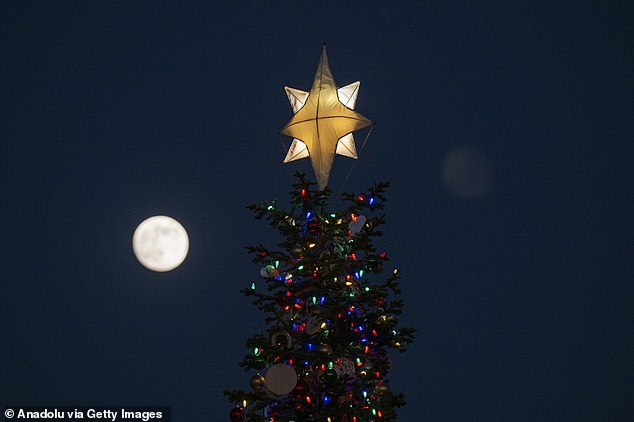
The third and final ‘supermoon’ of the year arrives tonight – providing a festive spectacle like no other.
Our moon will appear as a big, bright round glistening white orb, like a huge shining snowball frozen in motion.
Photos from the last 24 hours show it already looking unusually immense and milky white – but it’s set to be even bigger and shinier tonight.
It’s all because our lunar neighbour is closer to Earth than usual.
Dr William Alston, astrophysicist at the University of Hertfordshire, said the moon will be around 221,965 miles away from Earth just after 11pm GMT.
In contrast, the average distance between the moon and the Earth is 238,855 miles.
‘The term supermoon is used to describe full moons that appear larger and brighter than typical full moons,’ Dr Alston said.
‘The December 2025 full moon will be the final supermoon of the year. It will genuinely be slightly closer and therefore appear larger and brighter.’
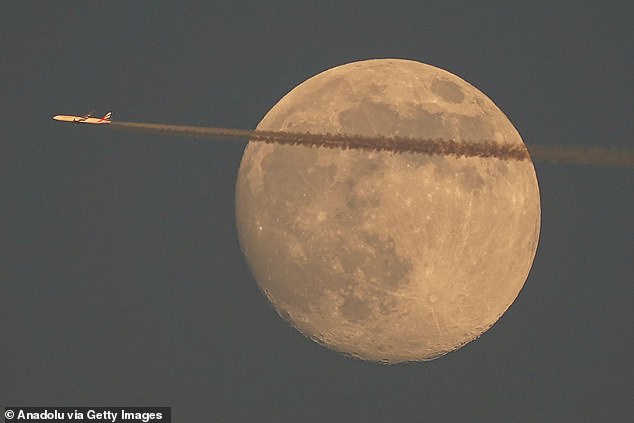
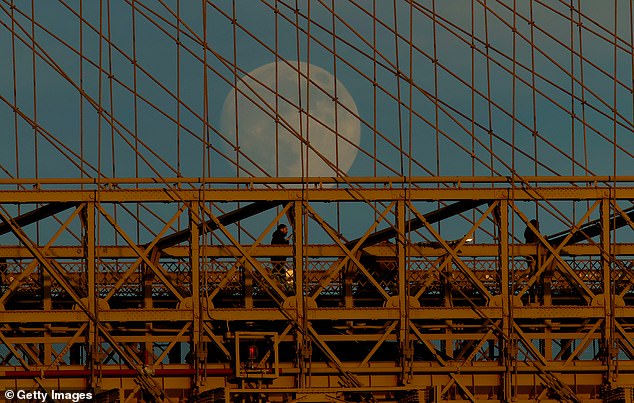
Most people know that a full moon is simply our moon at 100 per cent illumination (when its full surface is catching the sun’s light, as seen from Earth) while a ‘supermoon’ is a full moon that appears bigger and brighter than a normal full moon.
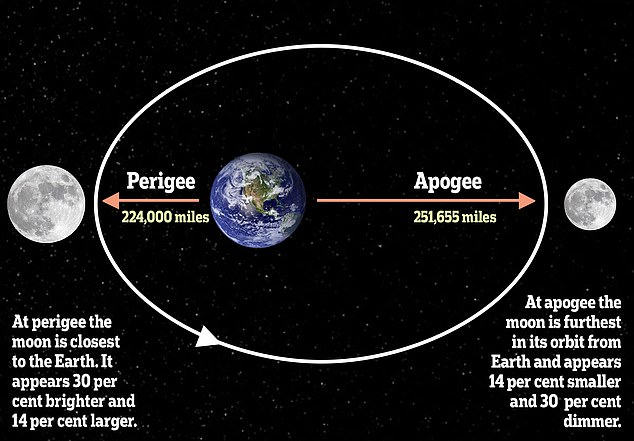
Supermoons occur because the moon orbits the Earth on an ‘elliptical’ path – one that’s not perfectly circular.
This means there is a point in its 29.5-day orbit where it is closer to the Earth, known as ‘perigee’ (in contrast the furthest away in its path is known as apogee and results in a ‘micromoon’).
‘At this perigee stage, the moon can appear up to 14 per cent larger and 30 per cent brighter than an average full moon,’ said Dr Alston.
Tonight, the best time to view will be 23:14 UK time (18:14 EST) – at which point the moon will be at its fullest phase and about 221,965 miles (357,219 km) away, appearing exceptionally big and bright.
However, the awesome spectacle can be enjoyed from the moment the moon appears in the east above the horizon – around 14:52 GMT.
You’ll be able to spot the full moon rising just after sunset (15:53 GMT), glowing low on the eastern horizon. As it climbs higher, its colour will shift from a warm amber to the familiar bright white.
‘Generally, the moon is visible in daytime, but it will get better as darkness falls,’ the academic added.
Even in the hours before perigee, the moon will appear big and bright throughout this evening – so you’ll still be able to enjoy it if you want an early night.
While anyone will be able to see the moon, the best photo opportunities will be in areas of low light pollution, far away from street lamps and city lights.
Those at higher altitude will get a clear view of the spectacle, because they’ll be above the dense air at low altitudes that contains haze, fog and smoke that mask your view of the sky.
Good examples include the Primrose Hill in London, Snowdonia National Park in South Wales, Exmoor National Park in Devon, and South Downs National Park in Sussex and Hampshire.
The latest forecast from the Met Office reveals cloud and rain will be confined to northern England and Scotland – although they may be fog in eastern England with frost forming under clear skies.
A Met Office spokesperson told the Daily Mail: ‘There will be some clear skies tonight across large parts of England and Wales.
‘As the front that is bringing this morning’s rain clears slowly to the North East, clear skies will develop across southern England, Wales and the Midlands through the evening.
‘There will still be cloud across much of Northern England, Scotland and Northern Ireland this evening and into the early hours of tomorrow morning – so good visibility of tonight’s moon for lots of people across Wales and the bottom two thirds of England.
‘Under these clear skies temperatures will drop away quite sharply this evening, especially in the south east, so there is a chance of a frost and a few patches of fog developing in the south east corner of England.’
Although you don’t need expensive gear to enjoy the supermoon, a pair of binoculars can reveal remarkable lunar surface features, according to telescope expert Alan Jones at 365 Astronomy.
‘Telescopes with modest apertures, such as a 4-inch refractor or a 6-inch Newtonian reflector, can provide stunning views of the moon,’ he said.
‘If using a telescope, always aim to observe the moon when it’s high in the sky to minimise distortion caused by Earth’s atmosphere.’
Not every full moon is a supermoon – there are only usually three or four supermoons in a year, compared with 12 or 13 full moons.
This year, there’s just three supermoons – on October 7, November 5 and finally December 4, according to NASA.
There will also be three supermoons in 2026, the first arriving on January 3.
Whenever the full moon appears, it is given a nickname depending on the month of the year – a tradition that goes back hundreds of years.
So January is Wolf Moon, February is Snow Moon, March is Worm Moon, April is Pink Moon, May is Flower Moon and so on.
December’s full moon is known as Cold Moon due to nights at this time of year being the longest and a winter chill in the air.
Read more
- Why is tonight’s breathtaking supermoon set to be the biggest and brightest spectacle of the year? Discover when to catch this jaw-dropping lunar event!
- Missed tonight’s dazzling supermoon spectacle? Fear not! Could upcoming November’s Beaver Moon be even better visibility-wise?
- How will next week’s colossal Harvest Supermoon brighten up the night sky?
- How can you get the clearest view of tonight’s mesmerizing supermoon spectacle?
- Will this year’s largest supermoon illuminate the sky brighter and bigger than ever?