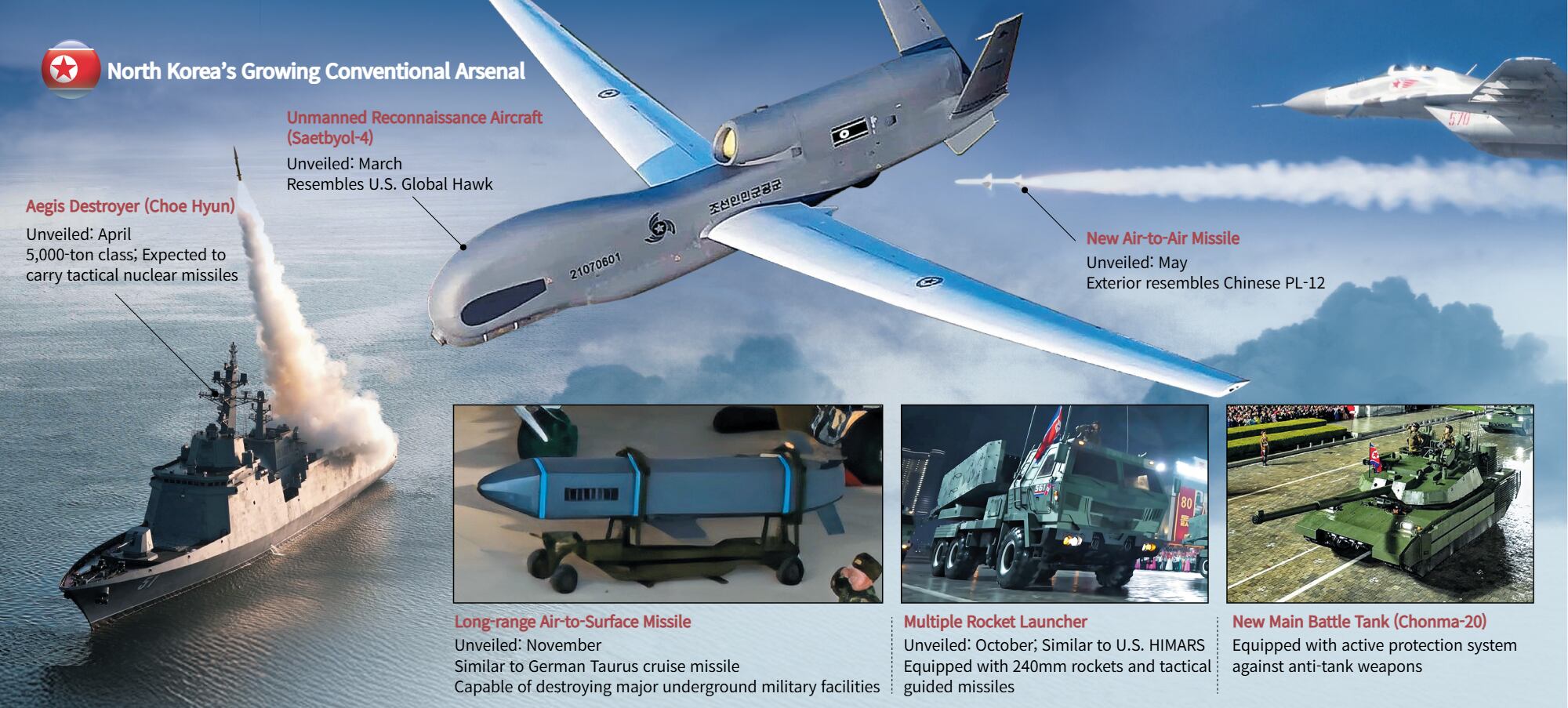
North Korea unveiled a missile presumed to be a long-range air-to-surface missile, dubbed the “North Korean version of Taurus,” at an event marking the 80th anniversary of its air force establishment last month. The German-made Taurus (KEPD 350) is an air-launched cruise missile capable of precision-guided strikes on targets up to 500 km away, and the North Korean missile unveiled this time has a similar external shape. South Korea’s military is currently using Taurus as a bunker buster to neutralize North Korean bunkers. If this missile becomes operational, North Korea could strike major underground facilities of South Korea’s military in the capital region from above Pyongyang. North Korea also unveiled a new air-to-air missile estimated to mimic Germany’s IRIS-T and precision-guided bombs. All of these are conventional military capabilities that South Korea had considered itself to have an absolute advantage over.
◇Rapid Growth in North Korea’s Conventional Forces…Has It Acquired Technology to Surpass South Korea?
South Korea’s military views this recent public display of air force capabilities as part of North Korea’s ongoing efforts to strengthen its conventional forces. In May, North Korea unveiled live-fire training for a new medium-range air-to-air missile launched from a fighter jet. South Korea began a domestic development project this year to replace existing U.S.- and European-made air-to-air missiles, but North Korea has already developed and successfully tested them. North Korea is also operating unmanned aerial vehicles (UAVs) resembling the U.S. attack drone “Reaper” and the surveillance drone “Global Hawk.” A source from the military said, “North Korea’s air force capabilities are still assessed to be inferior compared to South Korea’s, but recent movements to strengthen its forces are notable.” Until two to three years ago, North Korea had effectively abandoned air superiority due to aging fighter jets and a shortage of aviation fuel, failing to conduct proper training. However, this trend has recently changed.
Naval capabilities are also growing. In April and June, North Korea launched the 5,000-ton-class “Choe Hyon” and “Kang Kon” destroyers, dubbed the North Korean version of Aegis-equipped warships. North Korean leader Kim Jong-un stated at the launch ceremony of the Choe Hyon, “Our navy’s activities cannot remain confined to our territorial waters and must extend to the open seas.”
Developments in the army’s conventional forces are also notable. During a military parade in October, North Korea unveiled a new multiple rocket launcher (MRL) similar to the U.S. “HIMARS,” equipped with 240 mm rocket rounds and tactical guided weapons. The parade also showcased the new tank “Chonma-20.” According to People Power Party lawmaker Yu Yong-weon, the Chonma-20 is equipped with an active protection system against anti-tank weapons. While its performance remains unknown, this system is not present in South Korea’s K2 “Black Panther” tank, which the military is still developing.
◇Full-Scale Implementation of the Nuclear-Conventional Force Parallel Development Policy
North Korea’s push to develop and strengthen conventional weapons appears driven by the judgment that its nuclear capabilities have reached a certain level. Lee Sang-kyu, head of the Korea Institute for Defense Analyses (KIDA) Nuclear Security Research Division, recently projected that North Korea possesses up to 150 nuclear warheads and could have around 200 by 2030 and 400 by 2040. Intercontinental ballistic missiles (ICBMs) capable of carrying nuclear warheads have also diversified. North Korea has developed the Hwasong-18, a mobile-launched ICBM with a range of 15,000 km, which can be launched immediately.
However, there is consensus that even such nuclear weapons are less effective without conventional support. Yu Yong-weon said, “North Korea is assessed to have already developed somewhat advanced nuclear weapons. However, with conventional weapons lagging as they are, if only nuclear weapons are neutralized, it would be difficult to properly wage war, so they appear to be considering countermeasures.” In September, Kim Jong-un visited a weapons research institute and stated, “At the 9th Party Congress next year, we will present a policy of parallel development of nuclear and conventional forces.” This is interpreted as a commitment to invest more to balance conventional forces, which lag behind nuclear capabilities.
Some argue that Kim Jong-un’s mentioned policy of parallel nuclear-conventional force development resembles the U.S.-South Korea integrated nuclear-conventional (CNI) strategy. CNI is a strategy to counter North Korea’s nuclear threats by combining U.S. nuclear capabilities with South Korea’s advanced conventional forces. The leaders of South Korea and the U.S. officially adopted this system through the “Washington Declaration” in 2023. There are also comments that North Korea is aligning with the global trend of arms races. A military official said, “With global arms expansion competitions unfolding due to the Russia-Ukraine war, Israel-Hamas war, etc., North Korea is also showing a tendency to follow this trend.”
◇Strengthening Capabilities Through Russian Technology Transfers and Hacking
The rapid strengthening of North Korea’s conventional weapons capabilities is underpinned by its strengthened relations with Russia following the Ukraine war. Many recently unveiled weapons show signs of Russian technology. The new air-to-air missile unveiled in May is externally similar to China’s “PL-12,” suggesting North Korea may have received technology transfers from Russia, as China is also known to have received such transfers from Russia. The Choe Hyon, North Korea’s Aegis-like destroyer, is estimated to be equipped with Russian systems. Its cruise missile resembles Russia’s hypersonic “Zircon,” and the four-faced phased array radar mounted on its mast is similar to radars on Russian ships. The Choe Hyon’s combined air defense system also appears similar to Russia’s “Pantsir.” The airborne early warning and control aircraft unveiled in March is analyzed as an Il-76 transport plane with a radar attached, a Russian model.
Hacking is also being used as a means to strengthen North Korea’s conventional forces. German defense company Diehl Defense was attacked by North Korean hacking unit “Kimsuky” last year. Diehl Defense produces air-to-air missiles like the IRIS-T. The new air-to-air missile unveiled by North Korea last month resembles this missile. North Korea has also hacked South Korea’s submarine technology in the past.
While Kim Jong-un’s push for modernization of conventional weapons may not pose an immediate threat to South Korea’s military, many argue it should be guarded against in the medium to long term. Cha Du-hyeon, deputy director of the Asan Institute for Policy Studies, said, “If North Korea’s close ties with Russia continue for the time being, it is estimated that it will take 5–10 years for North Korea to balance conventional forces to the extent that they pose a threat to South Korea.” Some argue that North Korea’s improved conventional weapons capabilities have increased the likelihood of localized provocations. While nuclear weapons are strategic and cannot be easily used, conventional weapons could be used for localized provocations in areas like the Northwest Islands.
Kim Jong-un Likely to Announce New 5-Year Defense Plan Next Month
North Korea’s modernization of conventional weapons is part of the “Five-Year Defense Development Plan” formalized in 2021. This plan is similar to South Korea’s mid-term defense planning. While the core of the plan is strengthening nuclear weapons, its details include enhancing conventional forces.
North Korea has not disclosed specific project plans, but some were mentioned at the December 2023 plenary meeting of the Party Central Committee. The details include enhancing naval underwater and surface capabilities, developing UAVs, developing electronic warfare equipment, and expanding conventional weapons factories. The Defense Intelligence Command has assessed that many of the tasks in North Korea’s Five-Year Defense Development Plan have progressed. Hong Min, a senior researcher at the Korea Institute for National Unification, said, “While North Korea’s strengthening of conventional forces is fundamentally based on the Five-Year Defense Development Plan, the pace has recently accelerated. This is likely influenced by the rapid transfer of Russian technology due to North Korea-Russia rapprochement.”
Kim Jong-un is expected to elaborate on the “nuclear-conventional force parallel development” policy he mentioned this year at the 9th Party Congress in January next year. A new defense plan is needed as the existing Five-Year Defense Development Plan has been completed. A military official said, “It is expected that a military parade will be held on the occasion of the Party Congress to present a blueprint for strengthening new conventional weapons systems.”
However, some argue that given North Korea’s current situation, the nuclear-conventional force parallel development policy could backfire economically. As one of the world’s poorest countries, North Korea’s economy could collapse if it invests astronomical budgets into strengthening conventional forces. According to the Bank of Korea, North Korea’s gross national income (GNI) last year was 44.4 trillion Korean won, less than South Korea’s defense budget of 59 trillion won. Even the portion of South Korea’s defense budget allocated to weapons-related (defense improvement) expenses was 17.6532 trillion won, accounting for 40% of North Korea’s GNI. Park Won-gon, a professor at Ewha Womans University, said, “Just as the former Soviet Union collapsed due to excessive defense spending to counter the U.S. ‘Star Wars’ plan, full-scale investment in conventional weapons will deal an unbearable shock to North Korea’s entire economy.”
☞Nuclear-Conventional Force Parallel Development Policy
A plan for the integrated development of nuclear and conventional weapons mentioned by Kim Jong-un in September. The aim is to strengthen conventional forces, which lag behind nuclear capabilities.
☞Star Wars Project (SDI)
Strategic Defense Initiative proposed by U.S. President Ronald Reagan in the 1980s. It was a plan to intercept Soviet nuclear missiles by deploying satellites in space. The former Soviet Union poured massive budgets into defense to respond, accelerating its collapse.


