For many Brits, a beer at the pub washed down with a salty snack is no doubt one of life’s greatest pleasures.
What’s more uncertain, it seems, is where exactly these Great British delicacies come from.
Experts at British Lion Eggs surveyed 2,000 British adults about their knowledge and opinions on nibbles commonly found behind the bar.
Scotch eggs, pork scratchings and pork pies were found to be among the nation’s favourites – but many were left scratching their heads over their origins.
Half wrongly said Scotch eggs originated in Scotland, while nine out of 10 didn’t know where the famous pork pie comes from.
Only 7 per cent knew the region where pork scratchings originated during the days of the Industrial Revolution.
‘We Brits take our pub snacks seriously, but it seems the history of where they come from has been lost,’ said Nick Allen at British Lion Eggs.
So do you know where these classics came from?
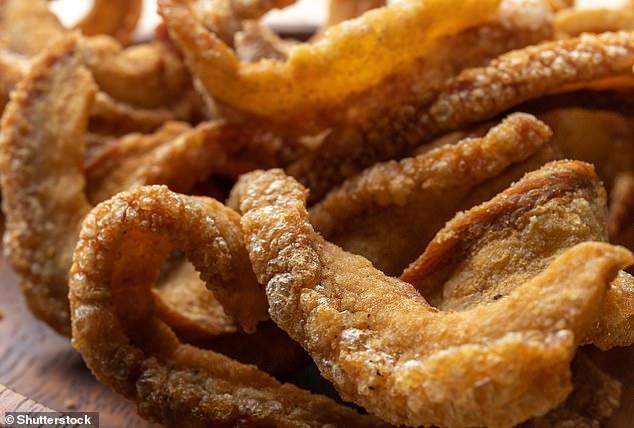
PORK SCRATCHINGS
There’s little that can repulse a vegetarian quite like a packet of pork scratchings – but no decent pub would be without them
These ultra-crunchy bites are simply salted and deep-fried pork skin, specifically from a pig’s shank – the top part of its hind leg.
They’re thought to have developed in the 19th century among West Midlands pig-keepers who fried leftover rind.
The snack became a signature of the region’s pubs and taverns before gaining popularity around the country.
In the survey, 7 per cent of respondents correctly identified where pork scratchings originated, while 24 per cent ranked it among their favourites.
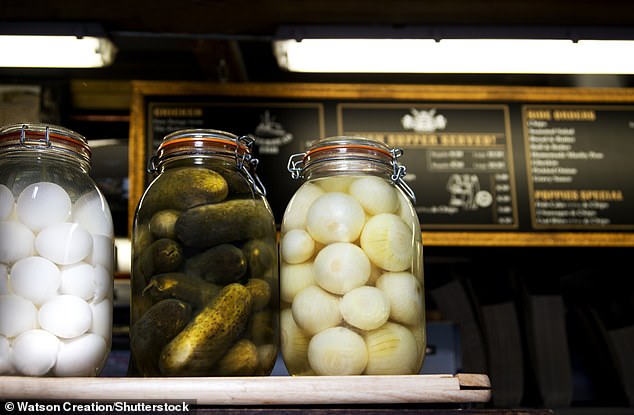
PICKLED ONIONS
Pickling is thought to have been around thousands of years as a method to preserve vegetables, particularly in regions with colder climes.
But the trend of pickling onions in jars and serving them up to peckish pubgoers can be traced back to East Anglia, according to the experts.
Pickled onions are linked to East Anglia’s long history of onion growing, particularly in Norfolk and Suffolk.
Pickling was a common way to preserve crops from at least the 18th century, although the Romans introduced us to pickling and sousing foods.
PICKLED EGGS
Equally likely to be found behind the bar in large jars – and a perfect companion to a pint of dark ale – are pickled eggs
According to the experts, pickled eggs date back a couple hundred years to Northern England – likely Lancashire and Yorkshire.
They were popularised in 19th-century northern pubs, where eggs were preserved in vinegar as a cheap, long-lasting source of protein.
In the survey, only 3 per cent of respondents correctly identified where pickled onions came from, while 10 per cent knew where pickled eggs came from.
SCOTCH EGG
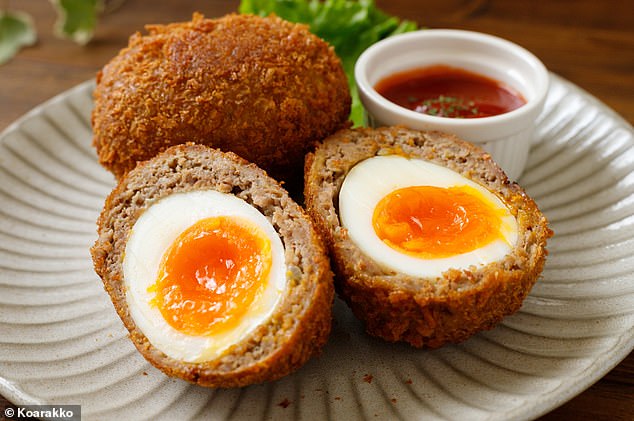
Despite the name, the Scotch egg – a boiled egg wrapped in seasoned sausage meat and breadcrumbs – is not Scottish at all.
More than half (51 per cent) wrongly said Scotch eggs originated in Scotland, but in fact, to scotch is an 18th-century term meaning to cut, score or roughly mince.
While we know the Scotch egg is English, where exactly it came from is still a hotly contested matter.
The most popular claim is it was devised up in Whitby, Yorkshire in the 19th century, but originally used fish paste before switching to sausage meat.
But the name in those days was ‘Scotties,’ allegedly because they were made at an eatery by the name of William J Scott & Sons close to the seafront.
Fortnum & Mason – the London department store founded in 1707 – claims to have invented the scotch egg in 1738, although it doesn’t offer documentary proof.
‘The first and the best, we created the Scotch Egg in 1738 as a meal for travellers heading west from Piccadilly,’ Fortnum & Mason says.
‘At the time, we referred to it as a “scotched” egg because of anchovies added to the meat to give it a stronger flavour, and to cut through the fattiness of the meat.’
PORK PIE
It’s little surprise that this was the pub delicacy whose origin was correctly identified by more respondents than any other snack – 12 per cent.
That’s because the town of Melton Mowbray in Leicestershire goes hand-in-hand with the famous pork pie – a pie like no other.
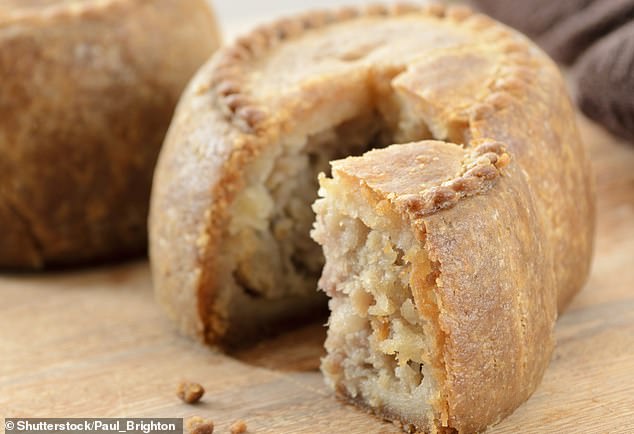
Traditionally served cold, it features roughly chopped pork and pork jelly sealed inside a dense hot-water-crust pastry.
The pork pie as we know it was allegedly developed in the early 1800s in hunting country around Melton Mowbray.
Bakers in the Melton Mowbray area began producing these pies for gentlemen who had come up for the hunting, but its origins may go back further.
According to The Oxford Companion to Food, it is a direct descendant of the medieval raised pie (‘coffyn’), in which a sturdy crust acted as packaging for something more delicate, such as game.
HALF A PINT OF PRAWNS
While not found at every public house across the land, a half-pint of prawns is a seaside pub tradition dating back to Victorian times.
Experts say it originates around the south-east English coast – notably Whitstable in Kent and Southend-on-Sea in Essex.
Exact origins are unclear but firmly tied to these fishing communities in Kent and Essex coastal towns.
SAUSAGE ROLLS
A more trendy occurrence in today’s pubs is the sausage roll, likely served on a wooden board with an array of condiments.
The sausage roll emerged in early-19th-century London, combining British sausage meat with French-style puff pastry.
It quickly became a street-food, bakery and fast-food favourite – and is now commonly associated with Greggs, the chain founded in Newcastle upon Tyne.
Read more
- Is the traditional Scotch egg disappearing? Uncover the thrilling history and current status of this iconic British bar snack!
- Why has a historic Yorkshire town been sent into a frenzy over the delicious aroma of scotch eggs called ‘the best ever’ by locals?
- Which quirky British food names sound like they were coined in a late-night pub brainstorm?
- Why are Brits flocking to a quaint Italian diner offering peculiar UK delicacies like Cornish pasties and Jack the potato?
- Are Aussie expats flocking to Aldi for Britain’s nostalgic tinned steak kidney pie and mushy peas? Find out why these divisive snacks are causing a stir!