“The government hopes export companies will sell some of the dollars they earn on the market to ease high exchange rate pressures, but companies on the ground are protesting, ‘We have no dollars to sell.’ They argue that with massive investments in the U.S. required starting next year, they are not in a position to sell dollars.”
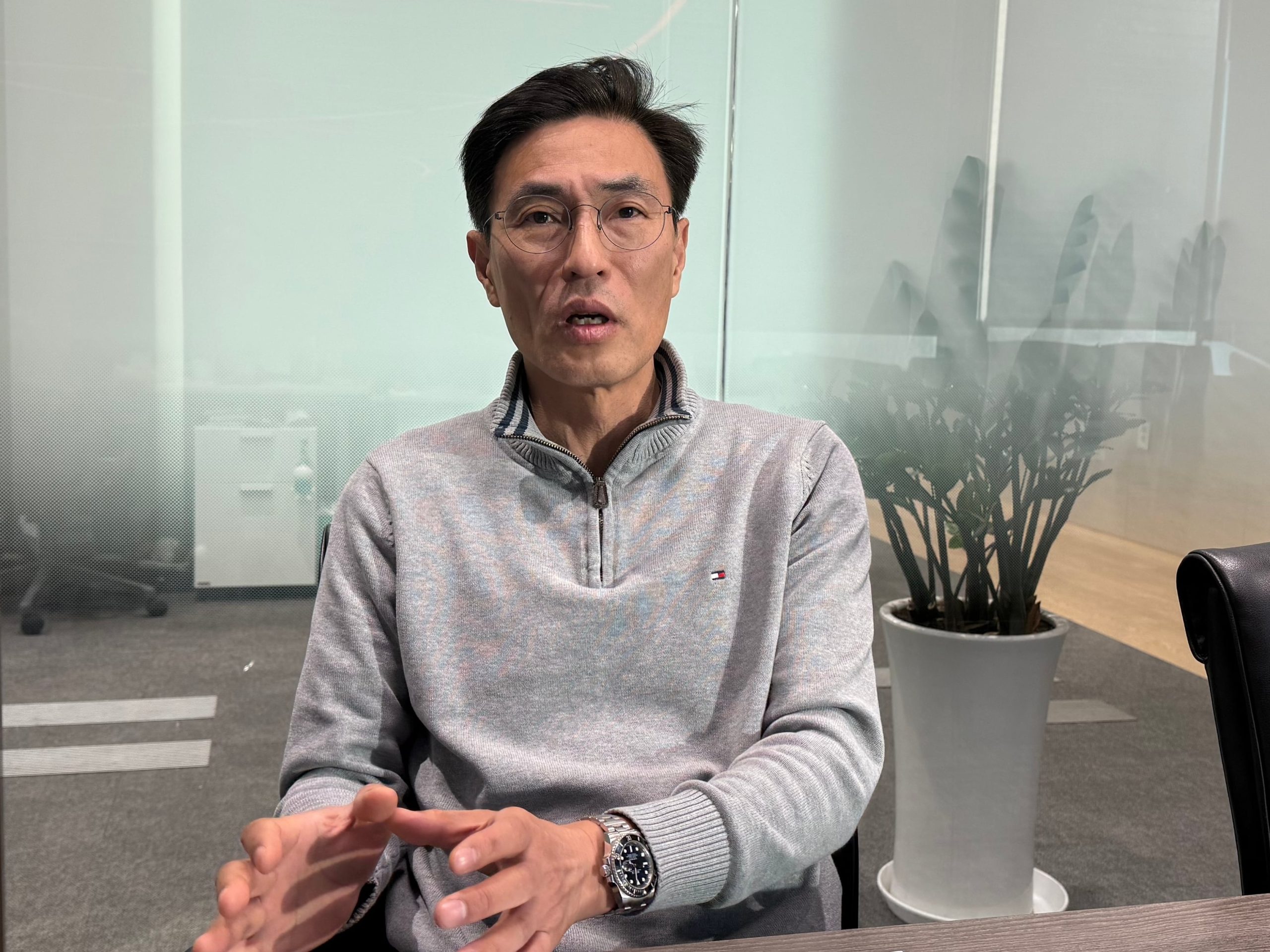
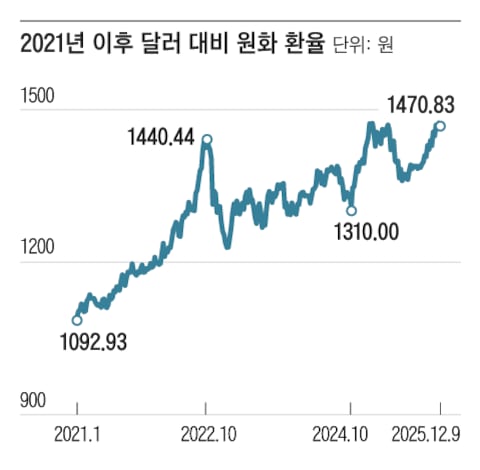
Despite the government’s various measures, the exchange rate shows no signs of falling below the 1,400 Korean won per dollar level, raising concerns that the ‘1,400 won exchange rate’ could become entrenched next year. Variables such as the replacement of the U.S. Federal Reserve Chair and the full-scale implementation of investments in the U.S. due to tariff negotiations will continue to influence the exchange rate next year. Speaking at Hana Bank’s main branch in Jung-gu recently, Hana Bank researcher Seo Jeong-hoon, who has worked as a currency analyst in the dealing room since 2008 during his time at Korea Exchange Bank, said, “I forecast that the current exchange rate level will be difficult to lower until the first half of next year.” This is because the continued growth of Korean individual investors’ U.S. investments and the annual U.S. investment commitment of up to 20 billion U.S. dollars starting next year are likely to keep the exchange rate at a high level.
◇Repeating 1,400 Korean Won Exchange Rate, ‘New Normal’ Cannot Be Excluded
-Why did the exchange rate rise so much this year?
“As many have diagnosed, the impact of ‘overseas investing individuals’ was significant. When the Fed shifted to a slightly tighter stance in August, the exchange rate fell as individual investors sold overseas stocks. While it’s unclear if this was solely due to that variable, the political situation stabilized after the presidential election, and capital market advancement measures led to funds flowing into the Korean stock market. However, in October, stock investment funds flowed overseas at a record high, and in November, around 4 billion U.S. dollars were net outflow. Simultaneously, foreigners sold approximately 14 trillion Korean won worth of stocks on the KOSPI alone, further driving up the exchange rate.”
-Is there a connection between Koreans’ increased U.S. investments and foreigners’ selling of Korean stocks?
“It can be viewed that way. Around this time, there was controversy over the overvaluation of AI (artificial intelligence) centered in the U.S., and foreigners sold semiconductor-related stocks in Korea intensively due to this impact. As AI overvaluation concerns emerged, risk aversion overlapped, leading to the sale of Korean stocks. Reports indicated that Korean investors bought a significant portion of these, which might have helped defend stock prices but had a ‘zero’ impact on the exchange rate when Koreans bought Korean stocks with won. Meanwhile, Korean investors viewed the decline in U.S. tech stocks due to AI overvaluation concerns as an opportunity to buy U.S. stocks. Even if the dollar rises, they judged that the stock price gains could offset potential losses if the dollar’s value falls.”
-If the exchange rate against the dollar falls at the time of future sales, doesn’t the risk of actual losses increase?
“Some argue that if the Korean economy improves next year and the current account surplus improves compared to this year due to more active responses to U.S. tariffs, the exchange rate could fall. However, others believe the high exchange rate may solidify as a long-term trend rather than a temporary phenomenon. Some even predict the exchange rate could reach 1,500 won per dollar next year.”
-What factors could push the exchange rate higher than it is now?
“Actually, the most critical variable is the U.S.-China trade conflict. Many seem to vaguely expect U.S.-China tariff negotiations to be resolved smoothly, but it appears unlikely. China is still trying to secure its own gains while making minor concessions on issues the U.S. wants. Rather than a dramatic ‘resolution’ between the two countries, a prolonged ‘push and pull’ based on each other’s actions is more likely. This uncertainty increases risk aversion in the foreign exchange market, meaning the won exchange rate could rise further.”
-There’s a lot of talk about the 1,400 won exchange rate becoming the ‘new normal.’ What’s your view?
“We need to examine this over a longer period, not just recent months. In 2022, the exchange rate stayed above 1,400 won for about four months, and after late last year, it remained in the 1,400 won range for about five months due to overlapping political and U.S. tariff uncertainties in Korea. After briefly falling to around 1,350 won, it has stayed above 1,400 won since September. The won-dollar exchange rate has repeatedly crossed the 1,400 won threshold. Is this state a new normal? From a quantitative analysis perspective, it seems plausible. The fact that the exchange rate does not fall below the 1,400 won level despite a continued current account surplus could signal that the 1,400 won exchange rate is becoming entrenched. At least, that’s how it appears now.”
◇U.S. Rate Cuts May Not Calm Exchange Rate
-If the exchange rate rises due to individual investors, isn’t it awkward for foreign exchange authorities to intervene?
“True. If speculative forces distorting the market to gain short-term profits approach the Korean currency market, volatility temporarily increases. In such cases, foreign exchange authorities can intervene. However, if the exchange rate is rising due to ‘overseas investing individuals’ like now, government intervention might struggle to stabilize it. That’s why the government is trying to use the National Pension Service for exchange rate stability and encourage companies to sell dollars earned through trade, but on-site experiences show it’s not that simple.”
-Why aren’t companies selling the dollars they earned from exports?
“Most companies earning dollars through exports these days are large conglomerates, especially in semiconductors, shipbuilding, and automobiles. The companies the government is negotiating with to sell dollars are mostly these. However, on-site managers say, ‘We understand the government’s stance, but we have no dollars to sell right now.’ This is because companies in these sectors need to significantly increase investments in the U.S. related to Trump’s tariffs. They need to make direct investments and build factories in the U.S., meaning they require more dollars. There’s no reason to sell dollars, and they can’t afford to do so.”
-Aren’t U.S. investments mostly made through returns on foreign assets held by the government?
“The government plans to secure up to 20 billion U.S. dollars annually and invest in the U.S. after consulting with companies. But what if the government fails to secure 20 billion U.S. dollars? Couldn’t companies then be forced to provide funds? It’s not that this will definitely happen, but companies cannot ignore the possibility. If the exchange rate rises further, companies might face a situation where they have to buy dollars at a higher price after selling them now.”
-The U.S. Federal Reserve Chair is expected to be replaced in May next year. Kevin Hassett, the White House National Economic Council director, is a likely candidate for the next chair, and if a Fed Chair aligned with Trump lowers the benchmark rate, won’t the dollar’s value fall?
“Many predict aggressive rate cuts if Hassett becomes chair. Textbook-wise, aggressive rate cuts are a factor for dollar weakness and could drive funds into won assets as risk assets are favored. However, Korea’s current situation is far more complex. Risk assets include not only the won but also U.S. stocks. This means Korean investors are more likely to buy U.S. stocks, a factor that could offset downward pressure on the exchange rate. There’s also the pre-announced variable of expanded investments in the U.S.”
-Hasn’t the government said it will minimize the foreign exchange market impact from U.S. investments?
“The government announced a plan to first cover the annual 20 billion U.S. dollars in U.S. investments with foreign exchange earnings and issue foreign currency bonds if insufficient. The current U.S. benchmark rate is 4% annually. If Hassett, as chair, cuts rates by 1 percentage point or more aggressively by 1.5 percentage points, what happens? There is an expectation of exchange rate decline factors. However, the problem is that the returns on Korea’s foreign assets, such as U.S. Treasuries needed for U.S. investments, will also decrease along with the U.S. benchmark rate. This means the risk of reduced earnings from foreign assets. If so, Korea might need to increase foreign currency bond issuance to cover the 20 billion U.S. dollars, which could again act as an instability factor for the won exchange rate. In the worst case, if foreign currency bonds cannot be issued on time, the government might have to buy dollars from the market to send investment funds, further fueling won weakness. While aggressive U.S. rate cuts could somewhat stabilize the exchange rate, it’s unlikely the won exchange rate will drop to the 1,200–1,300 won per dollar range seen in the past solely for that reason.”
◇The Real Problem with Rising Exchange Rates Is ‘Inflation’
-Will the Fed’s benchmark rate decision meeting on the 9th–10th have a short-term calming effect on the exchange rate if they cut rates? Bond experts are highly predicting a rate cut.
“The market’s sentiment is currently skewed toward ‘rate cuts.’ However, bond experts don’t set benchmark rates. The more critical issue now is the market’s overly skewed expectation of rate cuts. Current U.S. indicators show both layoffs and hiring decreasing, cooling the job market, while inflation risks from tariff hikes are growing. The former is a rate cut factor, the latter a rate hike factor, and they are in perfect conflict. If the Fed freezes rates despite the market’s entrenched expectation of cuts, the exchange rate could rise sharply again.”
-It seems many ‘common senses’ about exchange rates are breaking.
“I feel the same. When predicting exchange rates, the theoretical ‘mean reversion model’ is used. Simply put, if there’s a trend-based average, the exchange rate rises and then returns to the average, or falls and rises back. In practice, when Korean companies earn many dollars, the won strengthens, making exports sluggish, and the exchange rate falls again. The exchange rate has moved along a trend line, reverting to the mean. This pattern has weakened significantly now.”
-What caused the pattern to break?
“Trump’s emergence and his changes to the global trade order could be a sufficient cause. His interventions in the global trade order seem to have transformed the overall economic and financial environment. Additionally, the rise in geopolitical instability—with successive major wars, the U.S. and China entering a new Cold War, and scenarios like a Chinese invasion of Taiwan—could also be factors. Global variables that have changed the premises we’ve taken for granted since the 1990s, post-Cold War, such as ‘if theory holds, it should move this way,’ have multiplied.”
-Could the 1,400 won exchange rate trigger a crisis?
“In a way, we’ve prepared well through past foreign exchange crises and global financial crises. With low ratios of short-term external debt to GDP and ‘CDS premiums’ (indicators of sovereign bond default risk), the risks of a high exchange rate haven’t spread to other areas. The problem is inflation. While prices haven’t risen sharply yet, if the exchange rate climbs further, the inflation rate could exceed the mid-2% range. This would make it harder for the Bank of Korea to cut rates. As the exchange rate rises and inflation increases, consumption capacity could shrink, risking economic damage. A high exchange rate directly raises import raw material prices, posing a heavy burden on small and medium-sized enterprises struggling to manage this.”
-How do you forecast next year’s exchange rate?
“It’s too early to predict the second half of next year, but at least until mid-next year, the ‘arrow’ of the exchange rate is expected to remain upward, hovering above 1,400 won.”