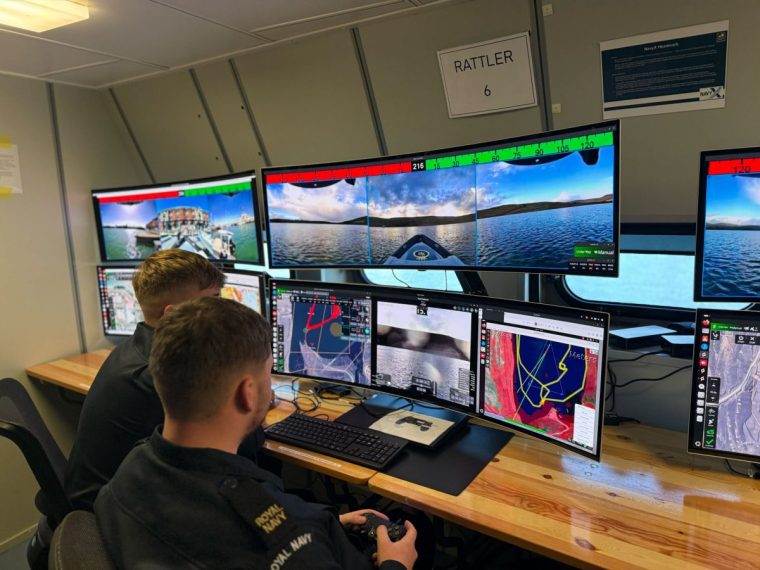
Aboard a vast Royal Navy warship docked in Portsmouth, two officers twiddle PlayStation controllers.
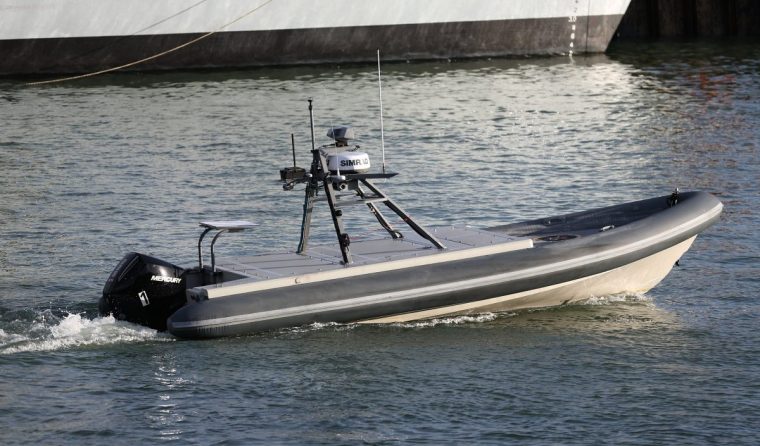
Live images from a small, uncrewed boat cruising in the sea waters over 100 miles away glare back at them from the screens in their control room.
At the flick of a toggle, the vessel responds, hitting the throttle and charging off in a simulated pursuit.
On this occasion, it’s a demonstration – but in recent months, these military boats have been on the front line of Britain’s response to Russian hybrid warfare at sea.
And now, ministers want to go further. Today, the Ministry of Defence (MoD) confirms it will establish a new hybrid naval force comprised of warships, patrol aircraft, uncrewed boats and drones to protect critical undersea cables and pipelines from Russian President Vladimir Putin’s submarines.
Britain is in a race to counter Russian threats at sea, including a 30 per cent increase in Moscow’s vessels operating in UK waters and the North Atlantic over the past two years.
It comes as the Royal Navy’s chief warns the UK’s current capacity is “stretched” in a competition against Russia, and without investment in new technology, Britain “will not stay ahead”.
“If you look at the Russian capabilities out of the northern fleet [in the Atlantic], their funding has continued to flow despite the war in Ukraine,” First Sea Lord Sir Gwyn Jenkins told reporters. “They consider it an area of expertise and advantage for them.”
He added: “We are in a competition to stay ahead.”
The new hybrid force, which will be known as Atlantic Bastion, comes amid heightened tensions between the UK and Russia at sea.
Covert submarines have monitored deep-sea critical infrastructure, while a “shadow fleet” of undercover cargo ships have cut communication lines, launched drone incursions and transported suspected spies into the UK – as revealed by The i Paper last week.
As peace talks over an end to the Ukraine war continue and US support for the continent fades, European nations are facing the prospect of standing alone against the Russian President’s aggression.
But Britain’s military is “nowhere near” where it needs to be to defend itself, according to a recent assessment conducted by Parliament’s Defence Committee.
The UK was falling “far short of its claimed leadership position”, the report warned. It also criticised the “glacial pace” of defence improvements, and called for the Government to accelerate the speed of its readiness.
Defence Secretary John Healey attempted to combat those concerns during a visit to HM Naval Base Portsmouth for the launch of Atlantic Bastion. He claimed the British military was ready to “fight tonight” but admitted the UK must “rapidly innovate at a wartime pace” to maintain the “battlefield edge” against Russia.
He said: “People should be in no doubt of the new threats facing the UK and our allies under the sea, where adversaries are targeting infrastructure that is so critical to our way of life.
“Our pioneering Atlantic Bastion programme is a blueprint for the future of the Royal Navy. It combines the latest autonomous and AI technologies with world-class warships and aircraft to create a highly advanced hybrid fighting force to detect, deter and defeat those who threaten us.”
The announcement comes as Ukrainian President Volodymyr Zelensky is due in London today for talks on peace proposals with Sir Keir Starmer, French President Emmanuel Macron and German Chancellor Friedrich Merz. Their meeting comes as discussions continue over a Washington-backed plan to end Russia’s war with Ukraine.
Russian threats at sea
In recent months, sabotage attempts at sea by Britain’s adversaries have stepped up, targeting undersea cables and carrying out acts of aggression near UK shores.
The UK has some 45 cables connecting Britain to other countries that carry essential power supplies and vast quantities of data, including financial information.
The growing use of the seabed has “increased opportunities for adversaries to threaten Western subsea critical national infrastructure”, according to the MoD.
Last month, a Russian “spy ship” – The Yantar – targeted an RAF patrol aircraft with lasers off the coast of Scotland. The same ship had previously been the source of a confrontation with British forces after it was suspected of deploying drones near subsea communication cables linking Ireland and the UK.
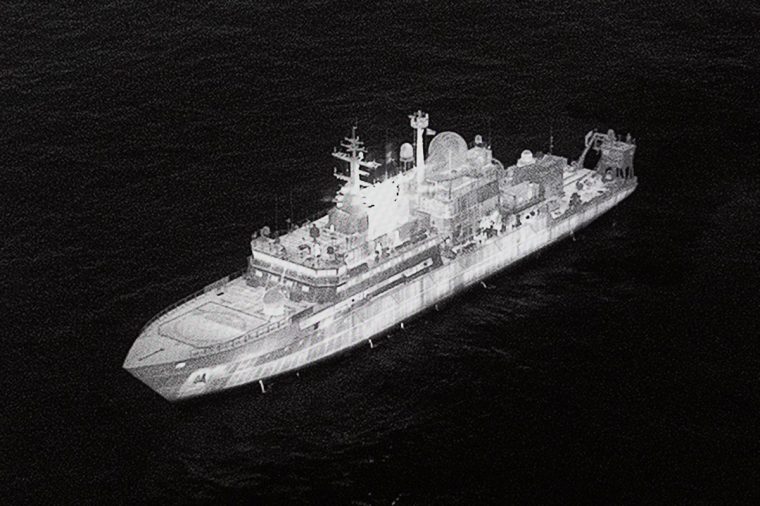
In a series of exclusive reports over the past month, The i Paper has revealed how the Kremlin is also accused of using seemingly conventional cargo ships to launch apparent drone incursions over European military bases, and transport alleged spies across the continent.
A report this summer by the China Strategic Risks Institute (CSRI) found that out of 10 cases of undersea cable sabotage since 2021, eight were directly linked to China and Russia.
Speaking alongside Healey, Norwegian Minister of Defence, Tore O. Sandvik, said Russia had continued to “prioritise” investment in its submarine fleet in the North Atlantic, which was now “armed with cruise missiles”.
“Russian deep water capabilities continue to pose a serious threat to Western underwater infrastructure,” he said. “Any attempts to harm our critical underwater infrastructure will be revealed and will not be accepted.”
The UK’s hybrid response force
His comments came while the ink was drying on the new £10bn Lunna House Agreement, which will see the UK and Norway operate an interchangeable fleet of British-built ships, of which Atlantic Bastion is a key component.
The Royal Navy’s Type 26 frigates – a 150m long warship with built-in state-of-the-art surveillance technology – will form the backbone of the “hybrid navy”. Each ship is designed to deploy uncrewed surface and underwater vessels, acting as a command centre for a wider monitoring network.
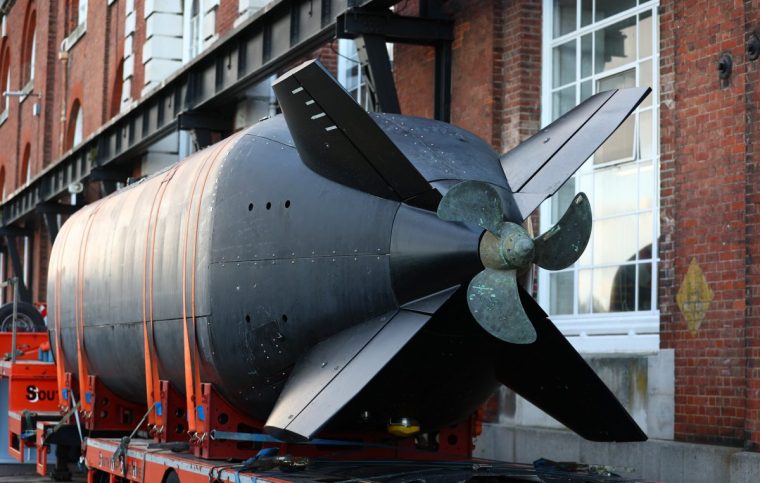
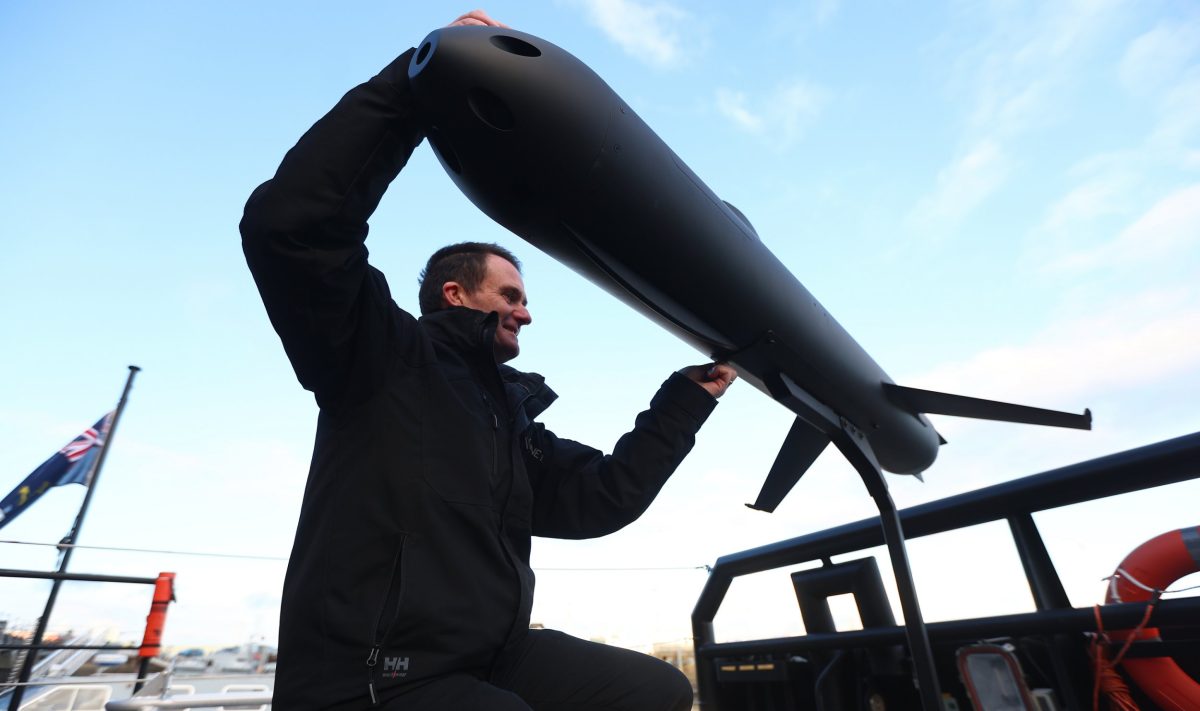
Autonomous vessels and underwater drones – like the ones being directed with PlayStation controllers – will link to warships, submarines and maritime patrol aircraft using AI, to create what officials say will be a “complete digital picture” of underwater activity.
The hybrid response force will enable the UK to find and track hostile activity in the North Atlantic. Uncrewed ships can be operated from hundreds of miles away, and fitted with infrared sensors and cameras. In the event that ships would be required to “act”, they can also be fitted with lethal weapons, the MoD says.
The Atlantic Bastion fleet has so far received a mere £14m investment, with a vast amount coming from the private sector, and will require further funding to fulfil the MoD’s ambitions. However, there are concerns circulating among military chiefs about the gap between the ambition and the budget of the Government on defence spending.
Sir Gwyn is expected to set out his vision for the future of the Royal Navy at the International Sea Power Conference in London later today, where he will announce the “bold new approach” to secure the “underwater battlespace against a modernising Russia.”
“A revolutionary underwater network is taking shape – from the Mid-Atlantic Ridge to the Norwegian Sea. More autonomous, more resilient, more lethal – and British built,” he will say. “We’ve already made rapid and significant progress with delivering Atlantic Bastion. A force that keeps us secure at home and strong abroad.”