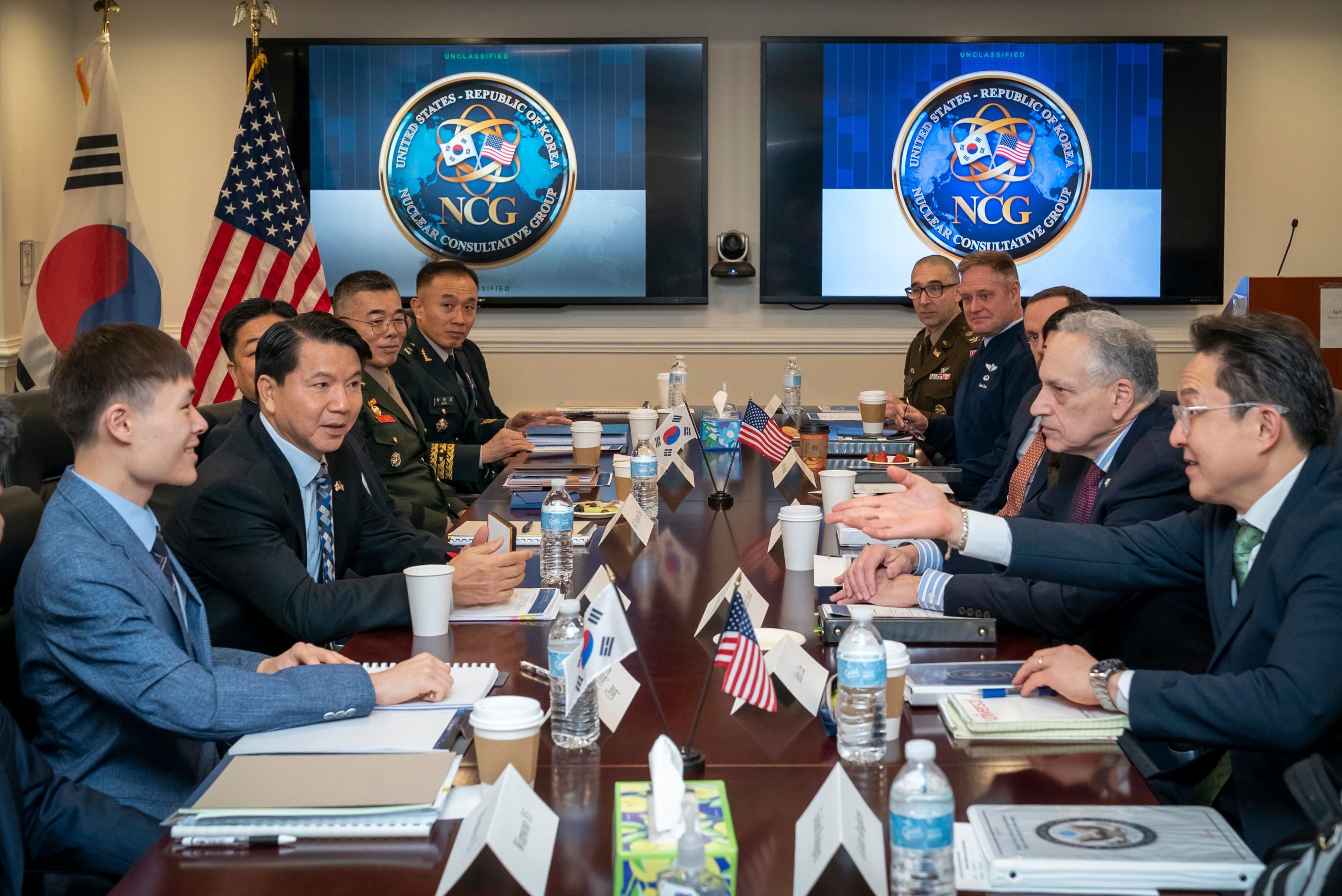
The 5th meeting of the Nuclear Consultative Group (NCG), a U.S.-South Korea nuclear umbrella consultative body, was held in Washington, D.C., on the 11th (local time). This is the first NCG meeting since the inauguration of the Lee Jae-myung government and the second Trump administration in both countries. It is significant that the consultative body, established during the previous administration to operationalize the U.S. provision of a nuclear umbrella and South Korea’s support for nuclear operations, continues to function even after a change in government.
However, the joint press statement released by South Korea and the U.S. after this meeting contained no direct mention of the North Korean nuclear threat or any warning statements toward the North Korean regime. The word “North Korea” itself did not appear even once. The National Security Strategy (NSS) released by the Trump administration on the 5th contained no expressions regarding the “denuclearization of North Korea.” Subsequently, the North Korean nuclear issue disappeared from the NCG joint statement as well.

In the 5th joint press statement released that day, the U.S. reaffirmed its commitment to providing South Korea with a nuclear umbrella by utilizing “all categories of military capabilities, including nuclear.” However, the expression included in the 1st, 2nd, and 4th joint statements—“Any nuclear attack by North Korea against the U.S. or its allies is unacceptable and will lead to the end of the Kim regime”—was deleted. This expression had been included for three consecutive years in the joint statements of the South Korea-U.S. Security Consultative Meeting (SCM) between the defense ministers of both countries until last year, but it was absent from the SCM joint statement released last month. Analysis suggests that the expression may have been removed to avoid provoking North Korea, considering President Trump’s desire for a U.S.-North Korea summit.
The previous four NCG statements always included content related to the deployment of U.S. strategic assets, but this time it was deleted. On the other hand, the South Korean side explicitly stated for the first time in this statement, “South Korea will take a leading role in conventional defense on the Korean Peninsula.” This appears to reflect the situation where President Lee Jae-myung aims to transition wartime operational control within his term, amid the Trump administration’s demand for expanded roles from allies.
◇Omitting ‘Regime End if North Korea Uses Nuclear Weapons’… First Explicit Statement on South Korea Leading Conventional Defense
The 5th South Korea-U.S. Nuclear Consultative Group (NCG) joint press statement, released on the 11th (local time), consists of a total of five items. This contrasts with the 4th meeting statement, released on January 10th during the final days of the Biden administration, which had 12 items. As the length was reduced, all content regarding South Korea and the U.S. “jointly planning” and “jointly executing” nuclear operations, and discussing the “Korean Peninsula Nuclear Deterrence and Nuclear Operations Guidelines” for this purpose, disappeared. Regarding these criticisms, South Korea’s Defense Ministry stated, “The South Korea-U.S. nuclear umbrella cooperation is actually deepening and becoming more concrete, and this statement concisely captures the substantive outcomes,” adding that their “resolve against North Korean nuclear weapons remains firm.”
However, concerns arise that the U.S. may be de facto tolerating North Korea’s nuclear weapons and neglecting its nuclear umbrella commitment to South Korea, as mentions of North Korea disappear from the NCG statements—which are central to responding to the North Korean nuclear threat—and descriptions related to the nuclear umbrella are reduced.
◇Deletion of Warning to North Korea, Considering U.S.-North Korea Dialogue?
The NCG was established as a result of the “Washington Declaration” announced in April 2023 by then-U.S. President Biden and then-President Yoon Suk-yeol. As North Korea’s nuclear and missile advancements led to discussions of nuclear armament in South Korea, the consultative body was created to enhance the credibility of the U.S. nuclear umbrella commitment by having both countries jointly discuss nuclear strategy. Accordingly, expressions reaffirming the U.S. provision of a nuclear umbrella consistently appeared in the four NCG joint statements held from July 2023 to January of this year.
The 1st, 2nd, and 4th joint statements included the expression, “Any nuclear attack by North Korea against South Korea will face an immediate, overwhelming, and decisive response.” The 3rd joint statement stated that the integration of South Korea and U.S. nuclear and conventional capabilities “substantially strengthens the alliance’s deterrence and response capabilities against North Korea’s nuclear and missile threats.”
Expressions related to the “deployment of U.S. strategic assets around the Korean Peninsula” were also included without exception in the 1st to 4th statements. The intent was to discuss how regularly and visibly the U.S. and South Korea would deploy U.S. nuclear aircraft carriers, nuclear submarines, strategic bombers, etc., to deter the North Korean nuclear threat.
These expressions all disappeared from the 5th statement. Former National Security Adviser Kim Sung-han said in a phone call with this newspaper, “While it is necessary to pressure North Korea by strongly issuing warnings like ‘the end upon nuclear provocation,’ it appears that messages that could provoke North Korea were omitted, considering President Trump’s remaining willingness for a U.S.-North Korea summit.” A military official stated, “Although message management can be done for U.S.-North Korea dialogue, the possibility of North Korea misjudging has increased as a result,” adding, “It is concerning that the deployment of U.S. strategic assets has been decreasing since the Trump administration.”
◇NCG-Related Training Also ‘Low-Key’ Due to North Korea
In the 5th statement, the South Korean side emphasized, “South Korea will take a leading role in conventional defense on the Korean Peninsula.” This is the first time such an expression has appeared in an NCG statement. This seems to be a result of the South Korean government’s position, which seeks to transition wartime operational control within President Lee Jae-myung’s term, aligning with the Trump administration’s plan to expand allies’ roles.
Regarding this, Commander of the U.S. Forces Korea Xavier Brunson stated on the 12th, “I know President Lee has expressed his desire to achieve this (wartime operational control transition) within his term,” adding, “Although the conditions must be met within that timeframe, one must also be able to say, ‘We cannot reach there.’” The intent was that while efforts can be made to transition wartime operational control within the term, it should not be rushed if preparations are insufficient.
It was also belatedly revealed that South Korea and the U.S. conducted the “Nuclear Consultative Group Tabletop Exercise (NCG TTX)” in September but did not publicize it. This exercise, linked to the NCG, involves discussing crisis management and military response plans under scenarios where North Korea uses nuclear weapons. According to multiple government sources, this year’s NCG TTX was conducted in mid-September alongside the South Korea-U.S. Nuclear-Conventional Integrated Tabletop Exercise (CNI TTX). It is said that the strategic commands of both countries and the U.S. Indo-Pacific Command also participated.
However, the Defense Ministry and U.S. Forces Korea have not publicly disclosed or officially confirmed the fact that the exercise was conducted. Analysis suggests that South Korea and the U.S. have adopted a “low-key” response, mindful of North Korea’s potential backlash. Former Defense Ministry Policy Director Cho Chang-rae, who represented South Korea in the 3rd and 4th NCG meetings, stated, “Although the absence of specific expressions in the NCG joint press statement does not necessarily mean a weakened commitment to the nuclear umbrella,” he added, “The previous administration believed that using expressions like ‘end of the North Korean regime’ or publicizing related exercises would help deter North Korea, but the current administration’s judgment seems different.”