… a legal foundation for CRM policy, safer homes and businesses
By Festus William AMOYAW
The National Petroleum Authority (NPA) has moved decisively to introduce the Cylinder Recirculation Model (CRM) since 2023, a system in which consumers no longer purchase and maintain LPG cylinders themselves but exchange empties for certified, pre-filled cylinders managed by licensed bottlers and distributors.
The aim of the NPA, and by extension, the government, is that through the CRM, Ghana can achieve 50percent usage of LPG among Ghanaian households by 2030. Just to remind you, this objective has changed many times since 2010. The goal of 50percent by 2030 aligns with the Sustainable Development Goal 7 – Affordable and Clean Energy.\xa0 There is also a direct contribution to SDGs 1, 3, 5, 8, 9, and 11.
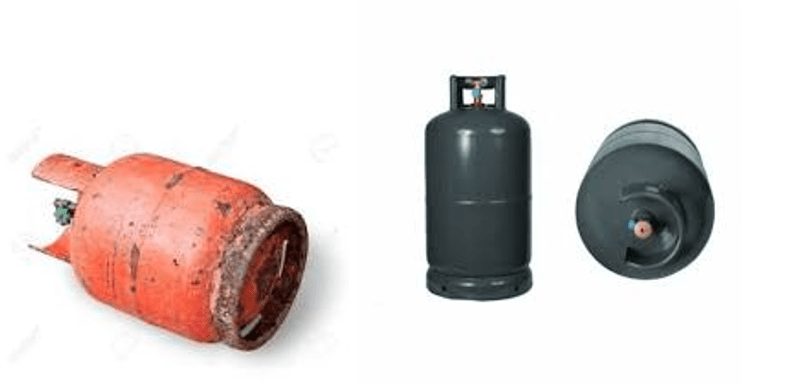
Image of a rusty cylinder\xa0\xa0\xa0\xa0\xa0\xa0\xa0\xa0\xa0\xa0\xa0\xa0\xa0\xa0\xa0\xa0\xa0\xa0\xa0\xa0\xa0\xa0\xa0\xa0\xa0\xa0\xa0\xa0\xa0\xa0\xa0\xa0\xa0\xa0\xa0\xa0\xa0\xa0\xa0\xa0\xa0\xa0\xa0\xa0\xa0\xa0\xa0\xa0\xa0\xa0\xa0 Image of a certified cylinder
As demonstrated in other countries such as Cote D’Ivoire, Senegal, Cape Verde and many others, a properly executed CRM policy can accelerate clean-fuel access, curb illegal refills, and raise safety standards. CRM has the capability to improve consumption because many hard-to-reach parts of the country and the barrier to owning an LPG cylinder will be reduced significantly, leading to accessibility and usage of clean cooking fuel.
The government revenue from the sector will be boosted as consumption spikes. In 2019, LPG consumption in Ghana and Cote D’ivoire was almost at par, but 5 years down the line, that of Cote D’ivoire has more than doubled due to the introduction of CRM, and Ghana remains the same with an annual average increase of about 8percent. In part the embargo on the establishment of new LPG stations in Ghana since 2018 can be attributed to the slowness in growth.
As Ghana has chosen this path, we must begin to consider the roadmap to success with the policy.\xa0 For the CRM policy to deliver on its safety promise, it must be anchored in a clear legal framework that includes a nationwide cylinder recall/replacement programme. The evidence from elsewhere and Ghana’s own statistics show why. Why a legally backed nationwide recall matters.
A recall programme involves the mobilisation where substandard, damaged, tampered or uncertified cylinders are systematically removed from circulation and replaced with certified, traceable units from LPG bottlers and distributors. There are various statistics on the number of LPG cylinders in homes and business premises, which is estimated to be from 5 million to 7 million. Most of these cylinders may have passed the requalification dates (usually 10 years after manufacture or tested dates), and coupled with imported used cylinders, there is a need for action now.
The process is not just about an administrative finesse, but it is a public-safety imperative. In Ghana, major referral hospitals report that a large share of severe burn admissions are linked to LPG incidents. Korle-Bu’s burns and reconstructive surgery reporting has repeatedly pointed to LPG-related fires and explosions as a leading cause of serious burns (reported figures range from roughly 35percent to over 40percent of burn admissions in different years), underscoring the human cost of faulty cylinders and unsafe practices. A recall directly reduces the population of risky cylinders in homes and businesses, lowering the incidence of catastrophic leaks and explosions that lead to those admissions.
International practice and lessons learnt. Countries that have moved toward branded-cylinder or recirculation-style systems (or strengthened cylinder certification and market surveillance) offer practical lessons:
- Philippines – The country has tightened legal and technical regulations for LPG pressure vessels and supporting safety regimes through laws and implementing rules that push for certified cylinders and stricter market surveillance. Their framework combines standards, registration and enforcement to keep uncertified cylinders out of circulation. The country using the appropriate legislation developed a framework within a period that all consumers must tender in their cylinders for a replacement with certified ones through the CRM. This is a model Ghana can adapt for certification, traceability and recall mechanics.
- Indonesia – Indonesia’s recent reforms around subsidised small-cylinder distribution and buyer verification show how government systems can be used to control the supply chain and reduce misuse. The process highlights the benefits of government-led logistics, registration and controls when changing distribution models. While Indonesia’s focus is partly on subsidy targeting, the governance techniques are relevant to establishing who is responsible for cylinder ownership, replacement and recall.
- Brazil and other markets – Brazil’s large-scale LPG programmes and recent debates about regulatory clarity illustrate the complexity of shifting distribution models at a national scale: regulatory gaps can create unintended consequences such as illegal refilling or market distortions. That experience argues for clear, anticipatory regulation that defines liability, responsibilities for inspection and timelines for cylinder decommissioning.
Let’s look at some of the core elements of a legally robust recall programme. To be effective, a recall under CRM should be embedded in law and regulation and include:
- Clear standards and mandatory certification of all LPG cylinders in the country – The national standards (for example, the GS 535 series in Ghana) should be referenced in law; only cylinders certified to those standards may be filled and circulated. Regular factory and market surveillance must be mandatory and resourced. The Ghana Standard Authority and other relevant agencies must be involved in the legal framework, and their role clearly defined with the right resources so they can play their role in the CRM rollout.
- Registration & traceability – For a successful CRM implementation and the improvement of safety across the value chain, there must be a repository of data on the cylinders in circulation. Each cylinder must be uniquely identified and traceable (QR/barcode on the cylinder) so regulators can monitor ownership, filling history and recall status. Traceability simplifies targeted recalls and fraud detection. The step will curb the importation of second-hand LPG cylinders and substandard ones that are left to the imagination of importers. By standards, all LPG cylinders require a re-qualification after 10 years of manufacture or re-testing, not just re-spraying. In some jurisdictions like Japan it is 5 years, and the cylinder will be decommissioned.
- Defined liability & decommissioning pathway – The cases reported at the Korle Bu Teaching Hospital caused by domestic use of LPG can be attributed to many factors, including faulty valves, regulators, hoses and most importantly uncertified or requalified cylinders. How can these factors be addressed if there is no way to hold anyone accountable? Most of the victims may be maimed for life, not to talk about those who lost their lives due to circumstances that could have been avoided. Under the current CRM policy it is not clear who is responsible for what. The laws must state who is responsible for identifying and removing defective cylinders (distributors, bottlers, or a licensed returns operator), who pays for replacement, and how decommissioned cylinders are handled as hazardous waste. The National Disaster Management Organisation (NADMO), the Environmental Protection Agency (EPA), and the Ghana National Fire Service (GNFS), and other related agencies must show a strong interest in how these policies and legislation are conducted. It must be a coordinated approach because the consequences impact national development and the Gross Domestic Product (GDP) of the country.
- Phased recall rollout tied to CRM exchange points (CEPs) – The NPA has agreed in principle with the LPG marketers and dealers (existing refilling plants) to operate side by side with the CRM for some years (is it 7 or 10 years?), I am not sure which is which. Through a proper use of legislation on a national recall, the CRM exchange network would act as the delivery mechanism for recalls: upon each exchange consumers surrender cylinders for inspection, and any non-compliant unit is immediately decommissioned and replaced with a certified cylinder. Furthermore, the NPA could collaborate with the existing refilling stations, which are still the most widespread (768 licensed as of date) and the first point of call for an LPG user, to become the recall centres. The approach will quickly “trap” any cylinder presented for refilling, especially those that are due for requalification or must be decommissioned. There would be a central database system through which the information on the user and the cylinder would be captured, so the consumer can either get a coupon or be issued an alert on their phone with a code to have access to a certified cylinder under the CRM. Again, the existing refilling plants will begin to adapt the CRM policy as the future of the business because they will be stocking the tracked cylinders which cannot be refilled at their point of sale.
- Enforcement & penalties – Laws are made to ensure everyone is aware of what is required of them as a player or citizen. The legislation around a nationwide recall and certification of cylinders through the value chain must bite. There must be robust inspection powers, civil and criminal penalties for illegal refilling and tampering, and public-private coordination to pursue rogue operators. Experiences from other countries show that weak enforcement invites illegal practices that undermine safety gains.\xa0 The cost of treating injuries caused by LPG accidents in households and businesses.
The CRM is a once-in-a-generation opportunity to modernise Ghana’s LPG market and make clean cooking safer for millions. But policy ambition must be matched by a legally enforceable recall framework that removes dangerous cylinders, holds actors accountable, funds inspection and aligns public health, fire safety and environmental protection. Removing a meaningful fraction of the most dangerous cylinders will reduce severe LPG-related burns and the downstream burden on tertiary hospitals such as Korle-Bu, leading to fewer long hospital stays, reconstructive surgeries, and rehabilitation costs.
The social and economic returns extend beyond healthcare: fewer household tragedies, reduced loss of productive life and enhanced public confidence in LPG as a safe cooking fuel. The existing players in the sector who are willing to collaborate with the NPA will feel empowered to support the overall objective to improve access to clean cooking fuel. They stand to gain.
The cost of inaction is measured not only in dollars or GDP but also in lives and lifelong. Ghana can and should learn from international experience while designing a Ghana-fit recall system that protects families, strengthens markets and makes CRM a genuine safety success. The run to the objective of 50percent LPG penetration by 2030 requires a collective approach with a strong will to take the bold decisions that will bring about the results and contribute to the relevant SDGs.
>>>the writer is General Manager – Xpress Gas Limited
Provided by SyndiGate Media Inc. (Syndigate.info).