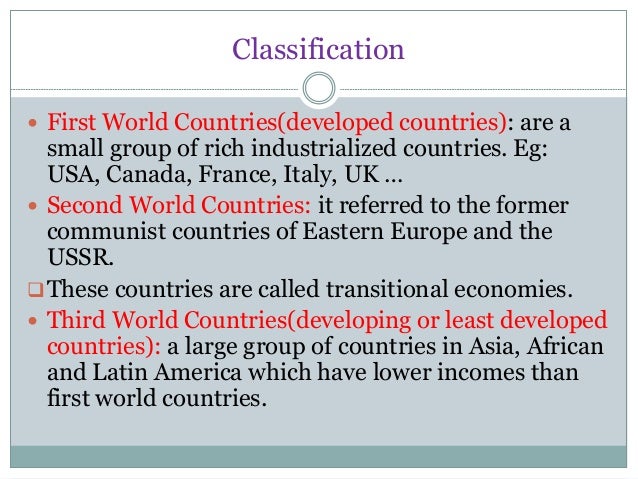
Two related ideas featured prominently at a gathering of 300 educationists in Laikipia last Monday. When asked about their vision of Laikipia, they were emphatic. Good governance, and economic transformation.To be like Singapore, they said. The latter resonated with the pitch by President Ruto, who in recent months has been talking about transforming the country, from a third to first-world economy, in our lifetime.To put this vision in numbers, that means increasing the annual per capita gross national income from the current $2,550 to around $14,000, the equivalent of Sh152,000 per month.The most commonly used categorisation of countries by income thresholds, is by the World Bank. Initially developed in 1989, the income classifications were designed to include all industrial countries in the high income ($6,000, at 1987 prices) category. The classification was partly to determine which (poor) countries would receive concessional lending terms.Today, the income classification is mainly for statistical and analytical purposes and is no longer strictly tied to lending by the bank. The thresholds are updated every year on July 1st, ensuring they remain fixed in real terms and do not shift due to global price changes.The gross national income (GNI) per capita for each country is calculated using a three-year average of exchange rates, adjusted for inflation to smooth out short-term fluctuations in currency markets. This is called the Atlas method.The current, 2026 fiscal year, income classifications are as flows. Low income countries, such as Ethiopia, Uganda, Rwanda and DR Congo, are those with a GNI of $1,135 or less.Lower-middle income countries such as Kenya, Ghana and Nigeria have $1,136 to $4,495. Kenya achieved this in 2013, forcing a re-stating of Vision 2030 to frame the aspiration as upper middle income by 2030. Upper-middle income category is GNI of $4,496 to $13,935. At our current trajectory, we shall join Mauritius, Botswana and South Africa in that category in five to six years.Read: Numbers show strong economic recoveryHigh-income countries, such as Seychelles, have GNI of more than $13,935 per person per year. This is the inflation-adjusted value of the original 1987 benchmark. Costa Rica is the most recent (July 2025) entrant to this category.The questions by the Laikipia educators, and policy wonks like me are which growth rates will get us there, and how long will it take?The highest economic growth rates in Kenya were 22.2 percent in 1971, and 17.1 percent in 1972. This, on top of eight percent growth achieved in both 1968 and 1969. Since then, other high rates of growth were 8.4 percent in 2010, 7.59 percent in 2021, 6.3 percent in 2018, and 5.32 percent quarterly growth in Q4 of 2020.1971 was a standout year during the “Kenyan economic miracle” (1964–1973), a period of rapid economic expansion that gave late president Kibaki, then finance and planning minister, fame as an astute economic manager.The primary factor driving growth in 1971-2 was the coffee boom, where Kenya benefited from a massive spike in global prices, vastly increasing foreign exchange earnings.Significantly however, the country had adopted an import-substitution industrialisation strategy, replacing foreign imports with domestic products. This led to a boom in the manufacturing sector, which grew at 8-9 percent annually for the period, including a spectacular 25 percent in 1971-3.The strategy coupled well with regional trade expansion. The establishment of the East African Community (EAC) in 1967, provided Kenya with expanded export markets for the growing industrial base.It is quite possible to transform to a first-world economy in our lifetimes, I assured the Laikipia educators. First, Kenya’s GNI per capita has grown from $414 in the year 2000 to $2,550 in 2025.That is an increase of 6.16 times in 25 years. If we stay on that trajectory, we will reach high income status by 2050.If we were to grow at the 1971 rate, we would transform to first-world in eight years! At the more modest annual growth rate of 12 percent, we will need about 15 years.A few hurdles remain though. Will irrigation transform small-holder agriculture, increasing productivity? Will the KTDA model of solving the aggregation problem work for, and therefore transform, pastoralism?Will physical infrastructure, ICT and mobile money, be enough to power the next Kenyan economic miracle? Above all, how will we overcome the negativity mindset deeply ingrained in current politics? On all four, superior county performance will help.Ndiritu Muriithi is an economist and partner at Ecocapp Capital. He is also the chairman of KRA and former governor of Laikipia County. Email: Ndiritumuriithi@kra.go.ke Provided by SyndiGate Media Inc. (Syndigate.info).