The Perilous Path of Daily Life
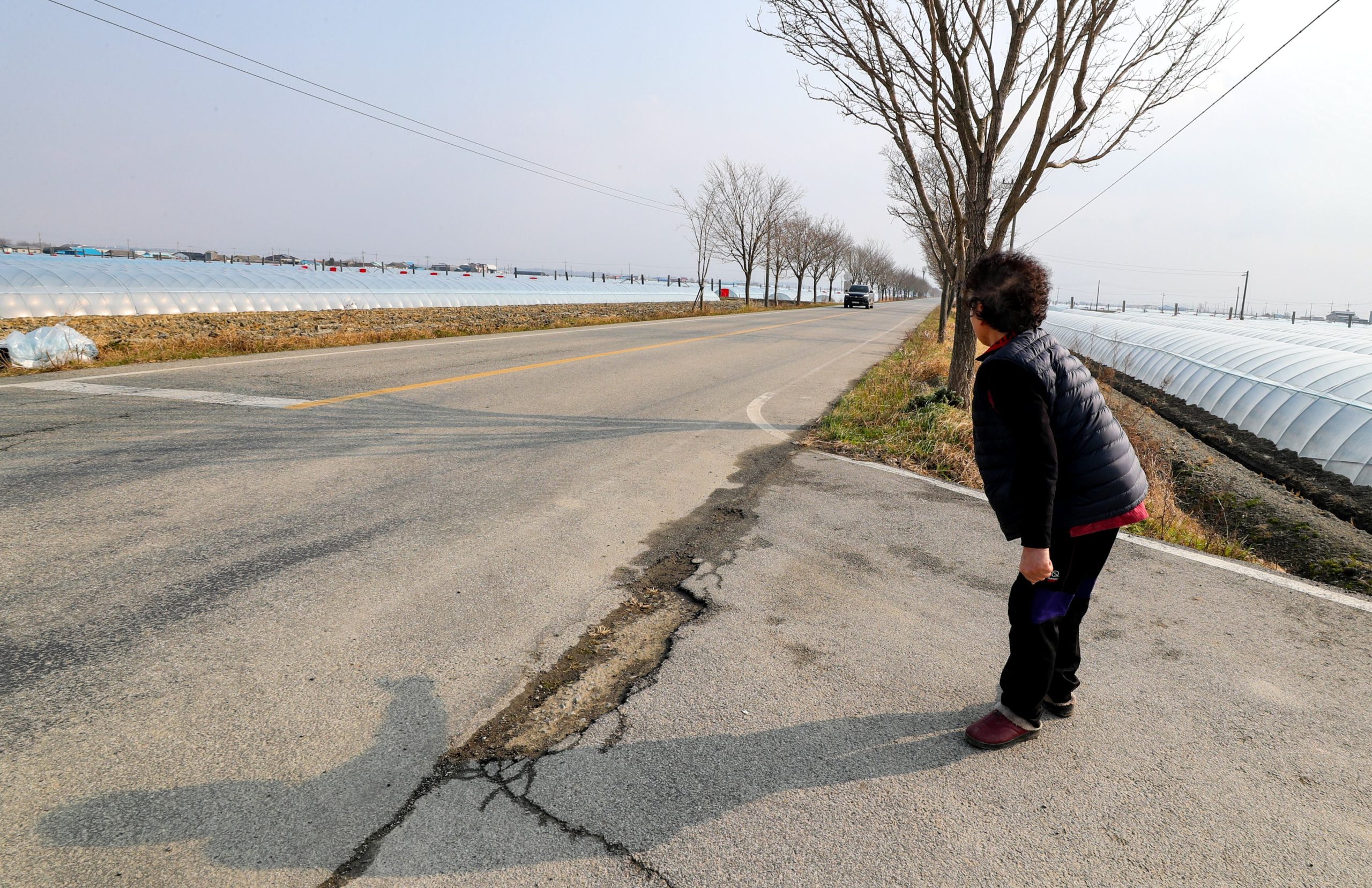
On the afternoon of the 3rd, a two-lane road in a village on the outskirts of City A in North Jeolla Province. Towering white poplar trees over 10 meters tall stretched along both sides. Every autumn, purple cosmos bloom between these trees, attracting tourists. However, locals call this road the “road to the afterlife.” Without parks or walking paths, residents often walk here after dinner, leading to repeated traffic accidents resulting in injuries or deaths.
As the sun set at 6 p.m., the road, devoid of streetlights, plunged into darkness. Large trucks sped past on both sides at over 60 km/h. Residents walking on the narrow white-lined shoulders looked vulnerable. The inner lane was less than 1 meter wide, forcing pedestrians to sway as vehicles passed.
“Mrs. ○○ died there. ○○ also died here… Four or five people have perished on this road in the past decade,” said resident Park Soon-ja, 68, gesturing at the dark road. She added, “There are no mountains here, just endless fields. Even if we want to walk, there’s nowhere to go.”
In Seoul National University’s Health Culture Business Unit’s (led by Yun Young-ho) “Korean Health Index” survey of 10,000 people across 252 local governments, inland mountainous and rural areas like City A ranked in the mid-to-lower tier. This contrasts with large cities with well-established living conditions, which topped the rankings. The disparity stems from weakened industrial bases, aging populations, lack of walking paths and exercise spaces, and reduced medical accessibility.
Seoul National University’s Health Culture Business Unit and Chosun Ilbo are launching the “Health Consulting Project (Healthy Korea)” to diagnose and improve health policies in local governments like City A. A panel of experts, including Director Yun Young-ho, and the reporting team will conduct field surveys referencing self-assessments by local governments on 54 evaluation criteria to propose improvements.
“This Is Our Village Walking Path” Rural Seniors’ ‘Dizzying Stroll’
“Doctors say labor isn’t exercise. Come see for yourself—where can we work out?”
Kim Geum-ja, 75, a resident of City A, said, “There’s not even a decent park in the village. To use sports facilities, we’d have to drive, but farmers don’t have time for that.” She added, “When I asked a provincial council member to create exercise spaces, they placed a couple of machines in front of the health center. If we’re sick, we just get medicine from the city hospital.”
Behind the village hall, three simple exercise machines for shoulders and waist were installed. Jo Dong-soo, 80, who suffers from diabetes and hypertension, visits daily. “With nowhere else to go, we gather here, but recently, even the parallel bars disappeared,” he said. Park Soon-ja, 70, noted, “Almost no one here is free of diabetes or high cholesterol, and many have heart issues. We’re too busy taking medication to manage our health.”
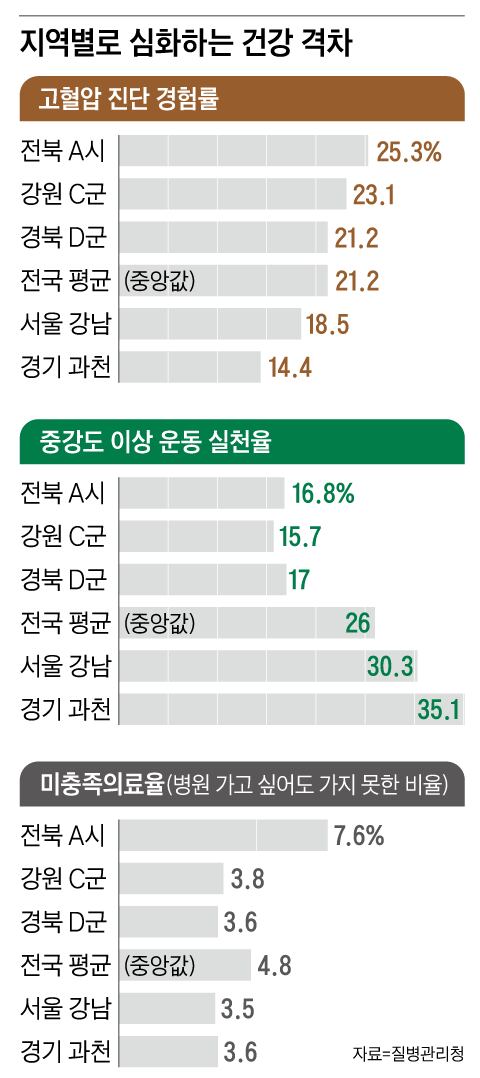
According to the “Korean Health Index” survey, regional exercise disparities were stark. City A’s moderate-to-high-intensity exercise rate was 16.8%, half of Gyeonggi’s Gwacheon (35.1%) and Seoul’s Gangnam (30.3%). The unit attributes this gap to differences in physical activity environments and medical infrastructure.
This disparity extends to disease rates. City A’s hypertension diagnosis rate (25.3%) was nearly double Gwacheon’s (14.4%). Its diabetes rate (12.1%) was twice that of Gangnam (6.7%) and Gwacheon (6.2%).
The village appeared flat and spacious, seemingly ideal for walking. However, paths between fields were too narrow for more than one person. Asphalt roads alongside fields were crowded with speeding vehicles, leaving residents without safe spaces to exercise after farming.
Residents with chronic conditions like diabetes, hypertension, and hyperlipidemia await exercise programs run by community centers or health centers, which occur twice a year. A visiting instructor from a neighboring village briefly teaches simple movements.
On the afternoon of the 23rd of last month, three elderly people lay on the floor of a nearby community center, chatting. One said, “A health center teacher taught us to lift our legs, but we’re bored and just wait for their next visit.”
The village health center serves 400 residents across five nearby villages. Kim Soon-rye, 83, who visited after kimchi-making-induced body aches, sighed when told painkiller injections were unavailable. Accepting muscle relaxants and anti-inflammatory pills, she said, “I rode my bike over 2 km this morning. If medicine doesn’t help, I’ll go to the city hospital. What else can I do?” Kim had surgery for a herniated disc at a university hospital months ago. City A has 2.3 doctors per 1,000 residents—18% of Gangnam’s 12.8.
Nearby County B in North Jeolla also struggles with medical accessibility. Located in mountainous valleys, reaching emergency care takes over 50 minutes by car. No direct buses operate; only three daily buses connect to a public hospital in a nearby city.
Lee Gwang-su, 71, of a remote village in County B, suffered a cerebral hemorrhage during last summer’s rainy season. Though a neighbor reported it immediately, it took over three hours to reach the emergency room via mountain and rain-soaked roads. His wife, Kang Gi-nam, 78, said, “They said the golden hour is four hours—we barely made it. I still shudder thinking about it.” Lee now walks with a limp but works in the city to support the family. Kang added, “After getting sick, I regretted living in the countryside.”
Residents at a County B community center expressed resignation. Kim Deok-ja, 74, said, “No doctors here—we just get medicine at the health center.” Park Myeong-su, 71, remarked, “Even if an ambulance rushes, it takes 45 minutes. If someone collapses suddenly, they’ll likely die before reaching the hospital.”
Director Yun Young-ho stated, “Reviving local industries must go hand in hand with investing in community-based medical and welfare infrastructure. In rural areas hit by aging and industrial collapse, ensuring residents’ health and safety is critical to the community’s survival.”