The government plans to pass a tax reform bill at the Cabinet meeting on the 1st, which has sparked controversy due to its differential application of the comprehensive real estate tax for non-resident single-homeowners. Although the ruling party leadership raised the need to revise the government’s proposal, they decided to stick with the original plan and submit it to the National Assembly. On the 31st, a voice within the ruling bloc said, “The president’s resolve to distinguish between actual and non-actual residence remains unchanged, and with strong opposition to revisions within the government, they have passed the ball to the National Assembly for now.” Despite significant public opposition to the differential application of the comprehensive real estate tax basic deduction based on residency status, there is a clear current within the government to push forward with the original proposal.
President Lee Jae Myung wrote in a post on X, X, formerly Twitter, the previous day, “The popular sovereignty government will break down national-destroying real estate speculation by any means necessary” and “Unfair and unreasonable tax systems that have been found to fuel real estate speculation will also be corrected in the name of tax justice.” He added, “We are preparing for a plunge in housing prices.” This was interpreted as a determination to proceed despite consecutive polls showing the president’s approval rating in the 30% range, with real estate policies cited as the top reason for the decline. However, the Democratic Party of Korea plans to revise and supplement the tax reform bill during the National Assembly’s deliberation process once the government submits it.
The political sphere also interpreted the president’s recent replacement of the deputy prime minister and ministers of the Ministry of Finance and Economy and the Ministry of Land, Infrastructure and Transport—while retaining Cheong Wa Dae’s Kim Yong-beom, policy chief, and other economic officials—as a statement of intent to continue the current policy direction. Regarding the prosecution dismissal issue, another factor in the president’s declining approval rating, there is speculation that the president’s will was reflected in nominating Kim Seung-won, a Democratic Party lawmaker who led a group advocating for prosecution dismissal, as the justice minister nominee.
◇Approval rating drops for 7 weeks, but Lee pushes ahead with real estate, prosecution dismissal policies
Regarding the 2025 tax reform bill, which applies different comprehensive real estate tax basic deductions for single-homeowners based on residency status, the government plans to submit the original proposal without revisions at the Cabinet meeting on the 1st. However, if amendments are made to the real estate tax portion after submission to the National Assembly, they will be announced separately. The portion regarding the reduction of benefits for the Individual Savings Account (ISA), which President Lee Jae Myung ordered to be reviewed, is expected to be partially revised before submission.
◇Ministry of Finance and Economy: “Time too tight for revisions”
Earlier, on the 3rd of last month, the government announced a tax reform plan for next year, raising the comprehensive real estate tax basic deduction for single-homeowners from 1.2 billion Korean won to 1.4 billion Korean won, while reducing it for non-resident single-homeowners from 1.2 billion Korean won to 900 million Korean won to rationalize real estate taxes. However, the ruling party later pointed out, “The comprehensive real estate tax deduction should not be differentiated based on a single-homeowner’s residency status,” raising the possibility of the government revising the deduction amounts.
A Ministry of Finance and Economy official said, “Revising the tax reform bill is not as simple as changing a few numbers” and “Time was too tight for revisions.” They added that if the government’s proposal is amended during the National Assembly’s deliberation, it will be announced separately. While the Democratic Party plans to adjust parts of the government bill facing strong public backlash, some within the party say, “Without the government taking the lead, major revisions to the complex tax reform bill will be difficult.” Without the government showing willingness, revising the original proposal is not easy. Kim Yong-beom, presidential chief of staff for policy, who oversees real estate policies and taxes, was scheduled to attend the National Assembly’s Budget and Accounts Committee but did not, citing scheduling conflicts. The opposition party criticized this as an attempt to avoid questions about responsibility for policy failures.
The government is reportedly planning to partially revise the proposal to reduce benefits for the ISA, a financial product dubbed the “all-purpose tax-saving account,” before submitting it to the National Assembly. The government previously announced plans to establish a “productive finance ISA” while limiting the maturity of existing ISAs to five years and prohibiting the carryover of unused annual contributions of 20 million Korean won to the next year. However, after investors criticized this as hindering long-term investment, the government began reviewing revisions.
◇Maintaining state affairs despite falling approval rating
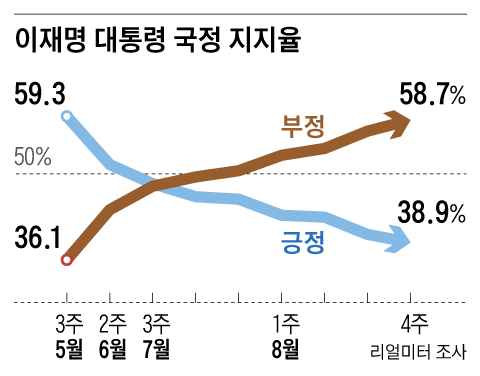
According to a regular poll by Realmeter released on the 31st, President Lee Jae Myung’s approval rating fell by 1.3 percentage points to 38.9%, marking the seventh consecutive week of decline and the first time it has fallen into the 30% range since his inauguration. Regular polls by Gallup Korea, NBS (National Indicator Survey), and others also show a clear downward trend in the president’s approval rating.
However, many evaluations suggest that the president’s recent state affairs have failed to create a turning point. Regarding real estate policy, President Lee promoted Hong Jee-sun, vice minister of transport, who worked with him in Gyeonggi Province, to minister of land, infrastructure, and transport. Hong, a second-class local civil servant, spent most of his career in Gyeonggi Province and is known for designing the “Gyeonggi Basic Housing” as head of the Urban Housing Bureau when Lee was governor. Despite having no central government experience, Hong was unexpectedly appointed vice minister last December and nominated as minister eight months later. There are observations within and outside the government that if formally appointed, Hong will aggressively push forward with current government projects like the Yongsan Park development.
Regarding the prosecution dismissal issue, another factor in the president’s declining approval rating, there are many opinions within the Democratic Party against pursuing it. However, President Lee ultimately nominated Kim Seung-won, a lawmaker who co-led a group advocating for prosecution dismissal, as justice minister nominee. A key figure in the ruling bloc said, “Many prosecutors feel burdened by prosecution dismissal due to potential backlash from fellow prosecutors,” and “It seems the president chose Kim, who is sincerely committed to prosecution dismissal and expected to execute it.”
- 월 5900원 멤버십, 신문 독자에게는 2900원, 조선멤버십
- 55000원 상당의 신문-잡지 8종 마음껏 보기, 조선멤버십
- 현금처럼 쓸 7000포인트 받아 알뜰한 쇼핑, 조선멤버십

Related posts:

Fiction park: He was the best in class. He still wasn’t good enough

Gagan Thapa takes oath as Congress president, vows to regain public trust

Inside knowledge that has locals gripped by fear after gran’s body found decomposing in cattle dip

New property purchase disclosure rule in Japan sparks fears it may curb foreign investment

Dino-mite treasures: inside Singapore’s Fort Knox storing playthings of ultra-rich