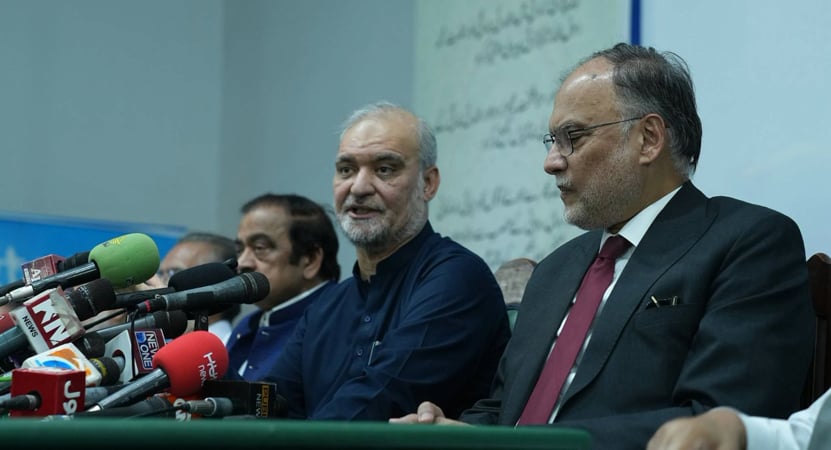
Pakistan, Sept. 4 — Federal Minister for Planning Ahsan Iqbal has said that the government and Jamaat-e-Islami (JI) agreed to form committees to discuss ways to provide relief to the public.
Speaking at a joint press conference in Lahore on Thursday along with JI Emir Hafiz Naeemur Rehman and Prime Minister’s Adviser on Political Affairs Rana Sanaullah, Iqbal said the government had already constituted a committee and asked the JI to form its own team.
“We have formed a committee and have also requested the Jamaat-e-Islami to form a team,” the planning minister said. He added that the government is ready to hold talks with the JI’s negotiating team and would present its position before it.
“If the Jamaat-e-Islami has proposals to reduce the petroleum levy, we will be happy to consider them,” Iqbal said, adding that the government wanted to provide maximum relief to the public.
The presser was held amid JI’s nationwide strike against the petroleum levy and inflation, which received a mixed response as markets and shops partially closed in parts of Sindh and Khyber Pakhtunkhwa (KP), while businesses largely remained open in Punjab and Balochistan.
Sanaullah said Hafiz Naeem had told the government that the JI had proposals that could provide relief to the people. “The government will implement the Jamaat-e-Islami’s workable proposals,” he said.
Hafiz Naeem, during the presser, said that the JI had formed a committee under the leadership of Liaquat Baloch for negotiations with the government.
He said the party’s demands included reducing petrol prices and the petroleum levy, lowering electricity costs and bringing down the price of bread.
“Petroleum levy should be abolished, and the price of petrol should also be reduced,” Hafiz Naeem said.
The JI emir said the party had no desire to stage sit-ins but had taken the step because of problems faced by the public.
He claimed that poverty had increased by 33% nationwide over the past six years and said inflation had made life difficult for people.
Hafiz Naeem also criticised the petroleum levy, saying Rs8 trillion had been collected since its introduction and that the government had exceeded its levy collection target this year.
Hafiz Naeem said the sit-ins would continue alongside talks with the government. “Sit-ins will continue, and talks will also continue.”
Iqbal thanked Hafiz Naeem for listening to the government’s position in a “constructive manner”, adding that the prevailing situation required collective efforts to maintain internal peace.
The JI announced the nationwide strike against the petroleum levy, rising fuel prices and inflation on September 3 (today), while its sit-ins in provincial capitals over the same demands, launched on August 16, continued.
In Sindh, several commercial areas in Karachi observed the strike, with JI Karachi chief Munim Zafar claiming more than 300 small and large markets were closed.
Markets in Federal B Area, Water Pump, Liaquatabad and Teen Hatti also remained largely closed. The Karachi Bar Association supported the strike and said it would hold a peaceful rally from the Sindh High Court to the Karachi Press Club against inflation.
The Orange Line BRT service remained suspended from the morning due to the JI sit-in, while the Green Line continued operating normally.
Near Korangi Crossing, unidentified people reportedly burned a tyre and two motorcycles, blocking the road. The Akbar Road motorcycle market also remained closed.
In Hyderabad, the strike was partially observed, with Chandni Market, Furniture Market, Khokhar Mohalla and Resham Bazaar closed.
Thatta observed a shutter-down strike, with commercial centres, hotels, petrol pumps and shops closed in Makli, Gharo, Dhabeji, Mirpur Sakro, Garho and other areas.
Commercial centres in Badin and Shikarpur also remained closed, including those in Golarchi, Talhar, Matli and Tando Bago. In Tando Muhammad Khan, shops that initially opened later closed.
Larkana observed a complete strike, with major markets and commercial areas shut, while Hala in Matiari also witnessed a complete shutdown, with all business centres closed.
In Tharparkar, JI workers staged a symbolic protest at Kashmir Chowk, where petrol was sold to citizens at Rs225 per litre.
In KP, the strike received a mixed response in Peshawar, with most shops on Ashraf Road closed while businesses in Qissa Khwani, Saddar, University Road and other markets remained open.
Lawyers in Peshawar also boycotted court proceedings on the Khyber Pakhtunkhwa Bar Council’s call, expressing solidarity with the JI strike and citing rising food and petroleum prices.
Lower Dir observed a complete strike, with commercial centres closed and traffic significantly reduced. Markets in Batkhela, Dargai, Sakakot and Thana Baizai in Malakand also remained shut, while the district bar association boycotted court proceedings.
Charsadda saw partial closures in Tehsil Bazaar, with the district bar supporting the strike. Most business centres in Shabqadar were partially closed, while markets and commercial centres in Dera Ismail Khan remained open.
In Punjab, the strike was largely ineffective in Rawalpindi, where Raja Bazaar, Murree Road, Commercial Market and Tench Bhatta remained open, and traffic was normal.
In Balochistan, business activity largely continued despite the strike call. In Quetta, most shops and commercial centres remained open, with activity continuing in Liaquat Bazaar, Shahrah-e-Iqbal, Kasi Road and adjoining areas.
Khuzdar, however, observed the strike, with commercial centres and markets closed. A JI protest camp was set up at central Azadi Chowk against the petroleum levy and inflation.
Six JI workers were arrested in Karachi on Wednesday on the accusation of setting motorcycles and tyres on fire at Korangi Crossing to block the roads, police said.
Karachi Mayor Murtaza Wahab on Thursday slammed Jamaat-e-Islami’s (JI) nationwide shutter-down strike, saying the business closures caused financial losses and disproportionately affected people who relied on daily wages.

Related posts:
Fiction park: He was the best in class. He still wasn’t good enough
Gagan Thapa takes oath as Congress president, vows to regain public trust

Inside knowledge that has locals gripped by fear after gran’s body found decomposing in cattle dip
New property purchase disclosure rule in Japan sparks fears it may curb foreign investment
Dino-mite treasures: inside Singapore’s Fort Knox storing playthings of ultra-rich