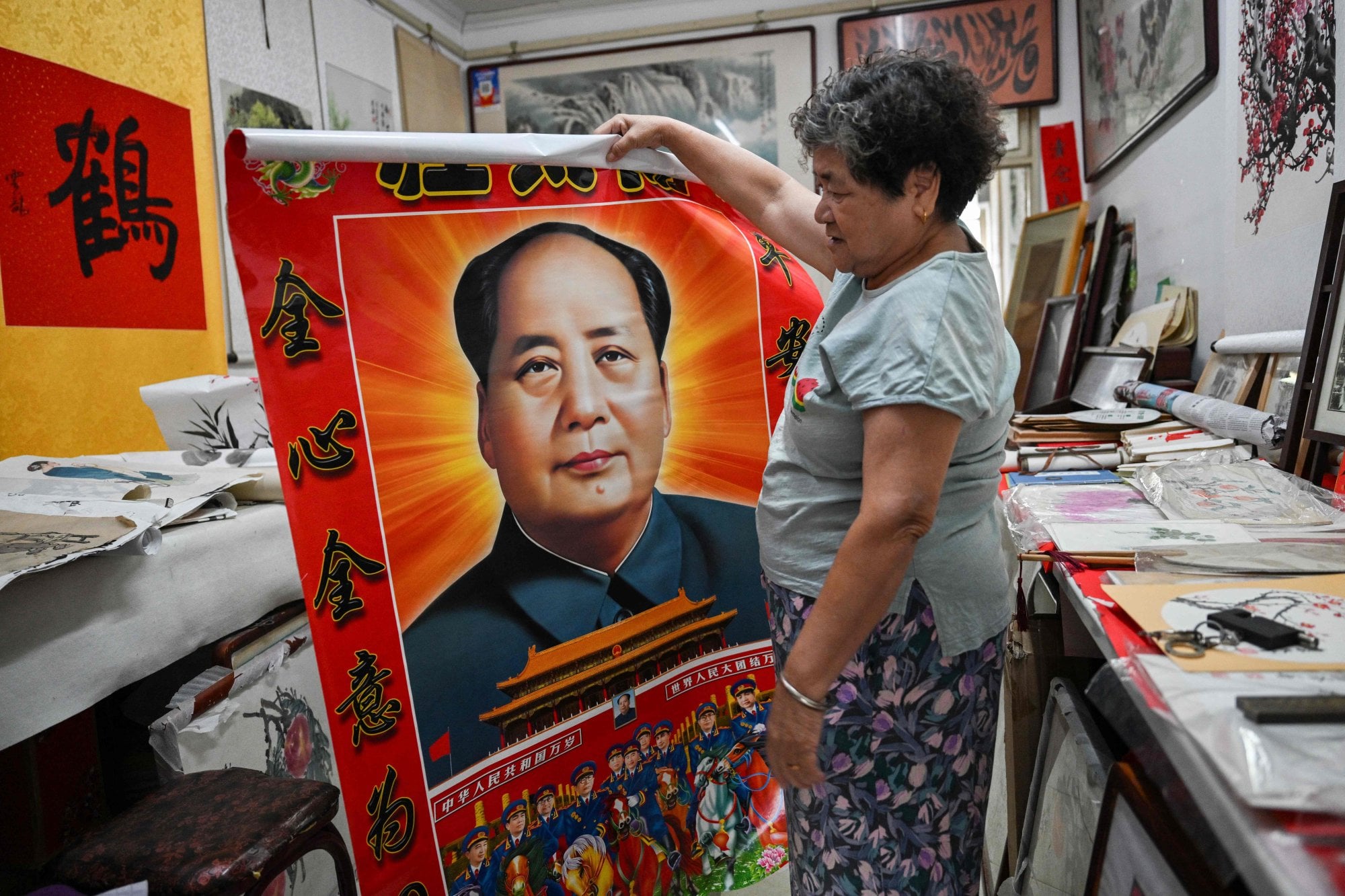
A new generation is embracing Mao’s teachings to cope with modern pressures, but analysts say the trend gives Beijing reason to be wary
When you are denied a pay rise, when you feel anxious about your children’s education, or when you are alienated by colleagues, Chairman Mao can help.
At least, that is what China’s online influencers and their hundreds of thousands of followers believe.
Wednesday marks the 50th anniversary of the death of Mao Zedong, founding father of the People’s Republic of China. Chinese authorities have not announced any plans to mark the date, as former state leaders are usually commemorated on the anniversaries of their birth.
Do you have questions about the biggest topics and trends from around the world? Get the answers with SCMP Knowledge, our new platform of curated content with explainers, FAQs, analyses and infographics brought to you by our award-winning team.
The only special arrangement in place is at the Chairman Mao Memorial Hall in Beijing, which will open for an extra three hours on Wednesday. Visiting slots for the week are fully booked.
Despite the official silence ahead of the anniversary, it is hard to ignore the quiet comeback of Mao’s popularity in the country.
In recent years, younger generations of Chinese have rediscovered Mao as their life coach. They organise online book clubs devoted to his works, spread the gospel through artificial intelligence-narrated videos, and affectionately refer to him as jiaoyuan, or “teacher”, a title Mao himself once said he preferred.
His views are regularly cited in times of US-China tensions. Last year, when the Trump administration imposed a 104 per cent tariff on Chinese goods, social media users searched for the term jiaoyuan, described imperialism as a “paper tiger” – one of Mao’s best-known slogans – and quoted his collection of speeches, On Protracted War.
While much of this youthful sentiment aligns with China’s official narrative about Mao as a symbol of national independence, especially in the face of US-led international pressure, experts say Beijing is also wary that Mao’s teachings could feed into scepticism about the country’s economic policies and its interpretation of Marxism.
Mao in youth culture
For Mao’s most vocal online admirers, the former state leader is a symbol of resilience, courage and dedication to the common people.
One blogger on the arts and culture forum Douban praised Mao’s selflessness, especially the fact that he sent his own son to the battlefield.
“He stood with us, the people, at all times,” she wrote.
The 29-year-old blogger, who asked to be referred to only by her surname Liu, describes herself as an “ordinary company worker”. She said she had read most of Mao’s works and applied them to her own life.
“Don’t regard a mistake as merely a disgrace; see it as an asset,” she said, quoting the late leader. She added that this perspective had taught her not to criticise herself too harshly.
Young people can also be spotted paying tribute to Mao at a giant monument in Changsha, Hunan province. Li Muqi, a second-year student at Hunan Normal University, has made a habit of visiting the enormous statue before final exams to pray for good luck.
“I believe his spirit in heaven can bless young students like us, help us make progress and achieve our ideals,” Li said.
According to public data, the number of annual visitors to the site has more than tripled in about a decade, from 5.88 million in 2016 to 19 million last year.
It is hard to estimate the number of Mao’s young followers in China today, but a glimpse is possible through growing library loans and merchandise sales. At Beijing’s prestigious Tsinghua University, the Selected Works of Mao Zedong topped the library loan list last year, open records show.
On Taobao, one of China’s largest online shopping platforms, a shop selling enamel mugs with Mao’s portrait sold more than 20,000 units in the past year.
Wealth gap and nationalism
The deeper reason for the interest in Mao is that young people are becoming increasingly disillusioned by today’s China and cannot achieve their aspirations, according to analysts.
In June 2023, the official urban unemployment rate for young people aged 16 to 24 hit a record high of 21.3 per cent. Fearful for their futures, university graduates have started joking that they have to “degrade themselves” and consider blue-collar jobs with low pay.
“I think a lot of people have realised that this isn’t something that could simply be solved with the cake being made bigger,” said Mobo Gao, professor of Chinese studies at Adelaide University in Australia.
He said that Mao’s theories on class struggle and conflict were still relevant today, as young people facing immense pressure, a wealth gap and few employment opportunities sought an explanation or simply comfort.
This has been accompanied by a rise in nationalism in recent years. Many admire Mao for his foresight in areas such as the development of nuclear weapons, satellites and the industrialisation of inland provinces – achievements that have helped China compete and defend itself against outside forces.
During recent US-China tensions, members of the public have regularly cited Mao’s teachings.
For example, a Baidu blog post from last year stated that thanks to the former leader’s strategy, China “holds the ace” for winning the trade war. Despite tariffs, China has developed its domestic industry chain, made alliances with other countries and used rare earths to counterstrike – all moves out of Mao’s playbook on protracted war, according to the blogger.
An April commentary in the Monthly Review, a New York-based independent socialist magazine, said Mao’s legacy offered a “powerful counternarrative to the Western-centric story of globalisation”.
“He represents the possibility of an alternative path to modernity, one that does not require submission to the economic and political dictates of Washington.”
Mao reimagined
Rana Mitter, S.T. Lee Chair in US-Asia Relations at the Harvard Kennedy School, noted that young people’s interpretation of Mao’s teachings generally did not include the violence of the Cultural Revolution.
When asked about the Cultural Revolution, Douban blogger Liu said she had mainly read Mao’s works to see the logic of his writing, how he worked and his attitude towards life, and she had not done “systematic research on historic events”.
Rebecca Karl, professor of history at New York University, said that for young people, the Cultural Revolution “reads as a liberatory moment”, rather than the “doom and gloom that we know from mainstream narrative convention and state repudiation”.
One reason young people have an incomplete view of Mao is due to censorship.
The Mao era came to an end with his death in 1976. In the years that followed, his legacy was officially defined by the Communist Party.
A 1981 party resolution under Deng Xiaoping, China’s leader at the time, established the basic framework: Mao was credited with major achievements and with laying the foundations of modern China, but his later rule was heavily criticised, particularly for the Cultural Revolution, which was described as a “catastrophe”.
Under President Xi Jinping, the emphasis has shifted towards more recognition of Mao’s achievements. Xi argued in 2013 that Mao’s three decades of rule “could not be repudiated” by the reform era.
Tiptoeing around Mao
Chinese authorities are prepared to tackle anyone who deviates from the official assessment of Mao’s legacy, and the government censors those who openly criticise him.
But at the same time, Beijing has been careful not to let Mao-related discussions get out of hand, especially those concerning his more radical ideas and the Cultural Revolution.
Analysts said that while the Mao revival among young people would not grow into a larger movement, it would persist as a form of self-expression.
“His return signifies that the fundamental questions he posed about China’s path are not relics of a bygone era. The questions of class, of social justice, and of who truly holds power in society have not been resolved by decades of market reforms … The revolutionary agenda, it seems, remains unfinished,” the Monthly Review commentary said.
Gao, the professor of Chinese studies, said the trend was a collection of mixed feelings mostly confined to the digital realm, and it would not be allowed to develop into something larger.
However, facing the problems of today, young people turn to Mao because “there’s no new path to take”, according to Gao.
“When the entire world is changing – and even chaotic – there’s no alternative narrative,” he said.
More Articles from SCMP
Meet Wynn Everett, who plays Tricia Yeager, the ‘Gus Fring’ of Chad Powers
Purity of China quartz deposit ‘highly similar’ to US Spruce Pine standard: study
China-Nepal floods; arthritis drug restores alopecia patients’ hair: 7 science highlights
Hong Kong targets biomedicine powerhouse status in debut 5-year plan
This article originally appeared on the South China Morning Post (www.scmp.com), the leading news media reporting on China and Asia.
Copyright (c) 2026. South China Morning Post Publishers Ltd. All rights reserved.

Related posts:

Fiction park: He was the best in class. He still wasn’t good enough

Gagan Thapa takes oath as Congress president, vows to regain public trust

Inside knowledge that has locals gripped by fear after gran’s body found decomposing in cattle dip

New property purchase disclosure rule in Japan sparks fears it may curb foreign investment

Dino-mite treasures: inside Singapore’s Fort Knox storing playthings of ultra-rich