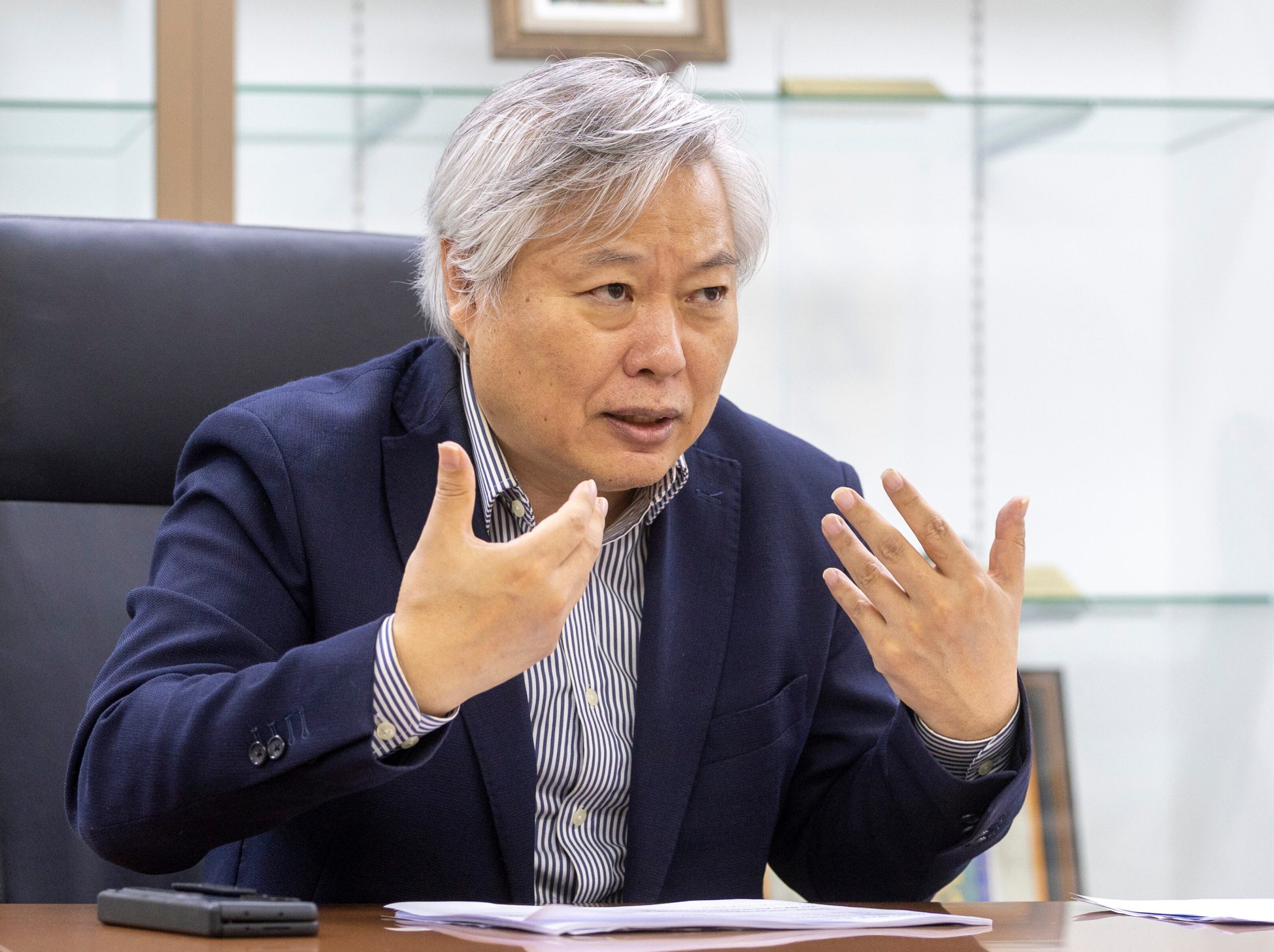
The backlash against the real estate tax reform pushed by the Lee Jae Myung government is intensifying. Although the government has eased tax disadvantages for non-resident single-homeowners and lowered the upper limit on comprehensive real estate tax increases from 200% to 150%, public opinion remains negative. The president’s approval rating, which has consistently hovered around 30%, reflects the cold public sentiment. We asked Kim Woo-cheol, a professor of real estate tax policy at the University of Seoul and president of the Korean Association of Public Finance, where things went wrong. On August 1, when we scheduled the interview with Professor Kim, the government announced a partial amendment to the real estate tax system.
◇This tax law is a ‘president-led tax law’
– The government has presented an amendment.
“The fundamental problem remains. Even if the comprehensive real estate tax cap is lowered to 150%, it’s still an enormous increase. It doesn’t make sense that taxes would rise by 1.5 times in a single year just for owning a single home. In the U.S., the purchase price of a home is used as the taxable base, and the tax increase is limited to the inflation rate. There are two reasons for this: there’s no need to investigate the current market value of each home to impose taxes, and the best indicator of a homeowner’s ability to pay taxes is not the current home value but the price at which the owner purchased the home.”
– What is the global standard for housing taxes?
“It’s to impose a single type of property tax at a uniform rate. South Korea imposes two types of taxes—property tax and comprehensive real estate tax—with progressive tax rates based on taxable value brackets. No advanced country has such a complex holding tax system.”
– What do you see as the biggest problem with the real estate tax reform bill?
“The root issue is that it’s a ‘president-led tax law.’ The president’s casual directives on social media were directly turned into legislation. For such a major tax reform, the president should have either gained public approval through campaign promises or at least made an effort to persuade the public. There are also significant issues with procedural legitimacy.”
– The government did hold real estate policy discussions.
“Have you seen any experts properly pointing out problems at those discussions? The Korean Association of Public Finance, which I lead, has many excellent tax policy experts, but not a single one was invited. It’s safe to assume they were intentionally excluded.”
– Why is the government taking such risks?
“In modern democracies, the principle of taxation is ‘no taxation without representation.’ Taxation must strictly follow laws based on public representation. However, this government seems to want to use taxes as a tool to control the public. They prefer a system where decisions are made by people rather than laws or institutions. They believe that since they are on the ‘right’ side, ‘what we decide is correct.’”
◇Why has the cautious president changed?
– From a tax principle perspective, what other issues exist?
“The basics of tax administration are clarity and predictability. Anyone calculating the tax should arrive at the same number. However, there are too many provisions like ‘a private deliberation committee will determine if the non-residency reason is genuine’ or ‘the committee will review if it’s a family business inheritance,’ leaving criteria blank and stating ‘the enforcement decree will specify.’ This approach eliminates predictability. Delegating tax authority to private committees is a late-stage symptom historically seen when tax administration becomes corrupt.”
– President Lee Jae Myung’s attitude toward real estate taxes has changed significantly compared to the early days of his term.
“During his candidacy and the first year of his term, he repeatedly stated he would not use taxes to control housing prices. This was likely because he witnessed the failure of Moon Jae-in’s real estate policies. In fact, until last year’s tax reform bill, while there was corporate tax hikes in the Democratic Party’s style, real estate taxes were untouched. It was a very cautious ‘low-key’ approach. However, the tone changed from late last year. He began flooding social media with tax agendas, breaking long-standing taboos by arguing that holding taxes are too low and pushing for residency-based regulations targeting speculative investments. As a result, the tax reform bill was filled with the president’s directives.”
– Why did the president’s approach change?
“As the stock market hit record highs, with indices surpassing 6,000 and 7,000 points, and his approval rating rose, he grew overconfident. Entering his second year in office, he may have become overly confident in his control over state affairs. He likely thought, ‘Since the public supports me this much, I can push forward with my original ideas.’ Still, this differs from Moon Jae-in’s real estate tax policies.”
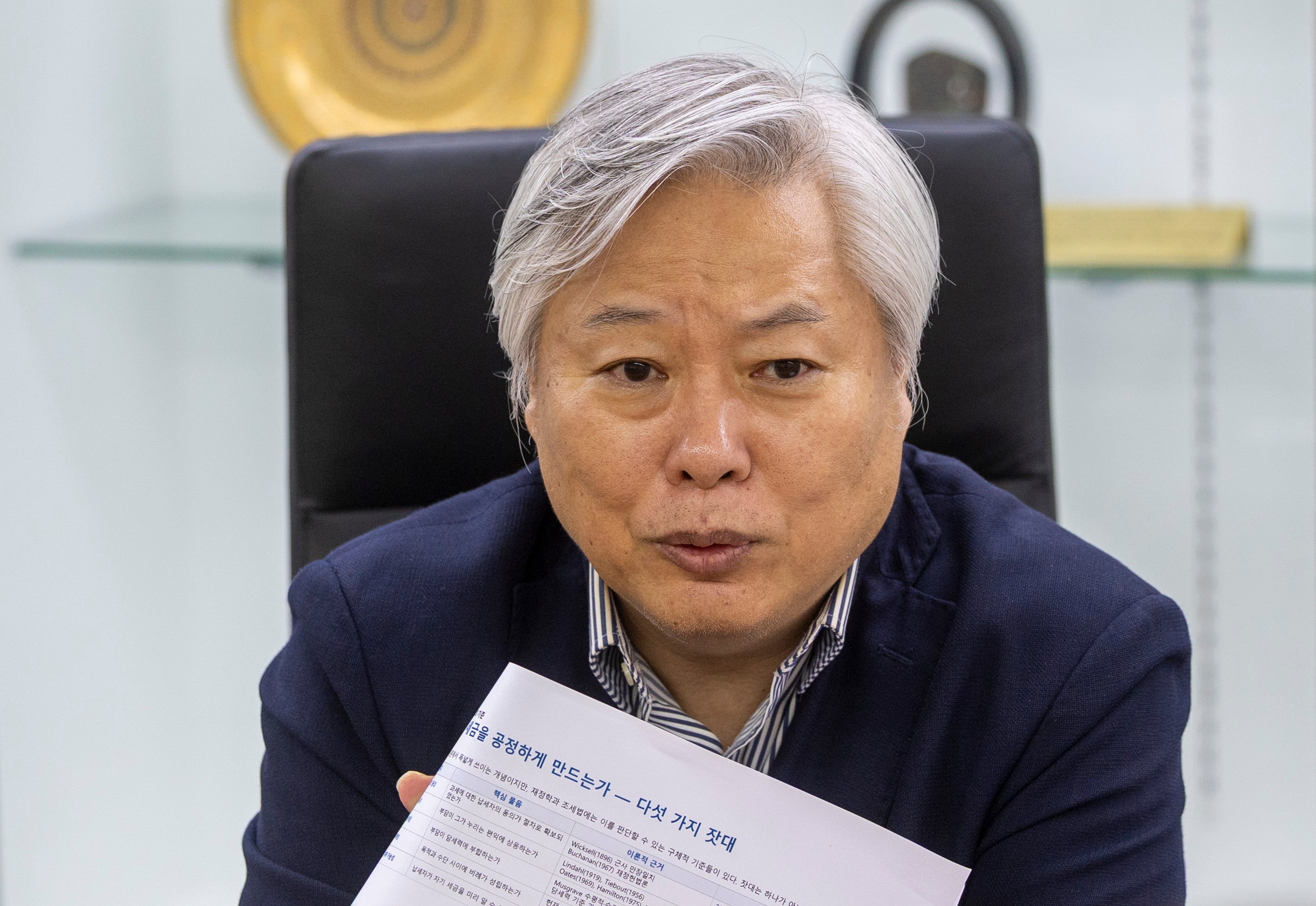
◇The ‘salami tactic’ of dividing taxpayers
– How is it different?
“The Moon Jae-in administration pushed for a real estate tax reform that raised all related taxes—holding taxes, capital gains taxes, acquisition taxes—based on a movement-oriented belief in resolving social contradictions. In contrast, President Lee Jae Myung structured the real estate tax reform by calculating the political pros and cons for his support base. The main framework favors his supporters while avoiding turning the middle class into enemies. By raising the comprehensive real estate tax threshold from 1.2 billion Korean won to 1.4 billion Korean won, the number of taxpayers subject to the tax dropped from around 400,000 to 200,000. Meanwhile, sharply increasing the comprehensive real estate tax rate for high-end homeowners shows this political calculation—shifting the tax burden entirely onto ultra-high-end homeowners.”
– Are you saying the tax system is being used as a political tool?
“Yes. The government is employing a ‘salami tactic,’ slicing the tax policy targets into small groups to minimize resistance, while rallying support through tax hikes on the wealthy. However, this approach contradicts the ‘fair taxation’ principle advocated by the Lee Jae Myung government.”
◇Comprehensive real estate tax: a ‘perverse wealth tax’ unique to the world
– Why is that?
“The basic principle of property tax, a local tax, is for property owners to share the cost of public goods in their region. In South Korea, only certain people pay property taxes, creating a distorted structure. Former President Roh Moo-hyun once pointed out, ‘How can homeowners pay less tax than car owners?’ The direction for normalizing holding taxes should be for homeowners to pay taxes at a single rate proportional to their home’s value. However, the system has deteriorated into one where only those who pay taxes end up paying more. This reform has turned the comprehensive real estate tax into a perverse wealth tax.”
– What makes it a ‘perverse wealth tax’?
“South Korea’s comprehensive real estate tax is a bad holding tax not found in any economics textbook. Wealth taxes historically implemented in Northern Europe were ‘net wealth taxes,’ taxing assets minus liabilities. They also taxed all assets, including financial assets, not just real estate. South Korea’s comprehensive real estate tax targets only real estate and does not subtract liabilities. France, nearly the only country that still levies a wealth tax, uses a net wealth tax with a rate around 1.5%. South Korea’s comprehensive real estate tax has a maximum rate of 5%. No country in the world has such a holding tax—or wealth tax.”
– There is strong backlash against eliminating the special tax deduction for long-term holding for non-resident single-homeowners.
“The government has framed ‘residency as good’ and ‘holding as evil.’ This is the first time in real estate tax history that taxpayers have been divided. It’s akin to condemning non-resident gap investors as the cause of rising home prices, based on confirmation bias. The problem is that the general public does not accept this framework. Most think, ‘I have valid reasons for being a non-resident single-homeowner, so why am I labeled a speculator?’ This is why the government faces strong opposition.”
– What is the economic rationale for tax benefits on long-term home holding?
“A home worth 1 billion Korean won 20 years ago and 2 billion won today may have similar real value due to inflation. Since people inherently prefer present consumption over future consumption, money tied up in assets for long periods should be discounted by the time value (interest rate). In other words, a significant portion of capital gains from long-term holding is not real profit but simply ‘compensation for time’ and inflation. To calculate strict real capital gains, the purchase price should be compounded (e.g., at a 3.8% annual rate) and compared to the current sale price. However, applying such compound calculations to every transaction would impose excessive administrative costs on both taxpayers and authorities. The current special tax deduction for long-term holding is a tax administrative device that substitutes for complex present-value calculations, offering a lump-sum deduction proportional to the holding period. Major countries also provide broad tax reductions for long-term assets to prevent tax distortion from inflation. These benefits are generally given regardless of residency.”
◇Discrimination between residents and non-residents violates tax principles
– Is it fair to impose tax disadvantages on non-residents?
“It’s unjust under the principles of ‘benefit taxation’ and ‘ability-to-pay taxation.’ Many who own homes in Gangnam, Seoul, and live elsewhere are not wealthy but are ‘middle-class struggling to make ends meet’—either unable to return deposits or elderly with no income. Real residents physically enjoy local public benefits, yet punishing non-resident owners with heavy capital gains and holding taxes is an emotional tax policy with no academic basis.”
– What backlash will the tax reform bring to the housing market?
“Serious side effects will erupt in the rental market. If homeowners pressured to meet residency requirements forcibly try to live in chronically oversupplied areas like Gangnam, Mapo, Yongsan, and Seongdong-gu, existing tenants will be displaced. Tenants unable to relocate will pass the increased tax burden onto jeonse or monthly rents, triggering a structural vicious cycle of soaring rents.”
– Is this distorted tax system sustainable?
“It’s unsustainable. While the tax-burdened group is small and their resistance may be minimal, South Korean society has a rational core that rejects irrational tax systems. This tax reform, filled with absurdities and irrationalities, will inevitably change.”
☞Kim Woo-cheol
Kim graduated from Seoul National University’s Department of Economics and received a Ph.D. in Economics from Yale University in the U.S. He served as a research fellow at the Korea Institute of Public Finance, a government-funded research institute, and as a tax policy analyst at the National Assembly Budget Office, combining theoretical analysis with policy practice. He is currently the president of the Korean Association of Public Finance and a professor in the Department of Taxation at the University of Seoul.
- 월 5900원 멤버십, 신문 독자에게는 2900원, 조선멤버십
- 55000원 상당의 신문-잡지 8종 마음껏 보기, 조선멤버십
- 현금처럼 쓸 7000포인트 받아 알뜰한 쇼핑, 조선멤버십

Related posts:
Artists protest National Theater for Young Audiences’ non-specialist appointment

Booker-winning translator Deepa Bhasthi on why she has ‘nothing kind to say about AI’

Beijing signals support for rebuilding flood-ravaged Rasuwagadhi route

Infrastructure Minister Sunil Lamsal on rebuilding after the Bhotekoshi floods

Why Nepal’s climate crisis is also a public-health emergency