The market will probably stay muted in the next three years.
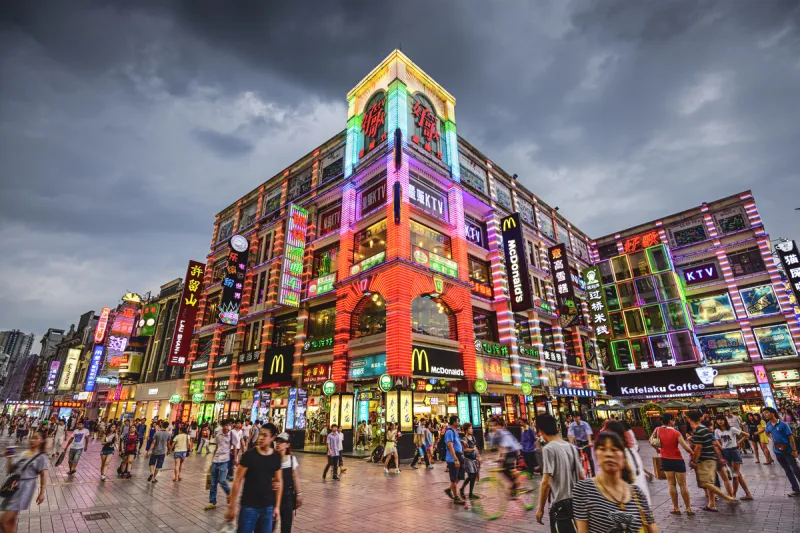
China‘s retail market remains trapped in weak demand and price competition despite government efforts to make stores destinations for leisure, entertainment, and social activities, analysts said.
“I don’t think the price-led themes will change in the foreseeable future,” Weiwen Han, a partner and head of Asia-Pacific retail practice at Bain & Company, told Retail Asia. “We expect the market to stay pretty muted.”
Han said China’s retail sector is nearing a period of falling prices, with weak consumer spending weighing on growth. Decades of expansion have also left the market with excess retail space, shopping malls, brands, and operators.
He expects low growth, fierce competition, and continued pressure on profits over the next three years.
Retail sales of consumer goods reached $3.7t (¥24.87t) in the first half. The government aims to raise the figure to $8.94t (¥60t) by 2030 as part of a plan to boost consumption in the next four years.
Jotham Lim, head of global marketing at Beijing Taomi Technology Co. Ltd., said the plan does not ask retailers to stop competing on price. “They are asking stores to be worth visiting for reasons beyond price,” he said in an emailed reply to questions.
The guidelines call for physical retail locations to combine shopping with leisure, entertainment, immersive experiences, and social interaction.
Lim said the measures represent a shift away from relying solely on foot traffic.
“It shifts the industry from betting on total foot traffic to increasing margins,” he said. “Experience raises the fixed cost per square metre, so it pays where footfall converts and hurts where it doesn’t.”
The government’s approach combines experience-driven retail with upgrades to neighbourhood shopping infrastructure. Lim said the plan’s “15-minute life circles” focus on daily necessities through supermarkets, convenience stores, and wet markets, whilst experience-led measures target commercial districts, pedestrian streets, transport hubs, and tourist destinations.
Han said the distinction between online and offline retail has become less important after two decades of rapid e-commerce growth.
Online sales of physical goods have risen 4.8% year to date, compared with 1.3% growth in total retail sales, he said, citing data from China’s statistics bureau.
“The difference is not that big anymore,” Han said, noting that declining foot traffic has historically been one of the biggest challenges for physical retailers, but consumers now move between digital and physical channels more freely.
‘Digitally capable’
There is no such thing anymore as pure offline retail, Han said. “It’s all about omni-channel.”
Lim said the government’s objective is not to have physical stores compete directly with e-commerce platforms.
“The guidelines are not asking offline retailers to beat online retail,” he said. “They are asking offline retail to become digitally capable.”
The plan calls for digital upgrades across purchasing, inventory management, sales, logistics, and distribution. It also promotes intelligent shopping tools, drone delivery, and unmanned vending systems.
Financing measures could have the biggest impact on retailers, Lim said.
The guidelines support eligible operators seeking funding through asset-backed securities and commercial real estate investment trusts, whilst encouraging lenders to develop industry-specific credit support and extend loan-interest subsidies to qualifying retailers.
Lim said retailers are not opposed to improving the in-store experience, but many are reluctant to invest because they are unsure whether the upgrades will generate enough returns.
He said the measures are particularly important for retailers that own property and want to upgrade stores without placing additional pressure on cash flow.
The guidelines also call for stricter procurement and product-traceability standards and support for private-label products.
“Private label is the part I would pay special attention to, because it lets retailers compete on value without cutting the headline price,” Lim said.
He also cited plans to remove barriers that make it difficult for chain retailers to operate across multiple regions. “If I had to name the measure most likely to change the shape of the industry rather than its margins, it would be this one,” he added.
He expects mid-sized domestic retailers to benefit the most from the changes, particularly those operating in grocery, fresh food, convenience retail, food and beverage, travel retail, and shopping centres.
Big international brands already have access to financing and compliance systems, whilst smaller independent retailers might struggle to absorb the costs of digital upgrades, traceability requirements, and financing structures, Lim said.
Price transparency remains one of the biggest challenges for physical stores. “If the product is also sold online, a shopper standing at your shelf can see a lower number on their phone in seconds,” Lim said.
Beijing Taomi’s Moojing Market Intelligence found discussions about in-store product checks and online price comparisons increased on one major Chinese short-video platform between the first half of 2024 and the first half of 2026.
Retailers also face pressure from rent, labour, and store operating costs. Lim said adding leisure, entertainment, and social spaces could increase fixed costs at a time when many operators are already struggling to protect margins.
For most retailers, the solution is integration rather than competition with digital channels. “The store becomes a fulfilment and service node that also happens to be worth visiting,” he said.
Lim said consolidation is likely as mid-sized chains acquire smaller operators. He also expects private-label products to account for a bigger share of sales and tourism-linked retailers to benefit from growing travel demand.
Han said retailers need to attract customers without sacrificing margins.
He noted that artificial intelligence is changing how consumers research products, plan trips, and make purchases. Retailers that use it better than competitors are likely to stay ahead.

Related posts:

Artists protest National Theater for Young Audiences’ non-specialist appointment

Booker-winning translator Deepa Bhasthi on why she has ‘nothing kind to say about AI’

Beijing signals support for rebuilding flood-ravaged Rasuwagadhi route

Infrastructure Minister Sunil Lamsal on rebuilding after the Bhotekoshi floods

Why Nepal’s climate crisis is also a public-health emergency